

Begin Your Quran Journey Today
Book a FREE trial class with a certified Quran teacher. No payment, no commitment.
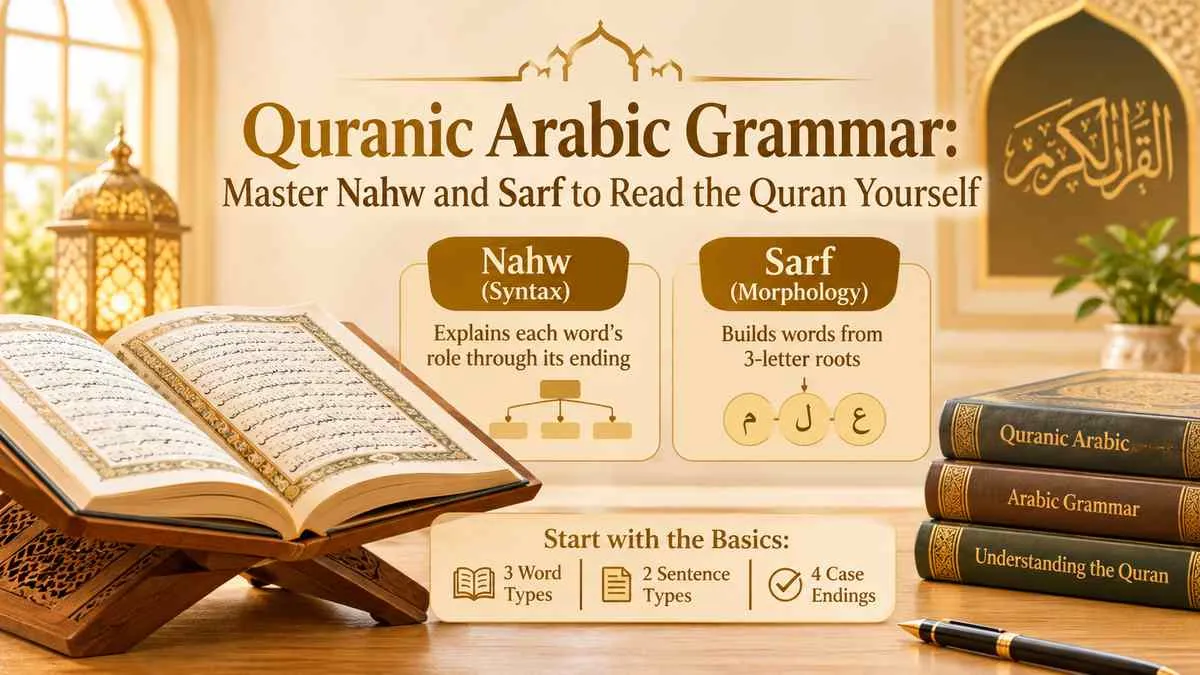
Quranic Arabic grammar lessons teach the 2 sciences you need to read the Quran’s sentences yourself. Nahw (syntax) explains each word’s role through its ending, and sarf (morphology) builds words from 3-letter roots. You can start following simple verses once you know 3 word types, 2 sentence types and 4 case endings. One vowel can also reverse who fears whom in a verse, and Surah Fatir 35:28 shows exactly how.
What Is Quranic Arabic Grammar and Why Does It Matter for the Quran?
Quranic Arabic grammar is the set of classical Arabic grammar rules, nahw and sarf, as they work in the Quran. These rules tell you who does an action, who receives it, and how each word relates to the next. Often a single vowel carries that information, so a translation can hide what the Arabic shows directly.
Word order is a good example. In إِيَّاكَ نَعْبُدُ (1:5), the object “You” comes before the verb “we worship”. Arabic grammar treats that early position as restriction, which is why translators add the word “alone”: You alone we worship. An English reader sees the extra word, while an Arabic reader sees the structure that produced it.
What Are the Three Main Word Categories in Quranic Arabic?
Every word in Quranic Arabic belongs to one of 3 categories: ism (noun), fi’l (verb) or harf (particle). An ism names a person, thing or idea. A fi’l describes an action tied to a time. A harf carries meaning only when it connects to other words, like “in”, “to” or “not”.
Al-Fatiha alone contains all 3 types, which makes it a common first text in a grammar course:
| Category | How to recognize it | Examples from Al-Fatiha |
|---|---|---|
| Ism (noun) | Can take ال, tanween or a preposition before it | الْحَمْدُ، رَبِّ، الرَّحْمَٰنِ |
| Fi’l (verb) | Shows a time: past, present or command | نَعْبُدُ، نَسْتَعِينُ، اهْدِنَا |
| Harf (particle) | Never stands alone as a full idea | بِـ in بِسْمِ، لِـ in لِلَّهِ، عَلَى in عَلَيْهِمْ |
Adjectives, pronouns and names all count as ism in Arabic grammar. That is why the noun category is much larger than English speakers expect.
Importance of Arabic in Islamic Studies Essential Guide
How Do Harakat and Vowel Marks Affect Quranic Meaning?
Harakat are the short vowel marks (fatha, damma, kasra) plus sukoon, shaddah and tanween, and in Quranic Arabic they decide grammatical roles. The vowel on the last letter of a word shows whether it is a subject, an object or something else. The vowels inside a word show its pattern, such as active or passive.
The clearest case is إِنَّمَا يَخْشَى اللَّهَ مِنْ عِبَادِهِ الْعُلَمَاءُ (35:28). The name of Allah ends with a fatha, which marks it as the object, and الْعُلَمَاءُ ends with a damma, which marks the scholars as the subject. The verse means that among His servants, only the scholars truly fear Allah. Swapping those 2 vowels would make Allah the one who fears, which changes the meaning entirely.
Internal vowels matter just as much. كَتَبَ means “he wrote”, while كُتِبَ means “it was written”. The letters are identical, and only the vowels change the verb from active to passive.
Learn Arabic Grammar for Understanding Quran Clearly and Deeply
How Does the Arabic Root System Work in Quranic Grammar?
Arabic root words are usually 3 consonants that carry a core meaning, and sarf shows how patterns built on that root produce related words. The root ع ل م, for knowing, gives عِلْم (knowledge), عَالِم (one who knows), عُلَمَاء (scholars), عَلِيم (all-knowing) and عَلَّمَ (he taught). All 5 appear in the Quran.
Quranic dictionaries count between about 1,650 and 1,800 roots in the Quran, depending on how they treat rare and borrowed words. Because each root produces many words, learning roots cuts the Quranic vocabulary you need to memorize.
Arabic verb patterns, called forms or awzan, change the meaning of a root in predictable ways:
| Pattern | Typical meaning | Quranic example |
|---|---|---|
| Form I: فَعَلَ | Basic action | عَلِمَ اللَّهُ (2:187), “Allah knew” |
| Form II: فَعَّلَ | Causing or intensifying | عَلَّمَ الْقُرْآنَ (55:2), “He taught the Quran” |
| Form IV: أَفْعَلَ | Causing someone to act | أَنزَلَ عَلَيْكَ الْكِتَابَ (3:7), “He sent down the Book to you” |
| Form X: اسْتَفْعَلَ | Seeking or asking for | فَاسْتَغْفَرَ رَبَّهُ (38:24), “he asked his Lord for forgiveness” |
When you meet a new word, strip the extra letters, find the 3 root letters, then match the remaining shape to its pattern. That single habit is the base of Arabic morphology.
What Is Noor Al Bayan? Learn Quran Reading Step by Step
What Are the Different Types of Nouns in Quranic Arabic?
Nouns in Quranic Arabic are sorted by 4 features: gender, number, definiteness and whether they are derived from a verb. Every noun is masculine or feminine, singular, dual or plural, and definite or indefinite. Each feature changes how the words around it behave.
Number is where Arabic differs most from English, because it has a separate dual form for exactly 2:
- Dual: جَنَّتَانِ (55:46), “2 gardens”
- Sound masculine plural, ending in -ūn or -īn: الْمُؤْمِنُونَ (23:1)
- Sound feminine plural, ending in -āt: الْمُؤْمِنَاتِ
- Broken plural, with an internal change: قُلُوب, the plural of قَلْب (heart)
Derived nouns come straight from verb patterns. The active participle on the فَاعِل pattern names the doer, as in خَالِق (creator). The passive participle on the مَفْعُول pattern names what receives the action, as in مَعْلُوم (known). Spotting these 2 patterns lets you recognize many Quranic words before you open a dictionary.
Best Way to Learn Fusha Arabic Ultimate Beginner Guide
How Are Pronouns Used in Quranic Arabic?
Quranic Arabic uses 3 kinds of pronouns: detached pronouns written as separate words, attached pronouns joined to the end of a word, and hidden pronouns implied inside a verb. All 3 can appear in one short verse, so recognizing them is one of the first skills a beginner needs.
| Type | What it looks like | Quranic example |
|---|---|---|
| Detached | A separate word | قُلْ هُوَ اللَّهُ أَحَدٌ (112:1), هُوَ = He |
| Attached | A suffix on a noun, verb or particle | رَبُّكُمْ, “your Lord” (ـكُمْ = your) |
| Hidden | No written word, the verb shows it | نَعْبُدُ (1:5), the prefix ن shows the hidden نَحْنُ, “we” |
Pronouns in the Quran also change person for effect. Al-Fatiha speaks about Allah in the third person for its first 4 verses, counting the basmala, then turns to address Him directly with إِيَّاكَ. Scholars of rhetoric call this shift iltifat.
Arabic language origin tree Complete Guide to Its History
How Do Nominal and Verbal Sentences Differ in the Quran?
A nominal sentence starts with a noun and describes a state, while a verbal sentence starts with a verb and reports an action. Nominal sentences have 2 parts, the mubtada (subject) and khabar (predicate). Verbal sentences have a verb, its fa’il (doer), and often a maf’ul (object).
| Nominal sentence | Verbal sentence | |
|---|---|---|
| Starts with | A noun | A verb |
| Parts | Mubtada + khabar | Fi’l + fa’il (+ maf’ul) |
| Usual sense | A fixed truth or state | An event or action |
| Quranic example | اللَّهُ الصَّمَدُ (112:2) | خَلَقَ اللَّهُ السَّمَاوَاتِ وَالْأَرْضَ (29:44) |
Verbal sentences have one rule that surprises English speakers. A verb that comes before its subject stays singular even when the subject is plural, as in قَالَتِ الْأَعْرَابُ (49:14), “the Bedouins said”.
Amazing 10 Facts About Arabic Language You Must Know
How Do Past, Present, and Imperative Verbs Work in Quranic Arabic?
Quranic Arabic has 3 verb types: the past (madi) for completed actions, the present (mudari’) for ongoing or future actions, and the imperative (amr) for commands. Arabic verb conjugation adds prefixes and suffixes to the root to show who does the action. The pattern stays regular across most verbs.
Here is the root ك ت ب (writing) conjugated for 4 common persons:
| Person | Past | Present | Command |
|---|---|---|---|
| He | كَتَبَ | يَكْتُبُ | Not used |
| They (masculine) | كَتَبُوا | يَكْتُبُونَ | Not used |
| You (masculine singular) | كَتَبْتَ | تَكْتُبُ | اكْتُبْ |
| We | كَتَبْنَا | نَكْتُبُ | Not used |
The Quran’s first revealed word is an imperative: اقْرَأْ (96:1), “Read”. A present verb after سَ or سَوْفَ points to the future, so you need to check the small particle before the verb, not only its form.
Basic Arabic Lessons for Beginners Step by Step Guide
What Are the Subjunctive, Jussive, and Passive Forms in the Quran?
The subjunctive (nasb) and jussive (jazm) are endings the present verb takes after certain particles, while the passive hides the doer. Nasb, usually a fatha, follows أَنْ، لَنْ، كَيْ and حَتَّى. Jazm, usually a sukoon, follows لَمْ, the prohibiting لَا, the command lam and conditional إِنْ.
These 3 verses show each change in context:
- Subjunctive: لَن تَنَالُوا الْبِرَّ حَتَّىٰ تُنفِقُوا (3:92). The final noon drops from both verbs after لَنْ and حَتَّىٰ.
- Jussive: لَمْ يَلِدْ وَلَمْ يُولَدْ (112:3). The sukoon on the د follows لَمْ.
- Jussive of prohibition: وَلَا يَغْتَب بَّعْضُكُم بَعْضًا (49:12).
The passive voice hides the doer and changes the verb’s vowels. In كُتِبَ عَلَيْكُمُ الصِّيَامُ (2:183), “fasting has been prescribed for you”, the verb كُتِبَ has a damma and kasra pattern. The fasting, not the one who prescribed it, becomes the grammatical subject.
Learn Arabic in English Step by Step for Complete Beginners
What Is I’rab in Quranic Arabic and How Do Case Endings Work?
I’rab is the system of changing endings that shows each word’s role in a sentence. Between them, nouns and present verbs use 4 states: raf’ (usually a damma), nasb (usually a fatha), jarr (a kasra, for nouns only) and jazm (a sukoon, for verbs only). Arabic syntax works mostly through these endings.
Al-Fatiha shows the 3 noun cases in its first verses:
| Case | Role | Usual sign | Example |
|---|---|---|---|
| Raf’ (nominative) | Subject or predicate | Damma | الْحَمْدُ (1:2) |
| Nasb (accusative) | Object | Fatha | الصِّرَاطَ (1:6) |
| Jarr (genitive) | After a preposition or as the second term of idafa | Kasra | لِلَّهِ (1:2) |
Some words show case with letters instead of vowels. Sound masculine plurals use -ūna for raf’ and -īna for nasb and jarr, so الْمُؤْمِنُونَ and الْمُؤْمِنِينَ are the same word in 2 different roles. Pronouns and most particles never change, and grammarians call these words mabni (fixed).
Best Way to Learn Quranic Arabic for Beginners Step by Step
How Do Idafa Constructions and Adjective-Noun Agreements Work?
An idafa construction joins 2 nouns to show possession or belonging, like “the Lord of the worlds” in رَبِّ الْعَالَمِينَ (1:2). The first noun drops ال and tanween, and the second noun takes the genitive case. Adjectives work differently: they follow the noun and copy its features.
Arabic adjective agreement covers 4 features at once: gender, number, definiteness and case. In الصِّرَاطَ الْمُسْتَقِيمَ (1:6), “the straight path”, both words are masculine, singular, definite and accusative.
Two details trip up beginners:
- A plural of non-human things usually takes a feminine singular adjective. In صُحُفًا مُّطَهَّرَةً (98:2), “purified pages”, the adjective is feminine singular even though “pages” is plural.
- An adjective that describes the first noun of an idafa comes after the whole idafa, and it agrees with that first noun.
Case and agreement together let you link every adjective to its noun, even when other words sit between them.
How to Learn Basic Arabic Quickly at Home Each Day
What Are the Best Online Arabic Grammar Classes?
The best online Arabic grammar classes for the Quran teach nahw and sarf through Quranic verses, give one-on-one correction, and follow a clear order from word types to i’rab. Check 4 things before you pay: the teacher’s qualifications, the curriculum, how much feedback you get, and whether you can try a class first.
| Format | Feedback | Pace | Best for |
|---|---|---|---|
| One-on-one tutor | Every sentence you analyze | Set by you | Beginners who need questions answered live |
| Group class | Shared among students | Set by the class | Learners who like a fixed schedule |
| Self-paced course | Little or none | Fully flexible | Revision after you know the basics |
Quran Beauty Online offers one-on-one Quranic Arabic grammar lessons with native Arabic-speaking tutors who hold Ijazah. Classes last 30 minutes, and monthly plans range from $28 to $70 for 2 to 5 classes a week. New students can take a free trial class, and the school offers a full refund within the first 7 days.
At Quran Beauty Online, the learn Arabic online course teaches Modern Standard and Quranic Arabic with practical conversation, in 30-minute live classes from 2 to 5 times a week.
How to Apply Quranic Arabic Grammar Rules to Understand Quranic Verses
Applying Arabic grammar rules to a verse takes 5 steps, done in the same order every time. The order matters because each step uses the answer from the one before. You can test it on اهْدِنَا الصِّرَاطَ الْمُسْتَقِيمَ (1:6), “guide us to the straight path”:
- Sort each word into ism, fi’l or harf. Here اهْدِ is a verb and the other 2 words are nouns.
- Find the verb’s doer. اهْدِ is a command, so the doer is a hidden “You”.
- Read the endings. نَا is an attached object pronoun, and الصِّرَاطَ ends with a fatha, so it is a second object.
- Check agreement. الْمُسْتَقِيمَ matches الصِّرَاطَ in all 4 features, so it is its adjective.
- Find the roots. هـ د ي (guidance) and ق و م (standing upright) give you the core meanings.
The Quranic Arabic Corpus, a free word-by-word grammar database of the Quran, lets you check your analysis against a full parse.
How to Learn Quranic Arabic Grammar Step by Step as a Beginner
A beginner learns Quranic Arabic grammar fastest in 7 stages, each building on the last. Quranic Arabic grammar lessons usually start once you can read Arabic script with vowels. If you cannot yet, begin with our Noorani Qaida online course before the grammar.
- Learn the 3 word types and test yourself on Al-Fatiha.
- Learn the harakat and the 4 i’rab states.
- Build nominal sentences with a mubtada and khabar.
- Build verbal sentences, then learn the past, present and imperative.
- Add sarf: roots, verb patterns and the 2 participles.
- Study idafa, adjective agreement and pronouns.
- Finish with the subjunctive, jussive and passive, then analyze one verse a day.
Learn Quranic vocabulary alongside the grammar, starting with the words that repeat most in the surahs you already know. A word you have already parsed in a verse stays with you longer than one from a list.
How Long Does It Take to Learn Quranic Arabic Grammar?
Most adult learners need from 6 to 12 months to reach a functional level in Quranic Arabic grammar, with at least 5 hours of study a week. Quran Beauty Online’s teachers give this estimate based on their students’ progress. A functional level means you can parse most short verses with a dictionary.
3 factors change the timeline more than anything else:
- Reading fluency. Learners who still sound out letters spend their first months on reading, not grammar.
- Weekly hours. 2 short Quranic Arabic grammar lessons a week move slower than 4 lessons plus daily review.
- Daily practice on real verses. Rules learned from charts fade quickly unless you apply them to the Quran the same day.
Understanding Quranic verses without a translation takes longer than this functional level. Expect to keep building vocabulary for years after the core grammar is in place.
Want a teacher to walk you through your first verse analysis? Quran Beauty Online offers one-on-one Quranic Arabic grammar lessons with a free trial class and a 7-day money-back guarantee. Classes last 30 minutes, and male and female teachers are available. Book your free trial class.
Frequently Asked Questions About Quranic Arabic Grammar
Do You Need to Know Arabic Before Quranic Arabic Grammar Lessons?
No, you do not need spoken Arabic before Quranic Arabic grammar lessons, but you must read Arabic script with its vowel marks. Grammar classes explain words by their endings and patterns, so a student who cannot read the vowels cannot follow the examples. A Noorani Qaida course covers that reading level before grammar starts.
Is Quranic Arabic Grammar the Same as Modern Standard Arabic Grammar?
Yes, the core rules are the same, because Modern Standard Arabic grew out of classical Arabic. The differences are in vocabulary, some older verb forms and rhetorical style. Spoken MSA often drops case endings, while Quranic recitation keeps every ending, so classical Arabic grammar matters more for Quran students.
What Is the Difference Between Sarf and Nahw?
Sarf studies how a single word is built, while nahw studies how words work together in a sentence. Sarf tells you that مُعَلِّم comes from the root ع ل م on a Form II pattern. Nahw tells you whether that word is a subject or an object, based on its ending. You need both to read a verse.
Which Book Is Best for Quranic Arabic Grammar?
No single book is best for everyone, so most teachers combine a grammar text with the Quran itself. Al-Ajurrumiyyah is a short classical primer on nahw that students have memorized for centuries. The Madinah books (Durus al-Lughah) teach grammar step by step in simple Arabic. Arabic Through the Qur’an covers the grammar in 40 lessons built on Quranic examples.
Can Children Take Quranic Arabic Grammar Lessons?
Yes, children can take Quranic Arabic grammar lessons once they read Arabic with vowels fluently. Teachers usually shorten each lesson, start with word types and simple sentences, and use short surahs the child already knows. Abstract topics like the jussive and the passive come later, after the basic sentence types feel familiar.