
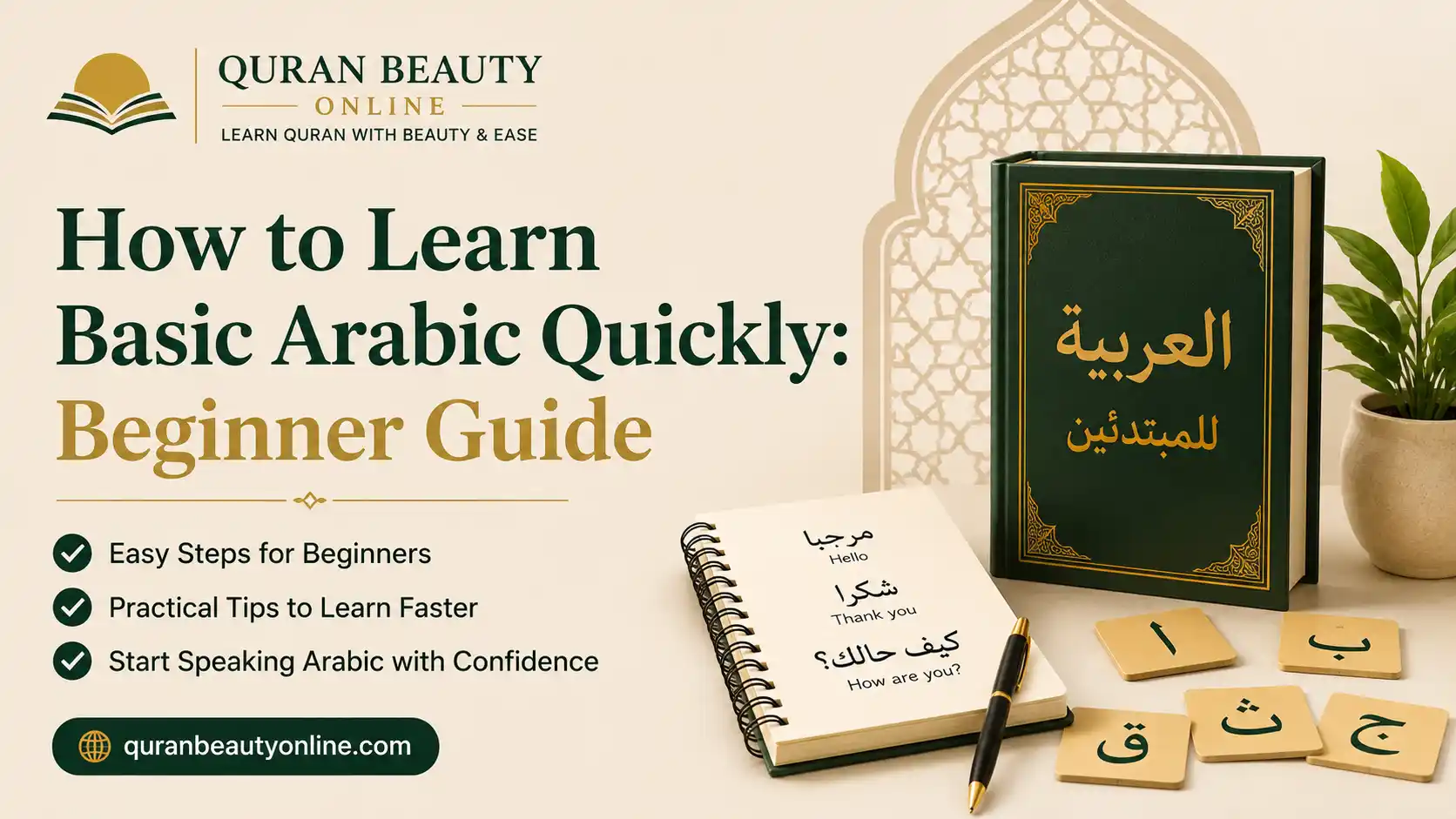
Arabic is one of the most spoken languages in the world — and one of the most rewarding to master. Whether your goal is to connect deeply with the Quran, travel the Middle East, or communicate with over 400 million native speakers, you don’t need to spend hours a day buried in textbooks. This guide shows you how to learn basic Arabic quickly, despite being a beginner.
What You Need Before You Start Learning Basic Arabic
Before diving in, set yourself up for success. A few things that make a real difference:
- A clear goal.
Are you learning Modern Standard Arabic (MSA) for reading and formal contexts, or a spoken dialect like Egyptian or Levantine? If your goal is Quranic understanding, classical Arabic is your path. Knowing your “why” keeps you motivated when progress feels slow.
- 15–30 minutes a day.
You don’t need hours. Consistent short sessions beat occasional long ones every time. Think of it like exercise — daily reps build the muscle.
- A notebook.
Writing Arabic by hand, even digitally, builds memory far better than passive reading.
- The right mindset.
Arabic looks intimidating at first. The script is unfamiliar, words read right to left, and sounds like “ع” (ayn) don’t exist in English. Accept the awkward early phase — it passes faster than you expect.
Step 1: Master the Arabic Alphabet as Fast as Possible
If you are still struggling to articulate letters correctly, you won’t be able to pick up basic Arabic swiftly. Arabic consists of just 28 letters. With dedicated practice, most beginners can identify all of them within one to two weeks.
Here’s the fastest approach:
- Learn letters in groups by shape. Many Arabic letters share the same base form and differ only by dots (ب, ت ث all share the same shape).
- Practice writing each letter immediately after learning it. The hand-brain connection accelerates recognition.
- Use audio from day one. Arabic has sounds that require hearing and mimicking, not just reading.
Aim to read basic Arabic words — even slowly — within your first two weeks. This unlocks everything else.
To build a strong foundation, you can start with our structured Online Arabic Classes for Adults
Step 2: How to Learn Basic Arabic Quickly Using Core Vocabulary
Once you can read the script, vocabulary is your next priority. The most effective method is to focus on frequency — the 300–500 most commonly used Arabic words cover the vast majority of everyday conversation and Quranic text.
Start with these essential categories:
- Greetings and pleasantries: السلام عليكم, مرحبا, كيف حالك
- Numbers 1–20
- Days, months, and time expressions
- Common verbs: to go (ذهب), to eat (أكل), to want (أراد), to know (عرف)
- Family and people words
- Question words: من (who), ماذا (what), أين (where), متى (when)
Use spaced repetition flashcards — apps like Anki are free and proven to lock vocabulary into long-term memory. Aim for 10–15 new words per day, with daily review of previous ones.
Improve your reading and retention with guided exercises in our Learn Arabic Online course
Step 3: Build Simple Arabic Sentences From Day One
One of the biggest mistakes beginners make is waiting until they feel “ready” to form sentences. Don’t wait.
Arabic sentence structure is different from English. A basic Arabic sentence often puts the verb first: “ذهبَ أحمد إلى المدرسة” — literally “Went Ahmad to the school.” This verb-subject-object order feels unusual but becomes natural quickly.
Start building sentences on day one using what you know:
- “أنا أتعلم العربية” — I am learning Arabic.
- “أريد ماء” — I want water.
- “هذا كتاب” — This is a book.
Don’t worry about perfect grammar yet. Get ideas out in Arabic, make mistakes, and correct as you go. Communication beats perfection at the beginner stage.
Step 4: Daily Practice Habits That Speed Up Arabic Learning
The learners who progress fastest aren’t necessarily the most talented — they’re the most consistent. Here are the daily habits that compound into real fluency:
Morning review (5–10 minutes). Go over yesterday’s vocabulary before looking at your phone. Fresh-brain retention is significantly higher.
Listen to Arabic daily. Even background listening — Arabic news, podcasts, Quran recitation — tunes your ear to the rhythm and sounds of the language. Your brain processes it even when you’re not consciously focused.
Label things around your house. Stick Arabic word labels on objects. You’ll passively read Arabic dozens of times a day without extra effort.
Speak out loud, always. Reading Arabic silently is half the work. Vocalise everything — even when practising alone.
End the day with one sentence. Write one Arabic sentence about your day before bed. It forces active recall and practical application.
Common Mistakes That Slow Down Arabic Learners
Avoid these common traps that hinder your progress:
Skipping the alphabet.
Some apps let you learn with transliteration (writing Arabic sounds in English letters). This feels easier, but creates a crutch that slows you down long-term. Learn the real script from day one.
Trying to learn multiple dialects at once.
Pick one form of Arabic and go deep. Mixing MSA with Egyptian and Levantine dialect simultaneously creates confusion.
Passive learning only.
Watching videos and reading about Arabic is not the same as using Arabic. Production — writing and speaking — is where real learning happens.
Inconsistency.
Missing a week, then trying to make up for it with a long session, doesn’t work. Daily exposure, even just 10 minutes, beats sporadic cramming every time.
Perfectionism.
Many beginners freeze because they’re afraid of making mistakes. In language learning, mistakes are the lesson. Make them freely and learn from them.
The Best Free Tools to How to Learn Basic Arabic Quickly
You don’t need to spend money to make serious progress. These free tools are genuinely excellent:
Anki — Free spaced repetition flashcard app. Download pre-made Arabic decks or build your own. Nothing beats it for vocabulary retention.
Arabic Pod 101 (free tier) — Audio lessons with transcripts covering beginner through advanced. The free content alone is substantial.
Madinah Arabic — A free structured curriculum widely used in Islamic institutes worldwide. The PDF books and audio files are available online at no cost.
YouTube Arabic channels — Channels like “Learn Arabic with Maha” and “Arabic with Sam” offer clear, free lessons for beginners.
Quran.com — Every verse with transliteration, translation, and audio recitation. Excellent for anyone learning Arabic to understand the Quran.
Quran Beauty Academy — Our online Arabic learning platform provides basic courses to read, write, speak, and understand Arabic. You can join by taking a free trial.
Frequently Asked Questions
How long does it take to learn basic Arabic?
Most dedicated beginners reach basic conversational ability in 3–6 months with daily practice. Reading simple texts comfortably often comes within 2–3 months after mastering the alphabet.
Is Arabic hard to learn for English speakers?
Arabic is considered one of the more challenging languages for English speakers due to the different script, sounds, and grammar structure. That said, the difficulty is often overstated. With the right method and consistency, beginners see rapid early progress.
Should I learn Modern Standard Arabic or a dialect first?
For reading, formal writing, and Quranic study, start with MSA or classical Arabic. For everyday conversation in a specific country, a spoken dialect is more practical. Many learners start with MSA and layer in a dialect once they have a foundation.
Can I learn Arabic on my own?
Absolutely. Millions of people have learned Arabic self-taught using structured resources, apps, and online communities. A good teacher accelerates progress, but self-study absolutely works.
Start Speaking Arabic Faster Than You Think — Join Quran Beauty Online Now
Learning Arabic on your own is possible — but the right guidance makes it dramatically faster and more enjoyable. At Quran Beauty Online, experienced teachers provide structured, personalised Arabic lessons that take you from the alphabet to confident reading and understanding, at your own pace.
Whether you’re learning Arabic to connect with the Quran, communicate with loved ones, or simply master one of the world’s great languages, you don’t have to figure it out alone.