

best way to learn quranic arabic best done with daily vocabulary lessons, light grammar, and recitation with a real teacher, rather than isolated self-study. Beginners attempt to memorize verses without knowing a single word, and after a few weeks they quit. This guide explains what to study, how long it can take, and which of the tools really help you get ahead. At the end, you won’t have to guess at the next step but have a clear, step-by-step path.
What Is the Best Way to Learn Quranic Arabic for Beginners?
The best way to learn quranic arabic for beginners is a core vocabulary list, light grammar, and live teacher correction. Self-study frequently stalled due to lack of anyone to correct pronunciation and provide explanations on word endings. structured path eliminates the guesswork: you’re learning words that are in the Quran, not just words from a dictionary, and you’re held accountable.
How Long Does It Take to Learn Arabic?
Most beginners become basic in the comprehension of the Quran in 12 to 18 months with 5 hours of study a week. The speed is for basic vocabulary and simple sentence structure, not fluent. The students who do their daily lessons with a tutor move faster as compared to those who use apps alone because their errors are corrected instantly.
Explore more about Earn an Accredited Certificate with Online Arabic Classes
Can I Learn Quranic Arabic Without Learning Modern Standard Arabic?
It is possible to learn Quranic Arabic without learning Modern Standard Arabic first. The vocabulary and structure of Quranic Arabic are different than those of other Arabic courses; therefore, a course designed around Quranic text will teach you everything you need. Modern Standard Arabic can be used for news and everyday conversation but is not necessary to understand the Quran.
Explore more about Online Conversational Arabic Classes
What Should I Learn First in Quranic Arabic?
Begin by learning the Arabic alphabet for Quran recitation, perfect letter sounds, and the 300-400 most frequently occurring words used in the Quran. The high-frequency words are constantly used in the Quran; learning them first will enable you to gain meaning quickly. After you become comfortable with reading Quranic Arabic, you will study Quranic Arabic grammar.
How Do Roots Help in Understanding Quranic Arabic?
Learning Arabic roots is one of the quickest methods to increase your knowledge of the Quranic Arabic words. Many words in the Quran have the same three-letter root, which can facilitate the understanding of meaning more naturally and make it easier to remember new words. Root-based learning facilitates ease of reading and meaningfulness of the Quran over time.
How Arabic Roots Improve Quranic Arabic Understanding in best way to learn Quranic Arabic:
- The way Arabic roots enhance understanding of the Quranic Arabic text. The benefits of Arabic roots for understanding the Arabic text of the Quran.
- A root unlocks several words: Knowing one root can aid in knowing a few related words that share the same basic meaning.
- Learn words more quickly: Rather than learning individual words, learn word families so that vocabulary development is more efficient.
- Be able to read words quickly: Knowing the roots helps you to know what the meaning of a word is even when you see a different form.
- Enhance your comprehension of the Quran: You will see the same words with the same meanings over and over, and you will be able to comprehend the quran word by word
- , not just from translations.
- Improve long-term memory: Linking similar words with a common root helps them to be learned and remembered when studying or reciting.
- Example: The root ك-ت-ب links words like “book,” “writer,” and “office,” indicating that words with similar meanings are members of the same family.
Explore more about Online Quranic Arabic Classes | Learn the Language of the Quran
What Are the Most Common Arabic Words?
The words that appear the most frequently in the Quran are short function words such as pronouns, prepositions, connectors, etc. There are repeated words on almost every page, such as من (from), في (in), and الذي (who/which). Learning these first will make it much more easier to learn the rarer words before them.
Is Tajweed Necessary for Learning Quranic Arabic?
Tajweed does not necessitate any knowledge of Arabic, but it is necessary to recite the Quran correctly. Tajweed deals with pronunciation and rhythm, whereas the study of Quraan is related to meaning and grammar. Learning together and then daily practice in learning the Arabic pronunciation provides a totally respectful relationship with the text.
How Do I Practice Arabic Daily?
best way to learn quranic arabic Daily practice works best as a short, repeated routine rather than long, occasional sessions.
- Study 5-10 words each day in the morning.
- Read through 1 short verse, accenting pronunciation.
- listen to quran recitation and read along with it.
- Handwrite words to help memory.
- For new words, review the words from yesterday first.
Explore more about Online Arabic Classes for Adults
Are Online Quranic Arabic Classes Worth It?
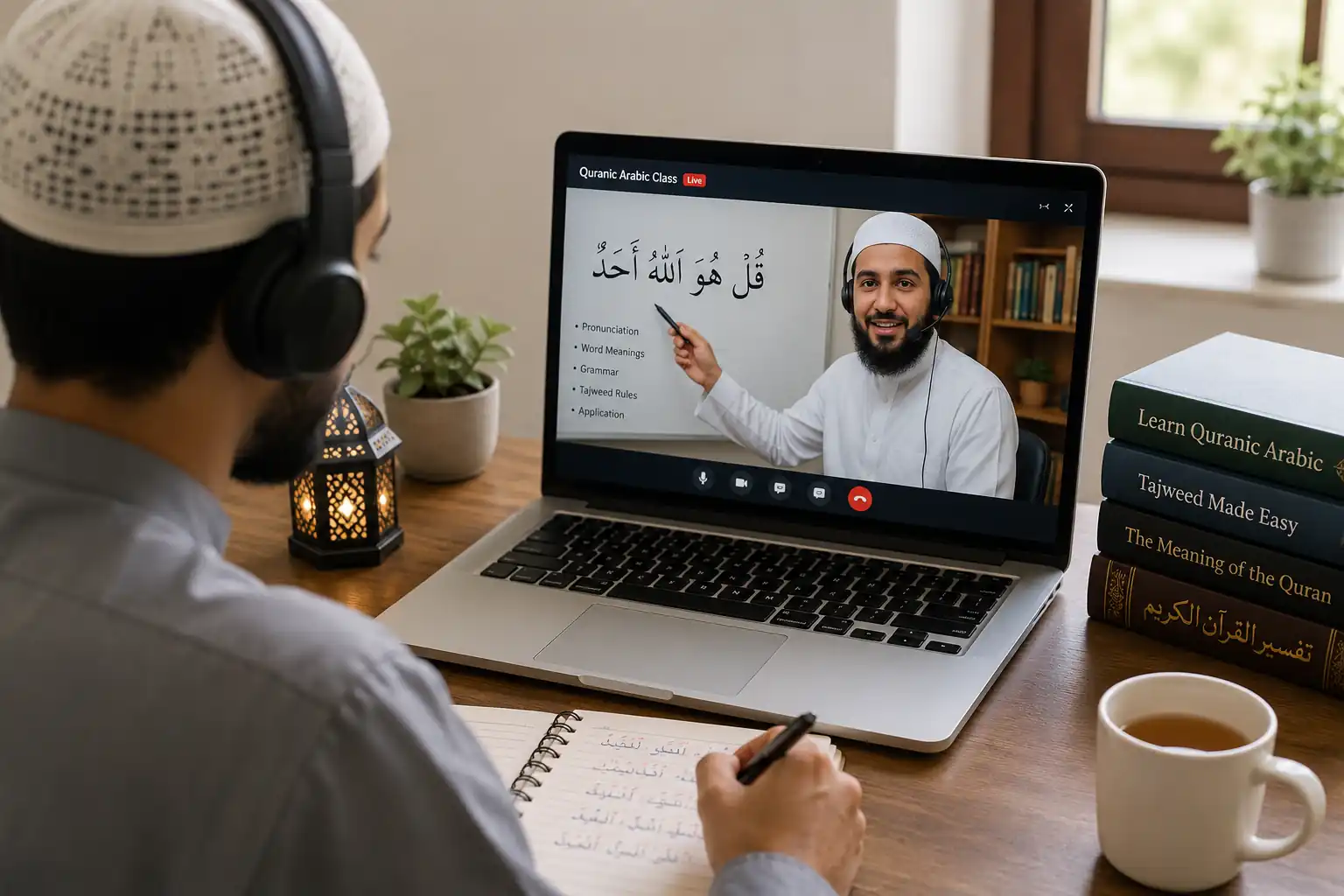
Yes, online Quranic Arabic classes are a worthwhile investment when they offer live and one-on-one classes. You can’t correct your pronunciation or answer a question during the lesson with a recorded video. Live classes with a qualified Quranic Arabic teacher detect errors early, and they can’t be detected by the app alone.
What Is the Difference Between Quranic Arabic and Classical Arabic?
| Feature | Quranic Arabic | Classical Arabic |
|---|---|---|
| Definition | Refers specifically to the language used in the Holy Quran. | Refers to the broader literary form of Arabic used from the 7th century onward. |
| Scope | Limited to the Quranic text and its linguistic style. | Includes the Quran as well as classical literature, poetry, historical writings, and scholarly works. |
| Context of Use | Primarily studied to understand and recite the Quran accurately. | Studied for literature, history, Islamic scholarship, and classical texts. |
| Vocabulary & Grammar | Uses the same grammar and linguistic foundations as Classical Arabic. | Shares the same grammatical system and vocabulary while covering a wider range of texts. |
| Main Difference | A context-specific label for the Quran’s language. | A broader term that encompasses all formal literary Arabic of the classical period, including the Quran. |
Should I Start With Grammar or Vocabulary First?
In best way to learn quranic arabic Vocabulary is the first step, then light grammar when reading becomes familiar. You will find grammar rules abstract and difficult to memorize if you learn them before you learn any words. Vocabulary provides you with the content to practice grammar on and makes each grammar rule “click” faster.
What Apps Help With Arabic Study?
Most benefit from flashcard and audio apps for Quran listening practice and spaced repetition. While apps help with daily vocabulary review between lessons, they can’t fix oral errors. The combination of an app and a live teacher addresses both memorization and learn arabic pronunciation.
Explore more about Take Your Skills Higher with Advanced Online Arabic Classes
How Do I Learn Quranic Arabic in the USA?
With the best online Quranic Arabic learning in the USA, live online classes of Quranic Arabic are best done based on the local time zone.
- Select a course that provides EST, CST, MST or PST scheduling.
- Take classes in the early morning, late evening or during the weekend.
- Verify your Quranic Arabic tutor has Ijazah and experience in teaching non-native speakers.
- Before signing up for the plan, try a free trial class.
What Is the Best Free Way to Learn Quranic Arabic?
A free word list, free recitation audio, and a free trial class are the best three things you can get for free for learning Quranic Arabic. Free resources include vocabulary and listening well, but they cannot correct your pronunciation as you speak it. After using free tools to see where students are struggling, most students soon increase their weekly number of live sessions to at least one.
Why Quran Beauty Online Is the Best Way to Learn Quranic Arabic?
The best way to learn Quranic Arabic is not to spend many hours in isolation with a book but to practice it daily with a teacher who corrects you while you’re learning it. Use high-frequency vocabulary first, then some light grammar, and use Tajweed and recitation to aid learning. Ready to begin?
Quran Beauty Online has taught non-native Arabic speakers for more than 5 years, with Ijazah-certified tutors trained specifically for adults, kids, and complete beginners. Every class is live and one-on-one, so pronunciation and word endings get corrected in real time, not left for a recorded video to miss. Students get a free trial session first, with no card required, plus a 7-day money-back guarantee if the pace isn’t right.
Book a free trial class with Quran Beauty Online and start learning Quranic Arabic with a certified tutor this week.
Frequently Asked Questions
Do I need to know the Arabic alphabet before starting Quranic Arabic lessons?
No. Complete beginners can start without prior knowledge of the Arabic alphabet. A well-structured Quranic Arabic course introduces the letters, correct pronunciation, and basic reading skills before moving on to vocabulary and grammar, allowing students to build confidence step by step from the very beginning.
Can children learn Quranic Arabic the same way as adults?
Children and adults learn differently, so teaching methods should be adapted accordingly. Children benefit from shorter lessons, repetition, games, and visual activities, while adults often progress faster through direct explanations of grammar, vocabulary, and sentence structure supported by consistent practice.
Will learning Quranic Arabic help me understand Salah (prayer)?
Yes. Learning Quranic Arabic helps you understand the meanings of the verses and supplications recited during Salah instead of simply memorizing their sounds. This deeper understanding increases concentration, strengthens your spiritual connection, and makes your daily prayers more meaningful and rewarding.
Is a live teacher better than a self-study app for learning Quranic Arabic?
In most cases, yes. A live teacher provides immediate feedback on pronunciation, grammar, and comprehension while answering questions in real time. Self-study apps are excellent for reviewing vocabulary and listening practice, but they cannot offer personalized guidance or correct mistakes before they become habits.