

Begin Your Quran Journey Today
Book a FREE trial class with a certified Quran teacher. No payment, no commitment.
Many learners read fluently up to ع or ح and then the sound abruptly splits. It is noted that the throat letters quran which the students of quran find difficult to learn are only six and each one of these has a fixed position in the throat. When you learn these locations, the sounds are easier to manage. This is an explanation of the 6 letters with their positions, their repetition errors and basic daily exercises that you can begin at home today.
What Are the throat letters quran (Huruf al-Halq)?
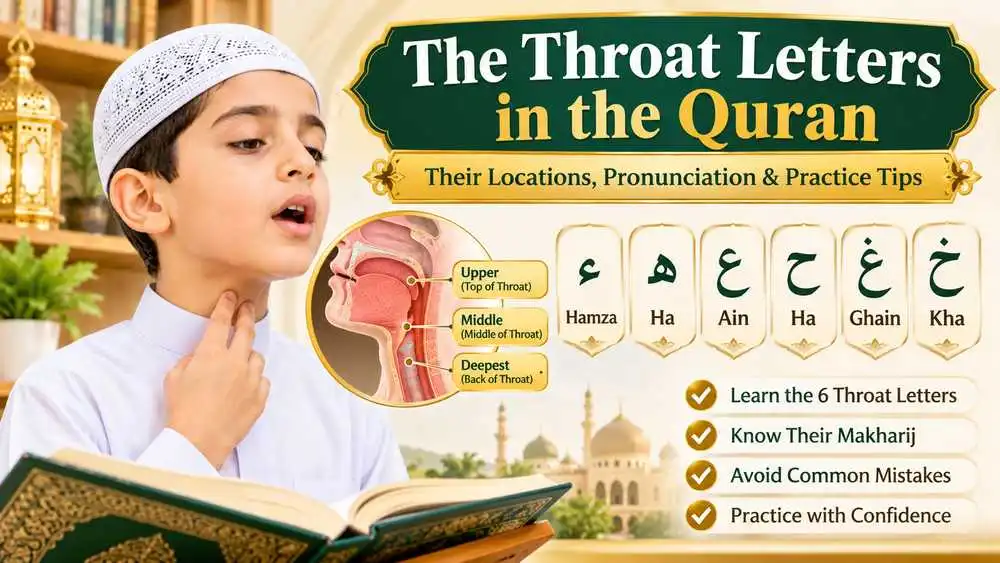
These are six Arabic letters that are produced in the throat: ء ه ع ح غ خ which are the throat letters studied by quran learners. They are called Huruf al-Halq by Tajweed teachers. This guide covers one area of the throat at a time, with each letter originating in one of these areas.
Why Are Throat Letters Important in Quran Recitation?
Letters of the throat are significant as a sound that is incorrect can change the meaning of a word and violate a rule of tajweed. There are three key reasons:
- Meaning: A change in letter in the throat position can alter the meaning of a word.
- Rules: Rules that rely on the correct pronunciation of these letters, like izhar.
- Memorization: If you hear something incorrectly, it becomes difficult to correct the error later on.
If one knows the point of each letter, then all three problems are avoided.
Stop Rules in Quran How to Pause and Restart Correctly
The Three Throat Articulation Points in Tajweed
Tajweed partitions the throat into three articulation points (makharij): lower, middle and upper.
Created for the throat letters quran reciters practice, each point results in two letters, that’s why they are always taught in pairs.
Deepest Throat Letters (Aqsa al-Halq): Hamza and Ha
Hamza (ء) and ha (ه) are the deepest letters. They start at the bottom of the throat, closest to the chest.
Hamza is a short firm stop as the catch in “uh-oh. Ha (ه) is a soft, breathy sound, similar to the “h” in “hat”. Neither needs force.
Meem Saakin Rules in English for Quran Beginners
Middle Throat Letters (Wasat al-Halq): Ain and Ha
The letters of the middle throat are ain (ع) and ha (ح). They are located in the middle of the throat.
Ain is a deep, voiced sound that is produced by gently closing the throat. Ha (ح) is soft and breathy, as if fogging a mirror.
This is the most difficult combination of letters in the Qur’ān to master for many students.
Upper Throat Letters (Adna al-Halq): Ghain and Kha
Upper throat letters are ghain (غ) and kha (خ). They originate from the top of throat closest to the mouth.
Ghain is a light gargling voice. A dry scrape is a scrape performed using only air.
Tajweed Classes Online for Kids with Expert Teachers
How to Pronounce the Six Throat Letters Correctly?
Say each letter by sounding it out at its location, with appropriate level of air pressure and repeat it with a short vowel. Follow these steps:
- Find the point: Press on your throat and identify it as deep, middle, or upper.
- Say the letter on its own with a fatha (a short “ah” sound): ءَ هَ عَ حَ غَ خَ.
- Allow airy letters (h, ح, and kh) and let the letters (ع, and غ) ring with voicing.
- Put long vowels, and then say a full word.
- Record your recitation and compare it to your teacher’s recitation.
Examples of Throat Letters in Quranic Words and Verses
Throat letters are short and familiar surahs that are taught to the Arabic learner.
Which Words Contain the throat letters quran?
These six words each contain one of the throat letters quran readers must master:
- ء in أَحَدٌ (Al-Ikhlas, 112:1)
- ه in اهْدِنَا (Al-Fatiha, 1:6)
- ع in عَلَّمَ (Al-Alaq, 96:4)
- ح in الْحَمْدُ (Al-Fatiha, 1:2)
- غ in غَيْرِ (Al-Fatiha, 1:7)
- خ in خَلَقَ (Al-Alaq, 96:1)
Easy Way to Learn to Read Quran for Kids and Adults
Summary of the Six Throat Letters and Their Makharij
This table reviews the throat letters quran in one view: each letter, its name, its point, and its sound.
| Letter | Name | Throat point | Sound |
|---|---|---|---|
| ء | Hamza | Deepest | Short, firm stop |
| ه | Ha | Deepest | Soft, breathy |
| ع | Ain | Middle | Deep, voiced |
| ح | Ha | Middle | Airy, whispered |
| غ | Ghain | Upper | Light gargle, voiced |
| خ | Kha | Upper | Dry scrape, airy |
How Throat Letters Affect Correct Quran Recitation?
The throat letters quran recitation covers pronunciation of each word in isolation.
A weak ع or ح makes the word look like its neighbors and among the best known is the rule associated with the weak letter of izhar.
Hams Letters in Tajweed Complete Guide for Quran Recitation
The Izhar Rule and Its Connection to Throat Letters
The pronunciation of Izhar is clear pronunciation:
when noon sakinah or tanween comes to meet a letter that requires throat, you must say the noon clearly without the humming of the throat (ghunnah) or merging.
Examples are مَنْ آمَنَ (Al-Baqarah, 2:62) and أَنْعَمْتَ (Al-Fatiha, 1:7). The rule only applies to the six letters of the throat in Arabic.
Hamzatul Wasl and Hamzatul Qat Complete Tajweed Guide
Common Mistakes When Pronouncing Arabic Throat Letters
The most prevalent errors are the use of a good plain vowel for ع instead of a good “a”, confusional pronunciation of ح and h, and the use of a plain “g” instead of a “غ”.
There are two others who are substituting the “k” sound and over-emphasizing the ء or ه.
In each of the throat letters that the students of quran practice, there is a typical slip and all of them can be corrected once they are heard.
How to Beautify Your Quran Recitation?
How to Improve Throat Letter Pronunciation for Non-Arabic Speakers?
Get better by working on one pair at a time, slowly, with a teacher who listens carefully to the exact point of each sound. Use these steps:
- Rest the hand on the throat and take note of the place of the sound’s origin.
- Compare similar-sounding sounds, such as ح and ہ, ع and ء.
- Practice within the short surahs, not just in the letters.
- Seek input on a weekly basis.
Feedback is more important than repetition in the case of Tajweed throat letters as they require an expert ear.
Using it the throat letters quran demands are easy for any beginner.
Join our Online Quran Ijazah Course and earn authentic certification while mastering Quran recitation with qualified teachers.
Daily Practice Exercises for Mastering Huruf al-Halq
A 10-minute routine is sufficient to develop the habit:
- 2 minutes: read ALL six letters (fatha, kasra and damma).
- Alternate ح and ه and ع and ء (3 minutes)
- 3 minutes – read Al-Fatiha slowly, with each letter from the throat.
- 2 minutes: Take a video and note down the one throat letter that is commonly missed by readers of Arabic.
Join our Quran Memorization Course Online and memorize the Holy Quran with confidence through personalized guidance from qualified teachers.
How Quran Teachers Help Students Correct Throat Letter Pronunciation?
A teacher corrects pronunciation by listening live, stopping you at the exact word, modeling the right sound, and having you repeat it.
In a one-to-one class, the steps look like this:
- You recite, and the teacher listens to every letter.
- The teacher stops you at the mistake.
- The teacher recites the correct sound.
- You repeat it until it is right.
This is how the throat letters quran classes in the online Tajweed course work, and the Quran memorization course uses the same corrections.
Start Mastering the Throat Letters With Certified Teachers
At Quran Beauty Online, the throat letters quran students learn are taught in live one-to-one classes by Ijazah-certified teachers. Mr. Eslam Ajoor holds Ijazah in Hafs ’an ’Asim and in Matn Al-Jazariyah, the classic Tajweed poem covering the makharij. Mistakes are corrected on the spot.
Ready to hear the difference? Book your free trial class, and your teacher will listen to you recite and suggest a plan. No credit card is needed.
Frequently Asked Questions About Throat Letters in the Quran
Are throat letters the same as heavy letters?
No. Throat letters are used to indicate the location of a sound, heavy letters indicate tongue and mouth elevation to form a full sound. Phonetics defines some of the letters from the throat as being heavy letters as well, like Ghain (غ) and Kha (خ).
Which throat letter is hardest for English speakers?
Ain (ع) is often the hardest throat letter for English speakers because English has no direct equivalent. It requires controlled articulation from the middle of the throat, which becomes easier through listening, repetition, and teacher feedback.
Can I learn throat letters without a teacher?
It is possible to get a start on learning throat letters via recordings and exercises. But if a qualified Quran teacher is present, he can point out what your pronunciation is incorrect and show you the correct pronunciation and give feedback immediately to help you get it right.
Can children learn throat letters?
Yes, children can learn Quran letters suitable for their age in their age-appropriate courses. They can learn individual sounds and practice with regular correction and encouragement, they can listen to the teacher’s model and repeat short portions of the Quran from about the age of six.
How many throat letters are there in the Quran?
There are six throat letters in Arabic: Hamza (ء), Ha (ه), Ain (ع), Ha (ح), Ghain (غ), and Kha (خ). They originate from three throat articulation points: deepest, middle, and upper.