

Two of the first tajweed rules that every Quran student encounters in any teacher are Hamzatul Wasl and Hamzatul Qat. Then mixing them up will affect the pronunciation of the word and how one ayah flows to the next. This guide teaches you what each hamza is, how to see them, when to say them and when to leave them out, and how to get in the habit of saying them every day.
What Are Hamzatul Wasl and Hamzatul Qat?
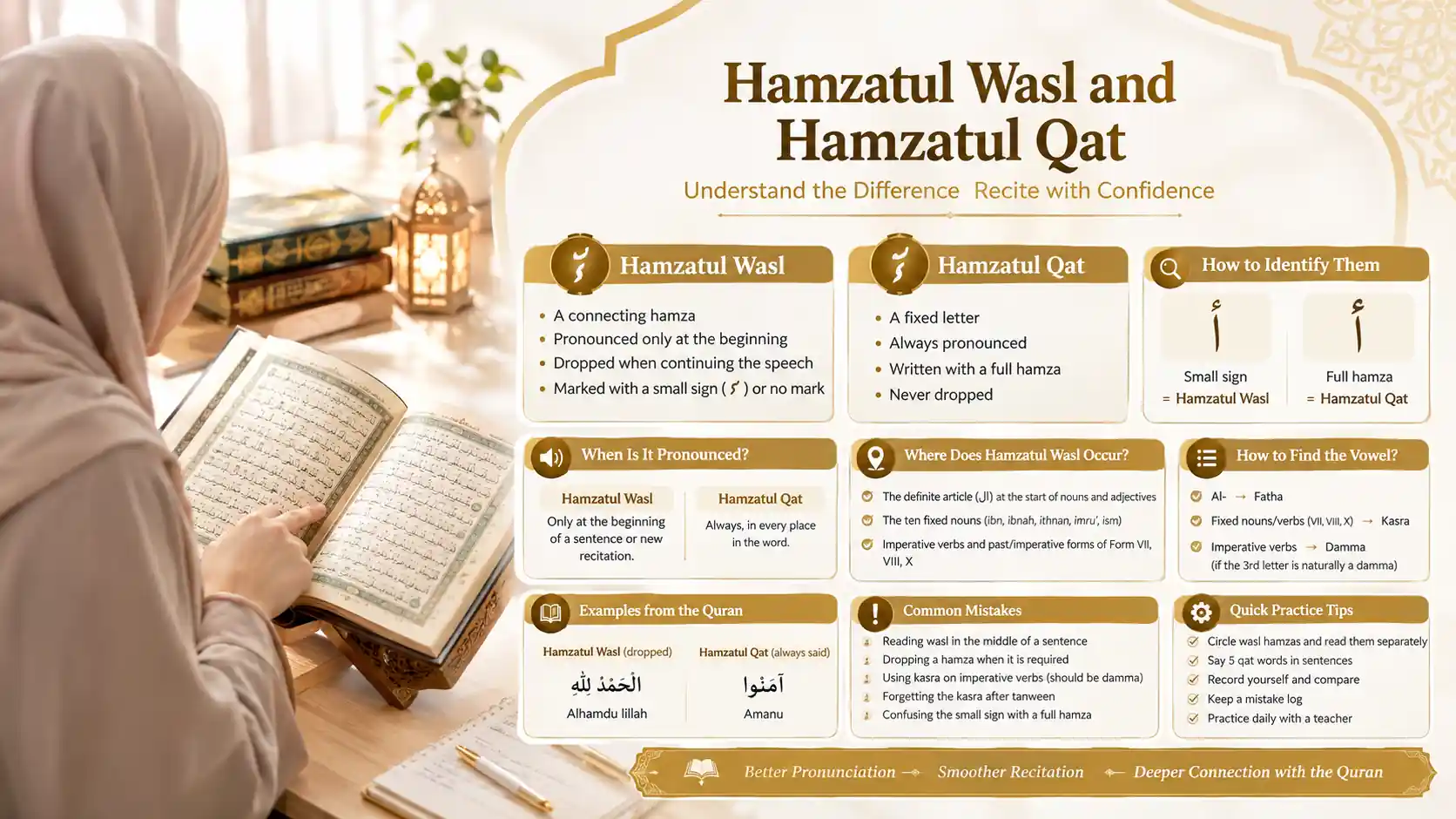
There are two kinds of hamza at the beginning of Arabic words: Hamzatul Wasl and Hamzatul Qat. Hamzatul Wasl is a connecting hamza that starts the pronunciation but is removed during the continuation of the speech with the previous word. Hamzatul Qat is a fixed original letter that will always be heard in any place.
What Is the Difference Between Hamzatul Wasl and Hamzatul Qat?
The distinction is in being permanent; hamzatul qat is pronounced each and every time, and hamzatul wasl is pronounced only at the beginning of speech. Hamza in print is written as a full hamza, and hamza wasl is written with a small mark of “sad” or without a mark.
There are two types of cues when the cue is printed, one that indicates that the sound does not change while in recitation and one that indicates that the sound would drop while in recitation.
Understanding the Importance of Tuhfat al Atfal for Tajweed
How Can You Identify Hamzatul Wasl and Hamzatul Qat in the Quran?
These are identified by the mark on the alif in the mushaf. The small, above the alif, ‘ ‘ indicates hamzatul wasl and informs the reader that it is absent in the middle of a sentence. A full hamza indicates that it is hamza ul qat and that it should be sounded each time.
The majority of Uthmani-script mushafs follow this convention regularly, and it is easy to recognize hamzatul wasl once you have learned the symbol.
When Is Hamzatul Wasl Pronounced and When Is It Dropped?
Hamzatul is only pronounced in the beginning of a sentence or a new recitation. When the reciter links that word with the preceding word, the hamza is dropped and the sound is transferred directly to the next syllable. It is therefore called “connecting” hamza and adding the hamza (al jami) to it makes an ayah misread in Arabic.
Master Arabic Qalqalah Letters and Recite the Quran Correctly
Where Does Hamzatul Wasl Occur in Arabic Words?
Hamzatul wasl is available in three fixed categories, making it easy to memorize:
- The definite article “al-” (ال) at the start of nouns and adjectives
- The following ten nouns: ibn, ibnah, ithnan, imru’, and ism.
- Imperative verbs, plus past-tense and imperative forms of verbs of Form VII, VIII, and X.
How to Beautify Your Quran Recitation?
How Do You Determine the Vowel of Hamzatul Wasl?
Hamzatul wasl is followed by a vowel that is determined by the category of the word:
- Al- is always with a fatha.
- The kasra is used for fixed nouns and verbs in forms VII, VIII, and X.
- In imperative verbs, if the third root letter is a damma by nature, then it is written; otherwise, not.
Different Types of Quran Recitation Explained Clearly
What Is Hamzatul Qat and When Is It Always Pronounced?
Hamzatul qat is a true ‘root’ letter and will always be pronounced. It seems to drop at the start of a new verse, or it drops from the previous word both counts as a recitation error, as it alters the identity of the word. The consistent pronunciation differs between hamzatul qat rules and the conditional nature of hamzatul wasl.
Join our Online Tajweed Course and learn to recite the Quran with confidence and accuracy.
Where Does Hamzatul Qat Occur in Arabic and the Quran?
Outside the short exceptions list that is reserved for hamzatul wasl, hamzatul qat will be present in all words. Verbs, nouns, and particles that start with a true hamza (such as amana, akala, and innha) will have hamzatul qat, and it will appear repeatedly, even in the beginning of many surahs. consonant),
What Happens When Two Hamzas Come Together?
If the word ending in hamzatul qat meets the word that begins with hamzatul wasl, then the wasl hamza falls. At that boundary, recitation is continuous (there is no pause between the qat hamza’s vowel and the next consonant) and the recitation of the ayahs is maintained in the same manner as their flow.
Join our Online Quran Ijazah Course and earn authentic certification while mastering Quran recitation with qualified teachers.
How Does Hamzatul Wasl Work After Tanween?
The only change after Tanween with Hamzatul wasl is
- If this sound of “tanween” were not present, then the last sound of the word would leave two silent letters in a row, a sound that is not allowed in Arabic.
- The tanween is followed by a short kasra to fill that gap.
- The intention of the hamzatul wasl does not influence the dropping of this hamza, which is done in the same way as in any other continuous recitation.
What Are the Common Mistakes in Hamzatul Wasl and Hamzatul Qat?
The most frequent error is to read the hamzatul wasl in the middle of the sentence instead of dropping it. Common mistakes are
- Dropping a hamza when it is required in a sentence
- The use of a kasra on some imperative verbs when it should be a damma.
- When the tanween is followed by a wasl hamza, then forget the kasra.
- The printed sad mark and full hamza glyph are considered interchangeable.
Join our Quran Memorization Course Online and memorize the Holy Quran with confidence through personalized guidance from qualified teachers.
How to Practise Hamzatul Wasl and Hamzatul Qat in Quran Recitation?
The best way to practice both the hamza is through structured repetition and feedback:
- Read one page slowly, verifying the printed hamza on all of the alif.
- Record yourself and compare to a certified reciter
- Maintain a log of mistakes and discuss it with a live tajweed teacher every week
- Do it every day, and the habit will become natural and swift.
Hamzatul Wasl and Hamzatul Qat Examples From the Quran
The opening chapters of the Quran provide two obvious examples. Hamza is taken out of the recitation in Surah Al-Fatiha from hamzatul wasl, which is present at the beginning of the Surah. The words such as «آمنوا» and «إنّ» always start with hamzatul qat and do not change their pronunciation. To internalise the difference between the two types of hamza (hamzatul wasl and the hamzatul qat) it is best to compare them side by side.
Quran Ahkam Tajweed Rules for Correct Quran Recitation
Hamzatul Wasl and Hamzatul Qat Practice Exercises
This skill can be developed more quickly with a short daily exercise set than by simply reading:
- On a page circle each hamzatul wasl, then read each one separately as a new sentence beginning.
- Select 5 words that contain hamzatul qat and say them at the beginning and end of sentences.
- Read one page with the personal error count of both types of hamza timing it.
Master Hamzatul Wasl and Hamzatul Qat with Expert Tajweed Guidance
Getting hamzatul wasl and hamzatul qat right consistently is the kind of detail a live Tajweed teacher catches that self-study can miss. Our Ijazah-certified instructors, each holding a recognized Ijazah in Hafs ‘an ‘Asim and extensive teaching experience, review this hamza distinction during a student’s first sessions, correcting pronunciation live. Students following this method can track their progress through ongoing teacher feedback and regular recitation practice.
Ready to stop guessing at hamzatul wasl and hamzatul qat on your own? Book a free trial class with a certified tajweed tutor through our Quran memorization program and get real-time correction on every hamza in your next reading session.
FAQs
Is Hamzatul Wasl the same across all Arabic dialects, or only in Quranic Arabic?
The rule is taken from classical Arabic and is always used in Quranic recitation. Certain initial hamzas can be treated differently in everyday speech in various spoken dialects, but in Tajweed, they are governed by the classical rules of pronunciation that are essential to accurate recitations and reading practice of the Quran.
Can a beginner skip Hamzatul Wasl and Hamzatul Qat at first and learn it later?
It is preferable to know these rules early in order to learn the difference, as many Quranic words are based on them. Correct pronunciation from the outset encourages the development of accurate pronunciation so that errors do not become ingrained, and later reading of the Quran, memorization, and Tajweed will be much easier.
Do Quran memorization apps mark Hamzatul Wasl the same way as printed Mushafs?
Most good-quality Quran apps use the usual conventions of Uthmani script and may use the small sign to mark Hamzatul Wasl. The markings, however, may be different in various apps and editions, so the learner should check the notation against a reliable printed Mushaf edition carefully.
How long does it usually take to master these two hamzas?
The distinction can usually be made comprehensible to the beginner, and he or she can understand and apply it within a few weeks or months, depending upon the amount of one-to-one correction. But for the purpose of consistently being accurate during rapid Quran recitation, it is generally needed to read, listen to the Quran, receive correction and feedback from the Qari, and do focused Tajweed work regularly at home for months.