

Begin Your Quran Journey Today
Book a FREE trial class with a certified Quran teacher. No payment, no commitment.
Beginners are exposed to the word “Tajweed” before they learn the word “Ahkam,” but they are not identical. Quran Ahkam Tajweed is not just a general topic of recitation but the rulings, the do’s, and the don’ts of how each letter and sound is to be pronounced. Many of the people who are interested in learning Quran tajweed rules actually require this sort of breakdown, rather than a general overview.
What does Ahkam al Tajweed mean in English?
“Ahkam al Tajweed” in English translates to “the rulings of Tajweed,” which are the pronunciation rules that a reciter observes, as opposed to the subject of Tajweed itself. A letter in one particular context (Hukm) indicates exactly how it is to be lengthened, softened, or extended to the next sound. the quran ahkam tajweed are the individual laws that are part of the subject.
What are the main Tajweed rules in Quran recitation?
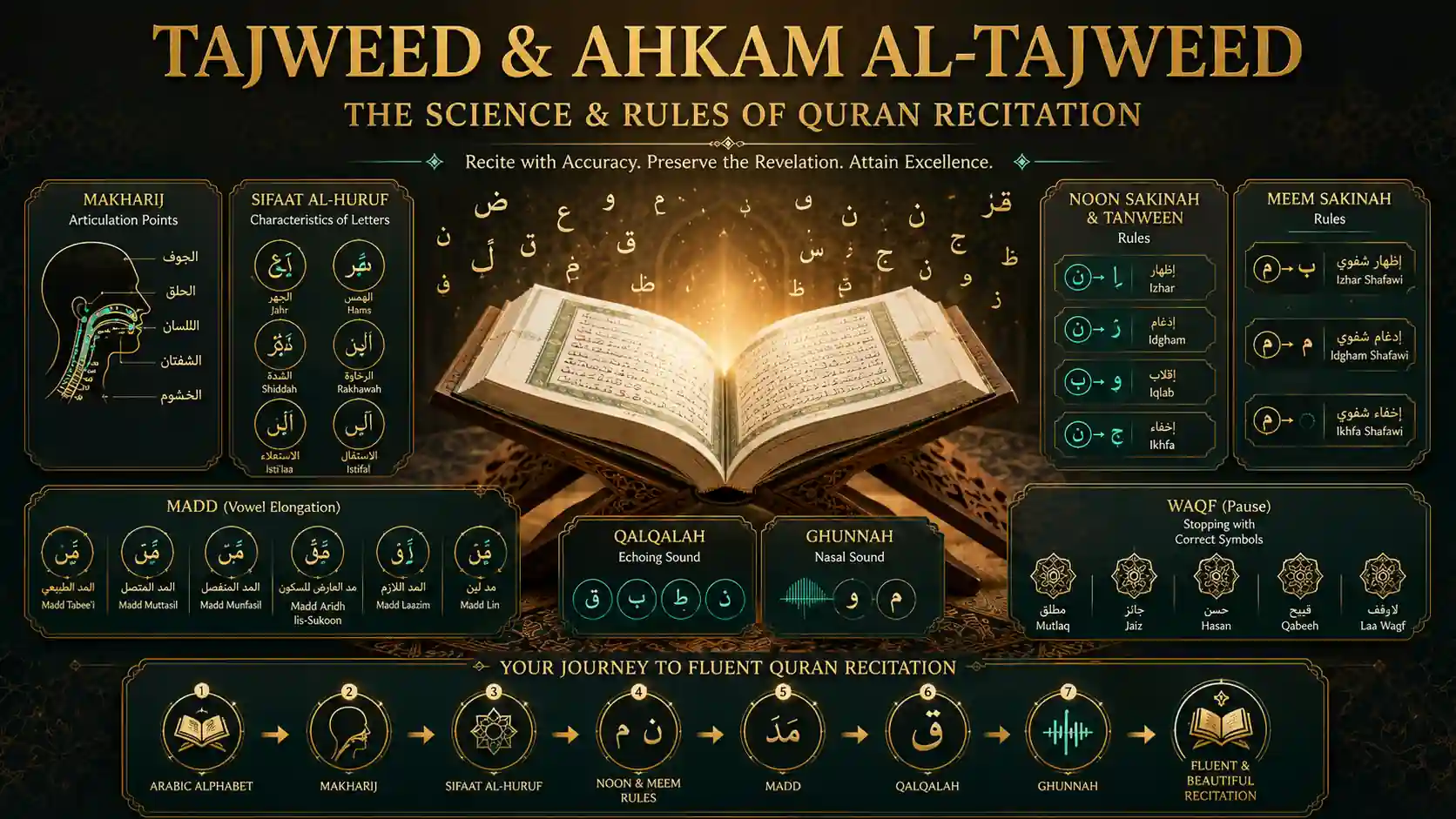
The basic rules of qiraat of the Quran are limited to a few basic rulings which every reciter will eventually learn:
- The proper place of articulation of each letter.
- Sifaat al-Huruf: Characteristics of letters that are similar.
- How to say the letter ‘w’
- Ahkam al-Meem al-Sakinah: three Rules of the Meem which remains silent.
- Ahkam al-Madd: The rules for the lengthening of vowel sounds.
- Qalqalah: the echoing rule for five specific letters
- Ahkam al-Waqf: Rules for pausing and stopping
Top Online Quran Classes with Tajweed for USA Learners
What should a beginner learn first in Tajweed?
The beginner should learn the correct pronunciation of letters before touching any Hukm. Each ruling in quran ahkam tajweed assumes the ability of the reciter to produce the sound for each letter correctly; otherwise, the right rule will be used for the wrong sound.
A reasonable sequence is:
- The Arabic alphabet, letters, and sounds. Arabic letters and sounds.
- Makharij (articulation points)
- Sifaat (letter characteristics)
- Mr. Al-Noon and Meem Sakinah’s rulings
- Madd and Qalqalah
Basic Rules of Tajweed in English for Quran Recitation
What is the difference between Tajweed and Ahkam al Tajweed?
Tajweed refers to the entire science of correct recitation of the Quran, and Ahkam al-Tajweed, on the other hand, refers to the individual rulings within that science. Apart from that, Tajweed is a field that includes etiquette and virtues and history of recitation, while the Ahkām are the technical, applied rules followed, letter by letter, during the process of Telawa.
Tajweed Course Certificate Online With Certified Quran Teachers
How many Ahkam are there in Tajweed?
The number of ahkam tajweed is not fixed but most curricula break it down into five to seven major ahkam: Noon Sakinah and Tanween (4 sub-ahka), Meem Sakinah (3 sub-ahka), Madd (multiple sub-types), Qalqalah, and Waqf. Inside these categories, there are many different applications that are referenced in the literature, often more than a dozen individual sub-rulings.
This is what is done because of the fact that courses are divided into levels rather than teaching all the ahkam tajwid of the Qur’ān in one go. The most frequent reason given for abandoning the study of quran ahkam tajweed at an early stage is to try to learn all the rules at once.
Explore more about Online Tajweed Course for Sisters with Female Teachers
What are the rules of Noon Sakinah and Tanween?
Whether the Noon sound is weakened due to the following letter is determined by the rules of Noon Sakinah and Tanween.
- Izhar: clear pronunciation before six throat letters
- Idgham: the Noon merges into the next letter, with or without Ghunnah
- Iqlab: the Noon converts into a Meem sound before the letter Ba
- Ikhfa: the Noon becomes a soft nasal sound before 15 specific letters
Tanween is similar in all four points to Noon Sakinah in that it is to be pronounced in the same way as Noon Sakinah, even though it is written differently.
Explore more about Online Hifdh Program for Quran Memorization and Revision
What is the correct way to pronounce Ghunnah?
The correct pronunciation of Ghunnah is a nasal huming from the nose, not the throat, not for more than two counts at a time, with a Noon and a Meem where they have a Shaddah or are in Idgham and Ikhfa. The sound should not come from the mouth, as most self-taught reciters make it.
A simple test: lightly pinch your nose and make the Ghunnah sound. If the sound is completely silenced, it means that it was coming out of the nose properly.
What is Qalqalah in Quran recitation?
Qalqalah in recitation of the Quran is an echoing bounce in the recitation of five letters (Qaf, Taa, Baa, Jeem, Daal) when each letter has a Sukoon. It is not only a stylistic choice to skip this echo, but also a pronunciation error in accordance with quran ahkam tajweed.
The five letters are remembered by this saying: Qutbu Jad (قطب جد) and the echo is strong in the mid-word (Sughra), and strong when pausing (Kubra).
Explore more about 7 Proven Steps to Master Noon Sakinah Rules in Tajweed
What is Madd in Tajweed and how many counts it is?
Madd in Tajweed is the ruling to extend the duration of a vowel beyond what is normal in terms of Harakat (counts). Natural Madd (Madd Asli) always has 2 counts, and Secondary Madd (Madd Far’i) has either 4 or 6 counts depending on the cause (usually a Hamzah or a Sukoon) with an extended letter.
Explore more about Learn Tajweed Online at Your Own Pace
How do I learn Tajweed step by step in English?
learn tajweed online in English, gradually from sound to rule to application:
- Memorize Arabic alphabet & practice Makharij
- Identify similar letters with Sifaat
- Use short verses for applying Noon Sakinah and Meem Sakinah.
- Practice Madd is not silent; it is with a voice.
- Include Qalqalah and Ghunnah in full verse recitation
- Read in full sentences with teacher feedback in real time
Quran Tajweed With English Translation for Easy Learning
What is the difference between Makharij and Sifaat?
The difference between Makharij and Sifaat is what each one describes about a letter. Makharij is the physical point where a letter’s sound is produced, in the throat, mouth, or lips. Sifaat is how that sound behaves once produced, such as heavy, light, whispered, or fully voiced.
Two letters can share the same Makhraj and still sound completely different because of their Sifaat, which is why both must be studied together.
Online Hifdh Program for Quran Memorization and Revision
What are the three Meem Sakinah rules?
The three Meem Sakinah rules apply when a silent Meem is followed by another letter:
- Ikhfa Shafawi: the Meem softens with a light nasal sound before the letter Ba
- Idgham Shafawi: the Meem merges into a following Meem, doubling the sound
- Izhar Shafawi: the Meem is pronounced clearly before all other letters
These three rulings mirror the logic of Noon Sakinah rules but apply specifically to a silent Meem instead.
Can You Read Quran Without Tajweed A Complete Beginner Guide
What is Waqf in Tajweed?
Waqf in Tajweed is the ruling for pausing during recitation, and it’s classified by whether stopping at a given word is required, permitted, or discouraged. The main categories are Waqf Lazim (obligatory stop), Waqf Ja’iz (permissible stop), and Waqf Mamnu’ (stopping is not allowed, since it would distort the meaning).
Reciters mark these pause points using symbols printed directly in the Mushaf, which is why learning to read those symbols is part of applying ahkam al tajweed correctly.
Can kids learn Quran Ahkam Tajweed easily?
Yes, kids can learn Quran Ahkam Tajweed easily when the rulings are introduced gradually through repetition and short verses instead of technical definitions. Children absorb Noon Sakinah and Qalqalah faster through sound and imitation than through memorized terminology, so a patient teacher matters more than the child’s age.
Why the Best Tajweed Quran Learning Happens With a Live Teacher
Reading about advanced tajweed rules explains the theory, but applying quran ahkam tajweed correctly requires a trained ear correcting your recitation in real time. At Quran Beauty Online, tutors are Al-Azhar and Ijazah-certified, native Arabic speakers with more than 5 years of experience teaching non-Arabic speakers specifically. The academy holds a 4.9 out of 5 rating from over 1,220 students, based on ongoing, verified sessions rather than a one-time review.
Start Applying the Rulings Correctly
Understanding the names and meanings of Quran Ahkam Tajweed is an important first step, but accurate recitation comes from applying each ruling under the guidance of experienced teachers. At Quran Beauty Online, students learn with Al-Azhar and Ijazah-certified instructors who provide live correction, structured lesson plans, and personalized feedback based on each learner’s level. If you’re ready to improve your Quran recitation with confidence, book a free trial class and receive a personalized assessment to begin learning the correct application of all rules of tajweed from day one.
Frequently Asked Questions
Is Ahkam al-Tajweed the same across every Qira’ah?
The basic principles of Ahkam al-Tajweed are universally the same in all of the main recitations (Qira’at). The main differences are found in the pronunciation of some words or particular elements of the recitation. Otherwise, the basic rules of the tilaawah remain the same. These variations are clearly explained by a qualified teacher and can be applied properly.
Do I need a teacher to learn Ahkam al-Tajweed correctly?
Yes. Books and videos can teach the rules, but only a qualified teacher can hear your recitation and correct your mistakes in Ghunnah, Madd, Qalqalah, and the pronunciation of letters. Live feedback helps ensure accurate application of the rules and builds confidence through repetition.
What happens if I recite without applying Ahkam Tajweed?
In most cases, the recitation remains valid. However, pronunciation errors that could be avoided are considered by scholars to be Lahn. Regularly neglecting Ahkam Tajweed can reduce the quality and accuracy of recitation. Therefore, every Muslim should strive to improve by studying, practicing, and learning under the guidance of a qualified teacher.
Is Ahkam al-Tajweed taught differently to children than adults?
The rules of Tajweed are the same for everyone, but the teaching methods differ. Children are generally taught through repetition, games, and memorization of short surahs, while adults often learn the reasoning behind each rule before applying it during guided Quran recitation.
Can I learn Quran Ahkam Tajweed without memorizing the Quran?
Yes. Memorizing the Quran is not required to learn Quran Ahkam Tajweed. Many students begin by learning the rules and practicing with short surahs and selected verses. Building a strong foundation in Tajweed makes it easier to recite and memorize longer portions of the Quran later.