An online Hifdh program is a systematic approach to memorizing the Quran via live video sessions with a qualified tutor, without the need to move to a madrasah. There are several types of Quran courses online today, and a specific Quran hifz online course is designed around memorization and revision, not general recitation. This booklet gives answers to the questions students and parents ask most before they enroll: How long is Hifdh? Do you need to master Tajweed first? What is murajaah?
What Is an Online Hifdh Program?
An online Hifdh program is a live, teacher-led Quran recitation program that is given via video calling (typically Zoom), where the tutor listens to the memorization in real time and corrects the mistakes as they come up and can handle the revision process.
It is based on the same basic approach of new memorization (sabaq), recent revision (sabqi), and long-term review (manzil) that is employed in traditional Hifz schools, but this time remotely. A well-run Quran memorization program also incorporates the correction of tajweed directly into each session so that students are not learning errors along with the Quran.
How Long Does It Take to Complete Hifdh Online?
One can recite the Quran in 6 to 12 months with diligent memorization, revision, and guided recitations of 2 to 4 hours a day. This is an intensive method that’s best for full-time students who have Hifdh as their primary focus for the day and review regularly to enhance retention.
Most of the students study 1-2 hours a day and can read the Quran in 2-4 years. This is a good rate of work to allow for suitable new memorization, frequent revision, and teacher feedback and is one of the most consistent for steady, accurate progress.
If you are unable to study for 60 minutes daily, it may be best for you to study between 20 and 40 minutes daily if you have to be working, in school, or have family obligations. It may take 4-7 years, but with daily practice and revision, verses can be well memorized, and they will stick with them for the long haul.
Revelation Recording and Memorisation of the Holy Quran Guide
Do I Need Tajweed Before Starting Hifdh?
It is not necessary to master Tajweed completely before you start reading, but it is necessary to have some knowledge of the correct pronunciation of the letters (Makharij) before you start reading and memorizing mistakes in your Hifdh. Most good programs begin from the start with tajweed and correct pronunciation as they memorize new verses.
Those who are complete beginners without any background in reading the Quran are typically taught to read first, as the memorization needs to be efficient after reading. That is also why a structure for online Quran memorization classes that divides the memorization from the correction is less effective than memorization and correction in the same class.
Explore our Quran memorization classes
What Is the Difference Between Hifdh and Hifz?
| Comparison | Hifdh | Hifz |
|---|---|---|
| Meaning | Means “to preserve” or “to memorize” in Arabic. | Has the same meaning: “to preserve” or “to memorize.” |
| Origin | A transliteration of the Arabic word حِفْظ (ḥifẓ). | Another transliteration of the same Arabic word. |
| Difference | No difference in meaning or practice. | No difference in meaning or practice. |
| Common Usage | Used by some academies and educational institutions. | More commonly used in English-speaking Muslim communities. |
| Purpose | Refers to memorizing the Quran with correct pronunciation and regular revision. | Refers to the same Quran memorization process. |
| Related Title | A person who completes it is called a Hafiz (male) or Hafizah (female). | The same titles apply after completing Hifz. |
Online Hifz Class for Kids and Adults in the USA
Are Online Hifdh Classes Good for Adults?
Yes, online hifdh classes are effective for adults, and age does not pose a barrier. Adults will usually learn at a slower rate than kids because they have competing demands and a realistic daily plan makes up for that deficit.
Consistency is key for adult students The adult who works 20 minutes a day will memorize more than the adult who works 3 hours a week but inconsistently. However, flexible rescheduling of Quran classes for adults is found to have much higher completion rates than rigid classes with fixed times.
Can Sisters Join an Online Hifdh Program in the USA?
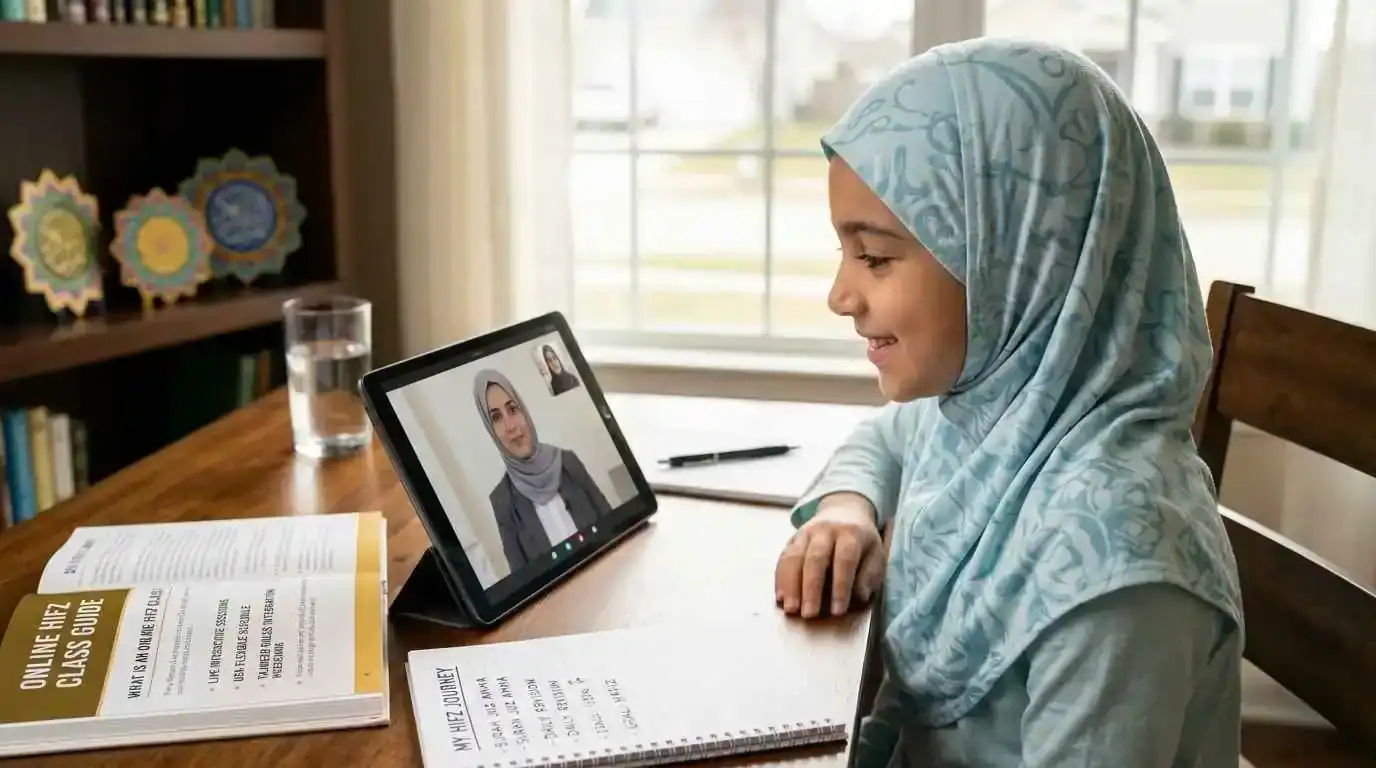
Yes, sisters in the USA can attend an online Hifdh program with a female tutor, private one-on-one lessons, and schedules across the USA time zones Eastern, Central, Mountain, and Pacific. Reputable academies automatically match up female students with Ijazah-qualified female teachers so that classes are maintained in a comfortable and respectful atmosphere for the entire family.
Explore our courses
Is One-on-One Hifdh Better Than Group Hifdh?
One-on-one Hifdh is usually more effective for serious memorization aims, as the tutor can correct each and every mistake as it occurs and can tailor the sabaq to your level of retention day by day. Group classes are less expensive and may encourage kids to learn through peer pressure, but the teacher has to pay attention to multiple students, and an underachieving student’s mistakes are more likely to be overlooked.
Words From Quran With Meaning For Easy Quran Understanding
How Much Time Should I Spend Daily on Hifdh?
As you increase your pace goal, the time you spend each day on an online Hifdh program should also increase, but even if you just do a small block, it’s still better than going for a long block sporadically. As a general guideline, use this:
- Beginners or very busy adults: 20-30 minutes a day, learning predominantly a few lines of new sabaq and yesterday’s sabqi.
- Standards-paced students will get 45-90 minutes a day of new memorization and recent revision, with a rotation of a manzil portion.
- Intensive students: who want to complete their studies in less than 2 years: 2-4 hours per day, consistent sabaq sabqi manzil cycles supervised by a tutor weekly.
- All levels: If you have to choose between revision and new memorization, remember to prioritize revision time.
Top Online Quran Classes with Tajweed for USA Learners
What Is Murajaah in Quran Memorization?
Murajaah is the systematic revision of all that has already been memorized, and it is this that keeps a Hifdh from going away quietly months after it has been learned. It usually is conducted in a three-part format:
- sabaq (the new lesson for the day),
- sabqi (the last lesson or two weeks, reviewed daily),
- manzil (all the older lessons, reviewed on a rotating schedule, so that nothing is forgotten for too long).
Best Way to Learn Quranic Arabic for Beginners Step by Step
Can Children Join an Online Hifdh Program?
Yes, most online hifdh programs will accept kids as young as 6, and they work with them via repetition games, storytelling, and short, energetic sessions that are appropriate for a young attention span. Younger children typically begin with short Surahs and Juz’ Amma and then gradually work their way into longer portions with increased reading fluency and stamina.
A private, one-on-one environment also allows the tutor to pace the class as per the individual child’s needs, not the entire class’ needs. Online, parents can find the same structure and correction quality without the commute as they would find in a hifdh classes near me to enroll their child.
Can You Read Quran Without Tajweed A Complete Beginner Guide
What Should I Look for in a Hifdh Teacher?
Seek out a tutor who has an Ijazah (formal certification of an unbroken chain of the transmission of the Quraan) and has several years of experience in dedicated Hifdh teaching, not just general Quran teaching. In addition to the credentials, look at how they organize revision: a teacher who doesn’t have a clear idea of their sabaq-sabqi-manzil is going to let old memorization slip. Some other practical indicators of a good teacher:
- Native or near-native Arabic pronunciation with visible Tajweed correction during sessions.
- A track record of students who completed, or are progressing steadily through, full Hifdh.
- Willingness to give a free trial session before you commit to a paid plan.
- Clear weekly progress tracking you can actually see, not just verbal reassurance.
Learn Tajweed Online at Your Own Pace
Are Free Trials Available for Hifdh Programs?
Yes, most of the academies provide a free trial class prior to any payment, and it allows you to get a first-hand experience of the way the tutors teach. A real free trial shouldn’t ask for any credit card information or impose any obligations that you need to pay for after the trial period.
Some academies extend their money-back guarantee period with a short window of the first week of paid lessons, which is a good indicator of their level of confidence in their teaching. When considering a specific online Hifdh course, do not accept the free trial as a formality but actually ask the tutor directly how he/she organizes sabaq, sabqi, and manzil.
7 Proven Steps to Master Noon Sakinah Rules in Tajweed
What Schedule Works Best for Busy Adults?
Occasional long sessions are not as successful as short fixed daily sessions for busy adults doing an online Hifdh course. One of these methods is a one-hour lesson most days of the week, after Fajr or a time that is known to the student, as it is much easier to lock into a specific time than a loose “whenever I have time” routine.
- Anchor the class to an existing daily routine, such as right after a prayer, rather than an open time slot.
- Choose one weekly session as a dedicated manzil-only day if new memorization and revision keep competing for time.
- Use a tutor available across multiple US time zones so a single missed morning doesn’t cancel the week’s class.
- Build in one planned catch-up day, since missed sessions are inevitable and a plan for them prevents a small gap from becoming a full stop.
Online Tajweed Course for Sisters with Female Teachers
How Do I Keep Quran Memorization Strong Over Time?
The ability to maintain a strong memory of a Hifdh for a long time after memorizing is a matter of revision, revision, and revision, rather than revisiting and rededicating to memory when parts slip. Follow this routine:
- Recite memorized parts every day during Salah; it’s revision without any effort, it is built-in!
- Memorize the Quran in 7 small parts (manzil) and review one part every day, going through one cycle every week.
- Use one Mushaf edition throughout, as the visual memory of the page where an Ayah is located is a real help to remember.
- Hear yourself read occasionally to catch up on the errors that may have slipped away so you don’t make them second nature.
- Review with teacher regularly after completion; there is no correction mechanism when making errors on one’s own.
Learn Hifdh With Real Structure, Not Just Good Intentions
Unlike new memorization piling up without any revision, every online hifdh program at Quran Beauty Online is centered around Ijazah-certified tutors who have several years of experience teaching Hifdh, a one-on-one live program, and a true sabaq-sabqi-manzil revision system that is conducted weekly. Female tutors are available for sisters; scheduling options are available for all US time zones, and all plans have checkpoints each week so you always know where your Hifdh is.
It is not enough to read about Hifdh; one must have a tutor over their recitation to check it page by page. Experience the beauty of the Quran through Quran Beauty Online, with no card necessary and a 1-week money-back guarantee, and find out what a well-structured Hifdh journey is like from your first class. Book your free trial class with Quran Beauty Online today
FAQ
Can I start Hifdh with no Arabic background at all?
Yes, there are online programs for Hifdh that accept complete beginners who know nothing of Arabic. This is typically followed by the Noorani Qaida to learn the alphabet and correct pronunciation before learning short Surahs. Once students become fluent enough in reading, they can begin memorizing without repeatedly making pronunciation mistakes.
Does Hifdh memorization differ between Qira’at (recitation styles)?
The majority of online Hifdh programs teach the most widely recited transmission in the world, Hafs ‘an Asim, so most students never encounter differences. Other narrations, such as Warsh ‘an Nafi’, have different wordings and recitation rulings. These are considered advanced studies and are typically learned after mastering Hafs.
Can I pause an online Hifdh program and resume it later?
Yes, good academies allow students to take breaks for travel, exams, or family commitments. However, if the break is lengthy, you will likely need to review your manzil to restore memorization before continuing. Informing your tutor in advance allows them to plan an effective review session.
Is the certificate from a Hifdh academy officially recognized?
An Ijazah can only be issued by a qualified teacher and serves as a personal endorsement of the accuracy of Quranic transmission rather than a government-accredited diploma. Always verify that your teacher’s own Ijazah is authentic before relying on any certificate as evidence of scholarly qualification.