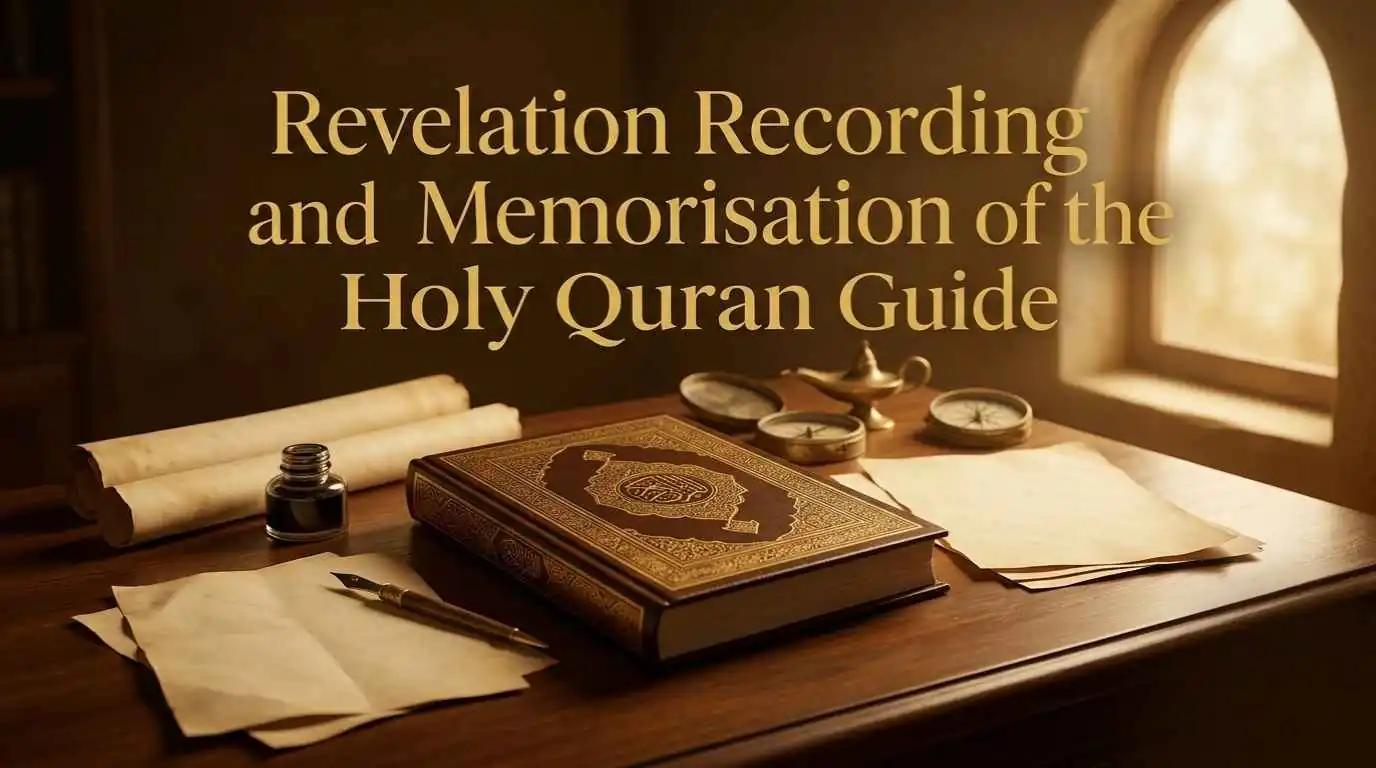
Revelation Recording and Memorisation of the Holy Quran through the efforts of Angel Jibreel, over forty scribes who wrote with bones, parchment, and palm-leaf stalks, and the memory of companions who memorized the Holy Quran exactly as it was revealed to Prophet Muhammad (saws) is one of the best-documented preservation stories in history. This book guides the reader step by step through the process from the first revelation in 610 CE to the Uthmanic codex.
What does revelation mean in the Quran context?
Revelation (Wahy) This is when Allah spoke His words directly to Prophet Muhammad ﷺ, not when a human being wrote them. It is on this basis that the entire Revelation Recording and Memorisation of the Holy Quran process is based on: It is known that all verses came from outside the Prophet ﷺ and were transmitted with no changes.
How was the Quran revealed to Prophet Muhammad?
The Quran was revealed one verse at a time during the mission of the Prophet ﷺ and not all in one go. Revelation came in various documented ways:
- It was inspiration that was given directly to the Prophet’s ﷺ heart without being mediated through another person.
- The Prophet (saw) in the form of an angel to give the exact words.
- The loudest was the “ringing bell” that Angel Jibreel reported.
- Very rarely did Angel Jibreel appear in his true form as an angel.
Explore our Quran memorization classes
Over how many years was the Quran revealed?
The Quran was revealed in a period of about 23 years, from 610 CE until the death of the Prophet ﷺ in 632 CE. The chapters from the Makkan period were shorter and focused on beliefs, while the chapters of the Madinan period are longer and have the theme of laws, including last revelation of holy quran verses, sent shortly before the death of the Prophet ﷺ.
Online Hifz Class for Kids and Adults in the USA
Revelation Recording and Memorisation of the Holy Quran
From day one, two parallel systems safeguarded the text: immediate memorization by companions and immediate written recording by designated scribes. All verses were double-checked against memory and manuscript before acceptance, a double-check unmatched by other early religious writings.
Explore our courses
What role did Angel Jibreel play in revelation?
The Prophet (saws) received the precise words of Allah through Angel Jibreel (as) never Allah’s words paraphrased. In addition, he used to read the Quran with the Prophet (saw) every year, verifying that there was no alteration in what was revealed and what was memorized and recorded by the companions.
How was the Quran recorded during the Prophet’s life?
Each time a verse was revealed, the Quran was written down on that very day by one of the scribes of the Prophet (sallallahu alaihe al-salam) during the Revelation Recording and Memorisation of the Holy Quran process:
- The revelation was given to the Prophet (peace be upon him), and he at once dispatched for a scribe.
- He guided the wording and its location in the surah.
- The scribe made notes on what was available and read it back to the group.
- If there was any mistake, the Prophet (saw) corrected it on the spot before approving it.
Words From Quran With Meaning For Easy Quran Understanding
What materials were used to write the Quran?
As paper did not exist in 7th-century Arabia, the Quran was written by scribes on the materials that were available to them at that time. The materials recorded are parchment, animal shoulder bones, palm-leaf stalks, flat stones, and leather, each of which was matched with memorized material at a later time.
Who were the scribes of revelation?
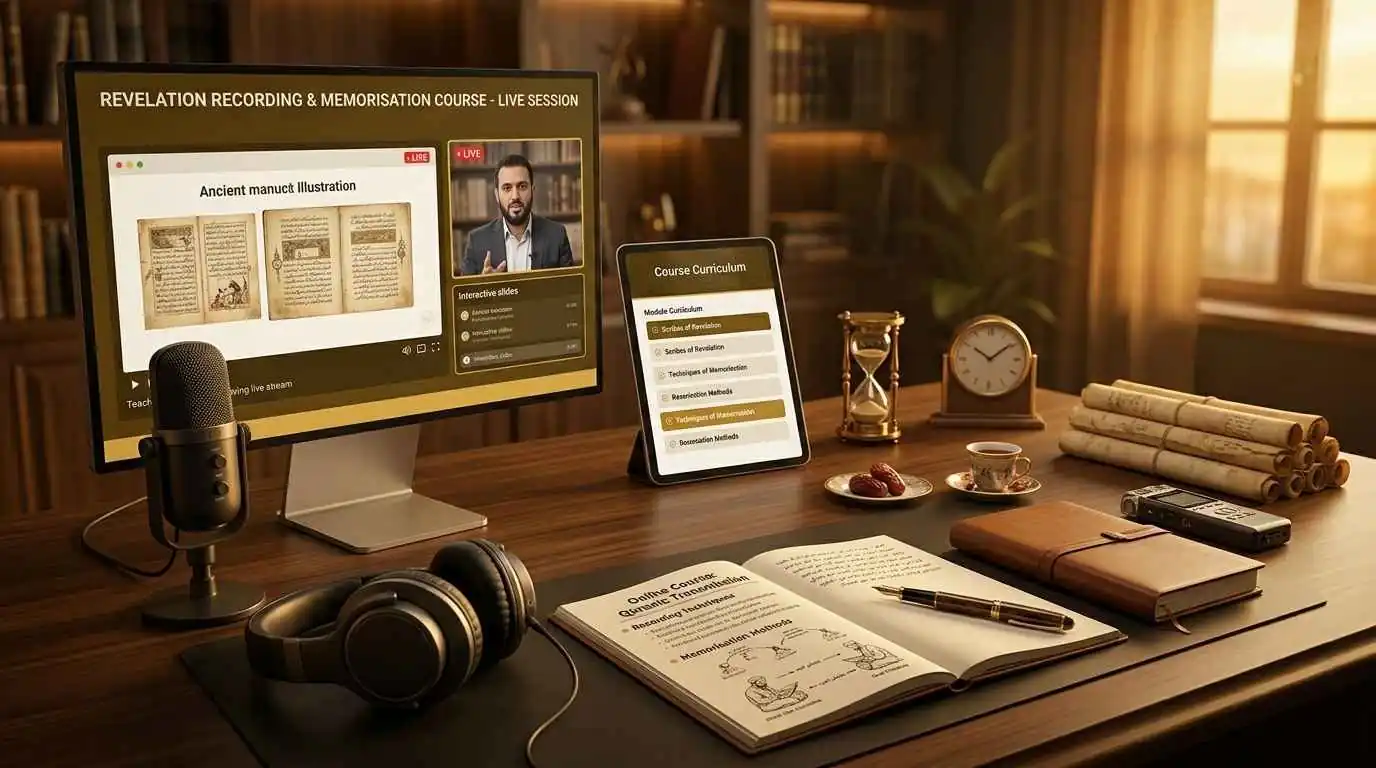
The scribes of revelation were literate companions the Prophet ﷺ personally chose to write down each verse. More than 40 scribes are mentioned in the sources, with the most prominent being Zayd ibn Thabit, who played a central role in The Complete History of Quranic Revelation, and who led the official compilation of the Quran.
Top Online Quran Classes with Tajweed for USA Learners
How did the companions memorise the Quran?
How Did the Prophet’s Companions Memorise the Holy Quran?, Companions memorized the Quran by reciting it directly from the Prophet ﷺ, while the culture of oral tradition in Arabia would help them to remember it; these are the same Methods Used by Early Muslims to Memorise the Quran that Hifz programs rely on today.
- Hearing the recitation of a new Surah by the Prophet (saws) with the Qur’an.
- Repeating it back until the pronunciation and words were correct.
- Reciting memorized bits in daily prayers to avoid forgetfulness.
- Passing on what they have memorized, multiplying the huffaz.
Also inquired about: How was the Holy Quran memorized by the Messenger’s S. (S. A.W. S.) companions? – At least 21 of them had memorized it entirely by 632 CE.
Best Way to Learn Quranic Arabic for Beginners Step by Step
Why is the Quran preserved through both writing and memorisation?
Combined writing and memorization gave a built-in checking system which could not be provided by either alone. A written fragment might be compared with a memorizer’s recitation; a memorizer’s recitation might be compared with a fragment, and an error in one would be detected by the other.
What happened after the Prophet’s death to preserve the Quran?
Caliph Abu Bakr commanded to collect the Quran in one volume because he was afraid that it might be broken into fragments. The battle of Yamama had killed many of the huffaz, so Zayd ibn Thabit was tasked to collect all the verses from the written and living memorizers.
Can You Read Quran Without Tajweed A Complete Beginner Guide
What is the Uthmanic codex?
The Uthmanic codex is the standardized written version of the Holy Quran that was standardized by the Caliph Uthman to help unify recitation throughout the expanding Muslim world. The expansion of Islam into areas outside Arabic-speaking ones put the danger of dialect variation on the table, so Uthman sent out master copies that were verified and discarded the previous ones in the major cities.
What is the difference between revelation and compilation?
Revelation is when Allah revealed the words to the Prophet (saws), and compilation is the process undertaken by the human, which is to gather the words into one book. This is the middle point in the study of Revelation Recording and Memorisation of the Holy Quran. Revelation ended in 632 CE, and compilation was under Abu Bakr and Uthman.
Learn Tajweed Online at Your Own Pace
How did the Prophet review the Quran every Ramadan?
During each Ramadān, the Prophet ﷺ read the whole Quran with Angel Jibreel, which they call Mudarasah.
- Jibreel recited all the portions revealed in the year to the Prophet (saws) back to him.
- They were recited back to Jibreel by the Prophet ﷺ.
- Immediate identification and rectification of any memorization drift was carried out.
- It is said the review took place twice during the last Ramadhan of the Prophet’s ﷺ life.
7 Proven Steps to Master Noon Sakinah Rules in Tajweed
Why is Tajwid important in Quran memorisation?
The importance of Tajwid is that if one letter is mispronounced, it alters the meaning of the word in the student’s mind, and he is reading it incorrectly without realizing it. That’s why serious programmes of Hifz and the study of Revelation Recording and Memorisation of the Holy Quran are always accompanied by live Tajwid correction.
Online Tajweed Course for Sisters with Female Teachers
Ready to start your own Hifz journey
The Revelation Recording and Memorisation of the Holy Quran weren’t preserved by chance it survived through a deliberate, dual-verification system of trained scribes and dedicated memorizers, refined by Zayd ibn Thabit’s compilation work under two caliphs. At Quran Beauty Online, that same discipline shapes every Hifz session: Ijazah-certified tutors break the Quran into manageable portions, correct Tajwid live, and follow a structured revision schedule so nothing memorized is left to fade.
Ready to start your own Hifz journey with a certified tutor? Book your free trial class with Quran Beauty Online today via whatsapp no card required, backed by a 7-day money-back guarantee.