
Seeking out the Top 10 Best Quran Reciters in the World for Hifz is not necessarily the reciter with the most beautiful or emotional voice. For memorization, consistency, clarity, pronunciation, and a manageable pace matter more than vocal beauty. Some reciters take their time in the delivery; others display strong emotions. This is a guide to ten popular voices and what you need to know about murattal and mujawwad, along with how you can find the best voice for your beginner, HIFZ student, and daily listener needs.
How Listening to the Best Quran Reciters Can Improve Your Quran Learning?
Listening to the best Quran reciters helps to tune your ear to imitate correct pronunciation, rhythm, and pauses. It helps by:
- Proper pronunciation: the words are pronounced at the correct articulation point of the letters.
- Repetition can produce improved flow; listen to find the stopping/starting/stretching points.
- Better memorization: repetition of a verse makes it easier to remember.
- More consistency: a daily audio habit helps you to practice even when you are very busy.
However, there are no one-size-fits-all recitations, so let’s make a comparison of the two primary styles of recitations.
Murattal vs. Mujawwad: Which Quran Recitation Style Is Best for Learning?
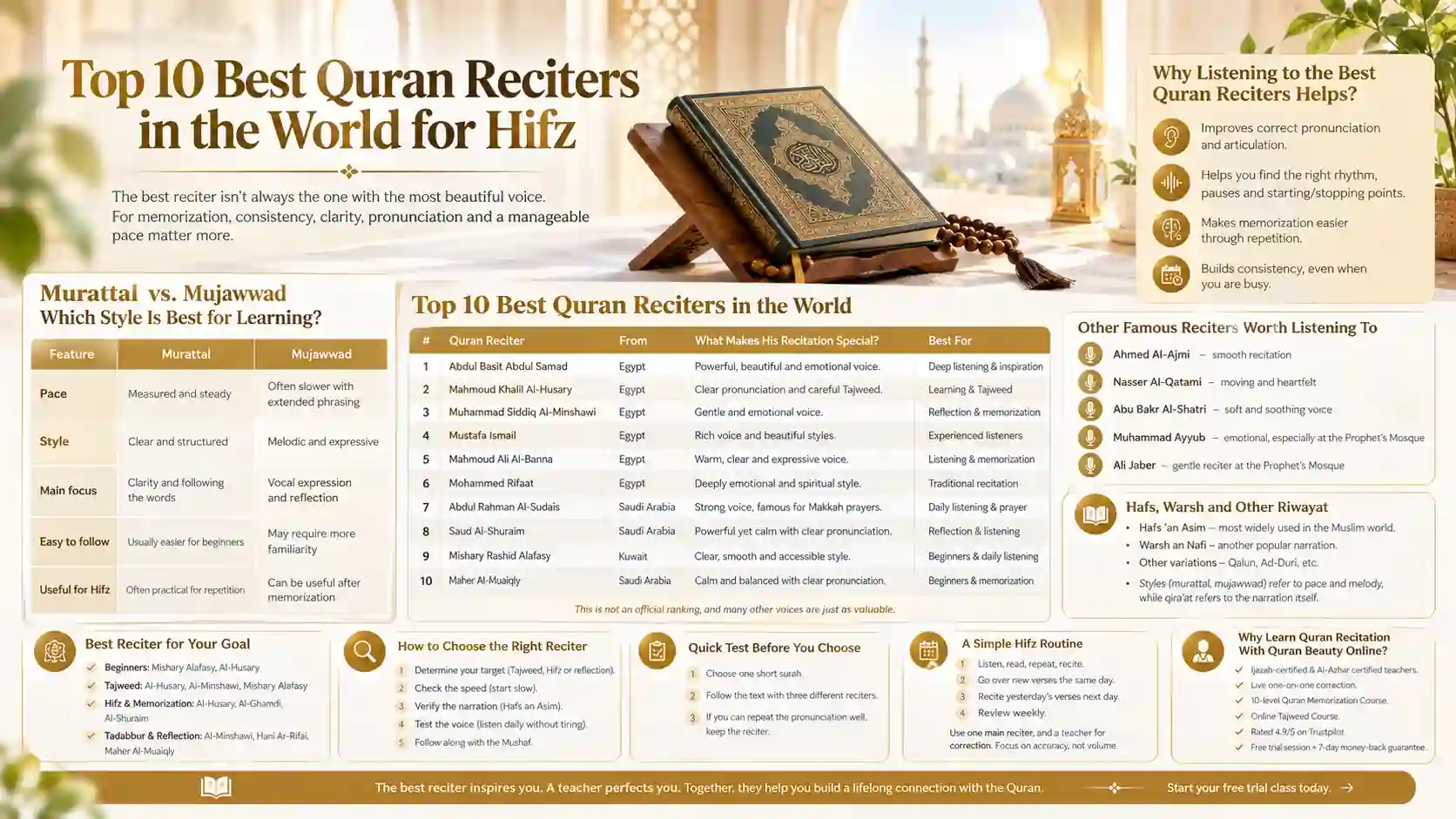
For Hifz, choose the recording that is easiest for you to follow consistently rather than choosing a style based only on its label. Here are the differences between the recitations of murattal vs mujawwad recitation differences at a quick glance:
| Feature | Murattal | Mujawwad |
|---|---|---|
| Pace | Measured and generally steady | Often slower with extended phrasing |
| Style | Clear and structured | Melodic and expressive |
| Main focus | Clarity and following the words | Vocal expression and reflection |
| Easy to follow | Usually easier for beginners | May require more familiarity |
| Useful for Hifz | Often practical for repetition | Can be useful after memorization |
With the styles clear, it’s time to meet the voices themselves.
How to Beautify Your Quran Recitation?
Top 10 Best Quran Reciters in the World:
These ten are among the most well-known and widely listened-to Quran reciters, each with a distinctive recitation style and different strengths for learning, Hifz, reflection, or daily listening.
| # | Quran Reciter | From | What Makes His Recitation Special? | Best For |
|---|---|---|---|---|
| 1 | Abdul Basit Abdul Samad | Egypt | A powerful, beautiful, and emotional voice. His recitation is easy to recognize and loved by millions. | Deep listening & inspiration |
| 2 | Mahmoud Khalil Al-Husary | Egypt | Very clear pronunciation and careful Tajweed. His steady pace makes the words easy to follow. | Learning Quran & Tajweed |
| 3 | Muhammad Siddiq Al-Minshawi | Egypt | A gentle and emotional voice with a strong sense of humility and reflection. | Reflection & memorization |
| 4 | Mustafa Ismail | Egypt | Known for his rich voice, excellent control, and beautiful use of different melodic styles. | Experienced listeners |
| 5 | Mahmoud Ali Al-Banna | Egypt | A warm, clear, and expressive voice with a comfortable pace. | Listening & memorization |
| 6 | Mohammed Rifaat | Egypt | One of the most famous early Quran reciters, known for his deeply emotional and spiritual style. | Traditional Quran recitation |
| 7 | Abdul Rahman Al-Sudais | Saudi Arabia | A strong and recognizable voice, especially famous for leading prayers in Makkah. | Daily listening & prayer |
| 8 | Saud Al-Shuraim | Saudi Arabia | A powerful yet calm recitation with clear pronunciation and a distinctive voice. | Reflection & listening |
| 9 | Mishary Rashid Alafasy | Kuwait | A clear, smooth, and accessible style that is popular with younger and newer listeners. | Beginners & daily listening |
| 10 | Maher Al-Muaiqly | Saudi Arabia | A calm and balanced voice with clear pronunciation and an easy-to-follow pace. | Beginners & memorization |
This is not an official ranking, and many other voices are just as valuable.
Hams Letters in Tajweed Complete Guide for Quran Recitation
Other Famous Quran Reciters Worth Listening To:
Some of the other well-known reciters of the Quran are Ahmed Al-Ajmi, Nasser Al-Qatami, Abu Bakr Al-Shatri, Muhammad Ayyub and Ali Jaber. These are the voices of some of the best Quran reciters in the world, apart from the top 10.
- The smooth recitation of the entire Quran is that of Ahmed Al-Ajmi.
- Nasser Al-Qatami: delivery of moving and heartfelt.
- Abu Bakr Al-Shatri: voice of softness, soothingness.
- Muhammad Ayyub: he is emotional in the recitation of the Prophet’s Mosque.
- Ali Jaber: gentle reciter in the Mosque of Prophet (saws)
Hafs, Warsh, and Other Riwayat: What Quran Learners Should Know?
There are different authentic recitations of the Quran known as Qira’ahs and Hafs ‘an Asim is the most widely encountered riwayah in many parts of the Muslim world and is commonly used in Quran learning programs. However, learners may study other authentic riwayat, such as Warsh ‘an Nafi’, depending on their region, teacher, or Quranic tradition.
- Hafs ‘an Asim: one of the most widely encountered riwayat and commonly used in Quran learning programs in many parts of the Muslim world.
- Warsh an Nafi: another popular narration that has its own pronunciation rules.
- Other variations of narration: Qalun, Ad-Duri, etc. are part of the known qira’ahs.
Styles (murattal, mujawwad) refer to the pace and melody of the narration, while qira’at refers to the narration itself. When you’re just beginning, look for hafs an asim recitation audio models and remain with one reciter until you have a consistent pronunciation.
Quran Memorization Word by Word A Simple Guide
How to Choose the Best Quran Reciter for Your Learning Goal?
Select a reciter to match the speed, intelligibility and style desired. To choose from the top 10 best Quran reciters in the world is easy when you follow these steps:
- Determine your target: tajweed, hifz or reflection.
- Make sure to check the speed: Start slow.
- Verify the narration: Hafs an Asim (unless your teacher says otherwise).
- Test voice: choose one that you can listen to every day without tiring.
- Follow along: Hold Mushaf while listening.
Explore Hifzul Quran & Islamic Education Centre Complete Guide
Quick Test Before Choosing From the Top 10 Best Quran Reciters in the World:
- Before you pick one of the top 10 best Quran reciters in the world, apply this three-step test!
- Choose one short surah.
- Follow the text, listening to it by three different reciters.
If you can repeat the pronunciation very well, then you should keep the same reciter.
Best Quran Reciter for Beginners:
Mishary Alafasy and Al Husary are the best reciters of the Quran for beginners, their recitations are clear and easy to understand. They both are in the top 10 reciters of the Quran list above, and their Qiraats are easily accessible.
The best reciter for non arabic speakers is one who recites slowly and clearly without any overtones. Have a Mushaf/transliteration with you while listening so the eyes and ears learn together.
When you are comfortable with the basics, you can concentrate on tajweed.
Major and Minor Mistakes in Tajweed Every Reciter Must Fix
Best Quran Reciter for Learning Tajweed:
Al-Husary is the best Quran reciter for learning tajweed as he recites slowly with a clear application of every rule. Join him from the top 10 best Quran reciters in the world, then add:
- Al-Minshawi: his teaching-style recordings, which will help you memorize each rule by repeating it.
- Mishary Alafasy: the modern and clear example with which to compare your recitation.
You can’t fix your errors with just audio. To learn quran online with tajweed rules with an online live teacher to correct you while you are listening. See our Online Tajweed Course page
Best Quran Reciter for Hifz and Memorization
Al-Husary, Saad Al-Ghamdi, and Al-Shuraim are strong choices for Quran memorization.Their pace is steady and every word is easy to follow. Al-Banna and Al-Minshawi also work, as long as you choose their slower murattal recordings instead of the more melodic mujawwad ones. All of them appear in the top 10 best Quran reciters in the world above.
What makes a Quran reciter good for Hifz?
A good reciter for memorization lets you hear every word clearly and repeat it without effort. Six things matter most:
- Clear pronunciation, including the letters learners often confuse
- A steady pace, so a verse sounds the same on the tenth listen as on the first
- Little vocal ornamentation, because heavy melody pulls attention away from the exact wording
- A recording of the complete Quran, so you never have to change voices halfway through
- The same riwayah as your mushaf (most students use Hafs ‘an Asim)
- Verse-by-verse playback, so you can loop a single ayah as many times as you need
Explor our Online Quran, Arabic & Islamic Studies Courses
Which Quran reciter is best for Hifz?
| Reciter | Why he helps with Hifz | Best for |
|---|---|---|
| Mahmoud Khalil Al-Husary | Very clear pronunciation and a steady pace | Beginners and Tajweed students |
| Saad Al-Ghamdi | Smooth, consistent reading | Daily Hifz practice |
| Saud Al-Shuraim | Clear voice and controlled pace | Memorization and revision |
| Mahmoud Ali Al-Banna | Warm, expressive recitation (use his murattal) | Regular listening |
| Muhammad Siddiq Al-Minshawi | Gentle, emotional style (use his murattal) | Reflection after you have memorized |
| Mishary Alafasy | Clear and accessible modern recording | Beginners & daily Hifz |
If you are just starting, begin with Al-Husary. His pace is slow enough to follow word by word, and his Muallim recording repeats each verse, which suits new learners.
How do you use a Quran reciter for Hifz?
Listening alone will not put a verse in your memory. You need to work with the recording, and a simple six-step cycle does that: listen, read, repeat, recite, correct, review.
- Listen to the ayah several times before you try to memorize it. Notice the pauses and the flow.
- Read along in your mushaf while the reciter recites, so the sound is tied to the written words.
- Repeat the same ayah. Start with a few verses, not a full page.
- Recite it from memory with the audio stopped, then play it again and compare.
- Correct any mistake by going back to the recording. Pay attention to the words and stopping points you keep missing.
- Review earlier verses every day. New memorization only holds when it is tied to regular revision.
Different Types of Quran Recitation Explained Clearly
Should you use more than one reciter for Hifz?
For new verses, stick to one main reciter. Hearing the same voice and pacing every day builds a consistent sound pattern in your memory, and switching between several reciters on the same passage works against that. Once the verses are solid, you can listen to other reciters for variety, or play your main reciter at a faster speed for revision.
What does a simple Hifz routine look like?
For a beginner or a young student, this is enough:
- New lesson: listen, read, repeat, recite from memory
- Same day: go over the new verses several more times
- Next day: recite yesterday’s verses before learning anything new
- Every week: review everything memorized that week
The goal is accuracy, not volume. A recording will play a verse the same way every time, but it cannot tell you when you got it wrong. A qualified Hifz teacher can, so use the reciter for repetition and a teacher for correction.
Join our Online Quran Ijazah Course and earn authentic certification while mastering Quran recitation with qualified teachers.
Best Quran Reciter for Tadabbur and Reflective Listening:
Al-Minshawi, Hani Ar-Rifai, and Maher Al-Muaiqly are well suited to tadabbur because their recitation is calm and moving.
- Read the translation of the passage before you listen.
- Replay one short passage several times instead of rushing to the next.
Finally, here is how to turn all of this into a daily routine.
Powerful Tajweed Course Certificate Online for Success
How to Use Quran Recitations for Daily Learning and Hifz?
Use recitations daily by listening to a short passage, repeating it, and revising it the next day. Follow these steps:
- Choose one reciter from the top 10 best Quran reciters in the world.
- Listen to a few verses with your Mushaf open.
- Repeat verse by verse, pausing after each one.
- Record yourself and compare it with the reciter.
- Revise yesterday’s passage before starting a new one.
- Ask a teacher to correct your mistakes.
Explor our Learn Quran and Tajweed Videos
Why Learn Quran Recitation With Quran Beauty Online?
Quran Beauty Online pairs your listening practice with Ijazah-certified, Al-Azhar certified teachers who correct your recitation live, one-on-one. The top quran reciters in the world are excellent models, but only a teacher can hear what you actually recite.
Our teachers use these voices as listening references, then fix your tajweed mistakes immediately, one small portion at a time. The Quran Memorization Course runs across 10 levels with weekly progress checks, and the Online Tajweed Course focuses on clear pronunciation. The academy is rated 4.9 out of 5 on Trustpilot, and every student can start with a free session and a 7-day money-back guarantee.
Ready to turn what you hear into correct recitation? Start your free trial class today.
FAQs:
Who is the most famous Quran reciter in the world?
There is no official ranking of the most famous Quran reciter. Some of the most popular voices are Mishary Alafasy, Abdul Rahman Al-Sudais and Abdul Basit, who all have their own unique style of recitation and loyal audiences all over the world today.
Can I learn tajweed only by listening to reciters?
Listening can help you get more familiar with the pronunciation, rhythm, pauses and patterns of tajweed, but it cannot take the place of correction. A competent Quran tutor is able to spot the errors, clarify the rules and help you apply them in your daily recitations at home.
How long should I listen to Quran recitation each day?
Begin with a daily 15-20 minutes of attentive listening. Regular short sessions can assist in pronunciation, memorizing, and becoming familiar with verses and facilitate ease of listening to the Quran day after day in your homes, consistency after consistency.
Is it better to listen with or without the Mushaf?
By using the Mushaf, listening can be linked with written words to help learners follow the pronunciation, verses, pauses, stopping points and unfamiliar words with greater accuracy, and enhance attention to the Quran text and memorization during study and recitation sessions each day.
What is the difference between a reciter and a Quran teacher?
A reciter gives an audio model in pronunciation, rhythm and recitation. A teacher who is knowledgeable about the Quran listens to you read it and corrects the errors you make, expounds on the rules pertaining to it, responds to any questions you have and continues to guide your practice throughout the learning process, giving you structured practice and tailored feedback.