
how to beautify your quran recitation is not a matter of a natural gift or talent in voice, but rather it is a matter of combining correct pronunciation, breath control, rhythm and understanding over one another until the recitation begins to lose its “mechanical” sound. The Prophet Muhammad (peace be upon him) commanded, “Beautify the Qur’an with your voices,” (Sunan Ibn Majah 1342) and this applies to all reciters, and not only to those who have a melodious quran recitation voice.
What Does It Mean to Beautify Your Quran Recitation?
Beautifying recitation is to recite with accurate Tajweed, proper breathing, the right tone, and a true understanding of the verse, rather than to add a melody on top of the recitation of the sloppy pronunciation. A beautiful recitation is good and pleasant first, nice-sounding second; nice-sounding first, good and pleasant second.
That distinction is the basis for everything else in this guide, which will be presented on how to beautify your Quran recitation, beginning with the order of the pieces to be learnt.
How to Beautify Your Quran Recitation?
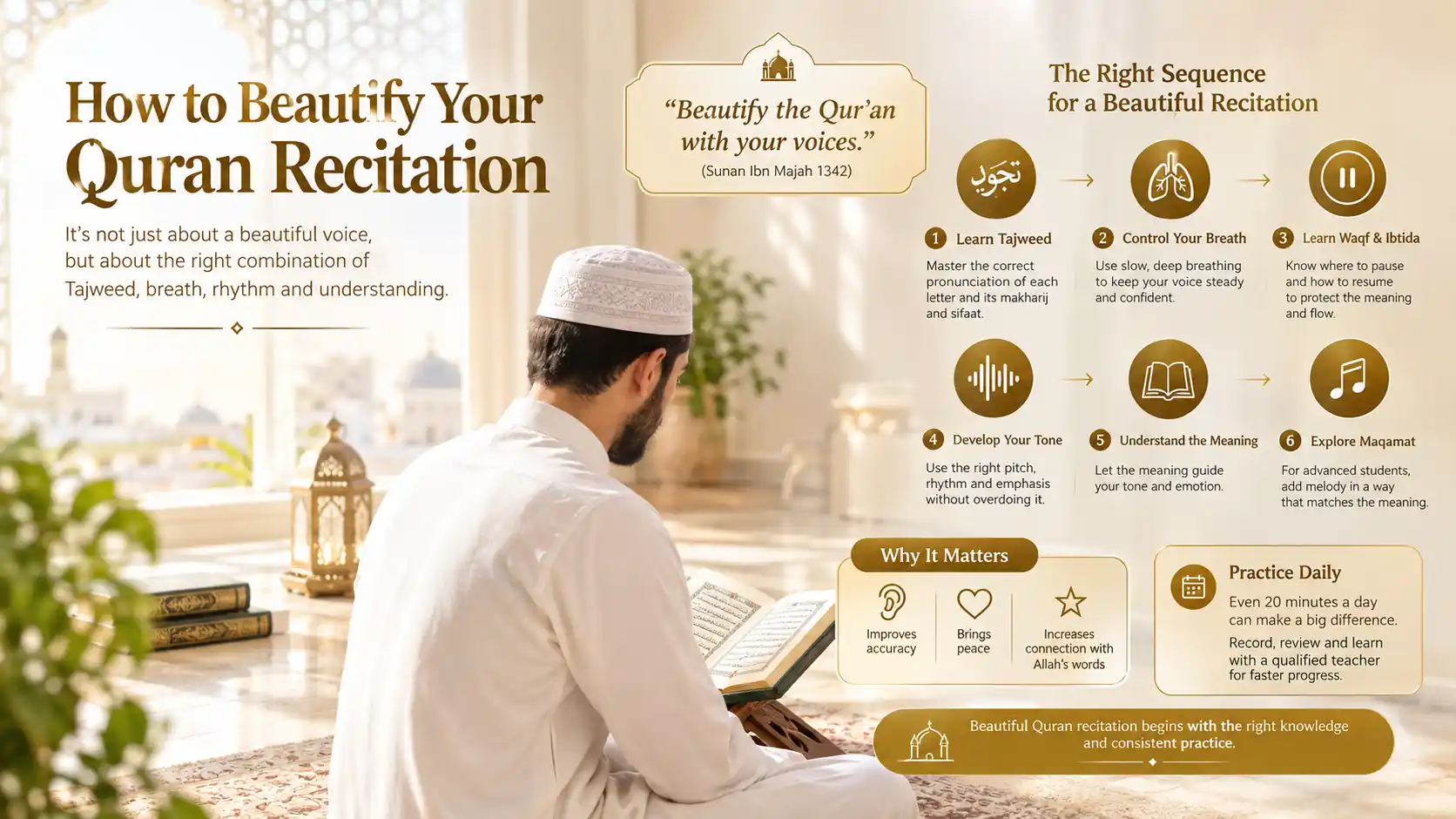
The short answer is that you must learn quran rules of tajweed and the pronunciation of letters first and then master the control of your breath and voice in your recitation, then learn the waqf and ibtida to master the pacing of your recitation
and then learn the tone of the recitation and for advanced students the quran maqamat, while keeping the quran recitation and meaning of the verse in mind. The most common reason students get stuck is to skip the voice technique before learning Tajweed.
How to beautify your Quran recitation in a realistic order
The order below works only if each section is solid prior to the next section – hence you will see the sequence performed rather than as a checklist to rush through.
Why Is Tajweed the Foundation of Beautiful Quran Recitation?
Tajweed is the science of the correct pronunciation of each letter and if one letter is mispronounced, the meaning of the word is completely changed; the difference between aleem (All-Knowing) and aleem (painful) depends on one throat letter. Any real solution to the question of how to beautify your Quran recitation will include accuracy as an absolute prerequisite, before even considering tone and melody.
Understanding the Importance of Tuhfat al Atfal for Tajweed
How Do Makharij and Sifaat Improve Your Recitation?
In practice, the first two steps of that sequence are makharij and sifaat. All the features of the Arabic writing system are described by makharij (articulation points) and sifaat (letter characteristics) that indicate the points and ways in which each Arabic letter is formed in the mouth and throat. When these are right, the rest of the skills of quran letter pronunciation have a strong foundation.
Automatic articulation allows the reciter to allow for attention to rhythm and tone rather than sounds.
Tajweed Course Certificate Online With Certified Quran Teachers
How Can You Improve Your Breathing and Voice Control?
After automaticity, the next step is in maintaining it, and that means breath. The ability to recite a long ayah without running out of breath or without finishing smoothly depends on breath control. Slow, deep breathing through the nose, holding the breath briefly
Then exhaling slowly and steadily while reciting develops the stamina to sustain steady, even delivery. This has a direct effect on your voice when reading the Quran, as your voice won’t be running out of breath naturally, which means it will be more steady and more confident.
Master Arabic Qalqalah Letters and Recite the Quran Correctly
How Do Waqf and Ibtida Make Recitation Smoother?
Whereas, the essential condition of the planned pausing is steady breath, and the condition of waqf and ibtida is the same. Waqf and ibtida, the rules of where to pause and how to resume, protect meaning and provide natural and planned breathing points for the reciter, rather than gasping where breath goes.
If the pause at Hasan or Kafi is not interrupted, the grammar of a sentence remains intact, and if it is restarted correctly (in terms of sukoon and handling hamzat al-wasl), the flow of a sentence will not be interrupted. Whilst many guides on how to beautify your Quran recitation skip over this step, it is a step that must be taken, as recitation without planned waqf sounds rushed despite the excellent pronunciation.
Basic Rules of Tajweed in English for Quran Recitation
How Can You Use Tone, Pitch and Rhythm Without Overdoing Them?
Once pronunciation, breath, and pausing are mastered, it’s time to focus on the level of tone. The meaning should be reflected in the tone and pitch of the words being recited: the mercy and supplication verses should be recited in a lower tone and pitch, and the weighty words should be given greater emphasis,
but not so much emphasis as to produce a change in the length or sound of a letter. The model that one should attempt to emulate is the recitation of the Quran in a measured, slow, and clear manner, as commanded by the Quran in Surah al-Muzzammil (73:4), which is not a fast recital performed with show. The aim is to express, not compete with, the text
Different Types of Quran Recitation Explained Clearly
How Does Understanding the Quran’s Meaning Beautify Your Recitation?
Tone is most easily and clearly established when it is created by a real object, meaning of the verse. In actual recitation the meaning and the recitation of the Quran go hand in hand: one who knows the meaning of a verse will naturally pause, soften, or emphasize the appropriate places, rather than forcing it.
The emotional resonance of words is real and not abstract when reading the translation before reciting it so that the voice of the reciter will react to the text. The link between the meaning and delivery is one of the most overlooked aspects of beautification in the Quran that can help those who have already developed a good knowledge of Tajweed but still sound flat when reciting the Quran.
Should You Learn Maqamat to Beautify Your Quran Recitation?
With meaning guiding tone, the last optional layer is melody itself. After firming up Tajweed. Every mode in the Quran (maqam) is used to give the music an emotional color that is appropriate to the meaning of the verse; for instance, Bayati is used for verses about Allah’s greatness, Hijaz for verses about his majesty, Saba for verses in hardship and repentance, and so on.
The introduction of maqamat before tajweed is a hindrance to how to beautify your Quran recitation and not an aid, since they change the melody and not the pronunciation or length of a letter.
Join our Online Tajweed Course and learn to recite the Quran with confidence and accuracy.
How Can You Learn from Famous Quran Reciters Effectively?
Building maqam awareness, like any of these stages, is easier with a reliable reference point. Listening to skilled reciters is one of the fastest ways to internalize correct sound before you can produce it yourself.
Building a habit to listen to Quran reciters like Al-Husary for clear Bayati or Abdul Basit for expressive Hijaz gives you a reference for what accurate, beautiful recitation actually sounds like then imitate short phrases rather than entire surahs at first, so you can match the details precisely.
Quran Ahkam Tajweed Rules for Correct Quran Recitation
How Can You Practise Quran Recitation at Home Every Day?
It is best to listen to reciters in conjunction with your own regular recitations. The consistency of Quran recitation practice is more important than the intensity; 20 minutes of focused practice each day is more beneficial than a lengthy session done once in a while. Make it simple: have a structure every day.
First warm up with letter pronunciation drills, then read a short passage slowly with attention to quran tajweed rules, and then read the same passage again with only attention to tone and pacing. This is the way to learn Quran recitation to ingrain it in the mind and not just repeat.
Join our Online Quran Ijazah Course and earn authentic certification while mastering Quran recitation with qualified teachers.
How Can You Record and Evaluate Your Own Quran Recitation?
What you actually notice is what can be improved with daily practice, and that is why it is important to record. Most reciters cannot accurately judge their own pronunciation while reciting, so recording yourself helps reduce the gap between how it feels when you recite it and the pronunciation that you actually use.
Play back at least one day after (not right away!) and look out for any letters sounding fast or rushed, consistent mad length, and steady maqam (if using). Weekly comparisons of self-recording with a reference reciter make vague self-assessment become a practice list.
When Should You Work With a Qualified Quran Teacher?
Even careful self-recording has a limit that only outside correction can fix. As early as possible, and continuously afterward a teacher catches pronunciation errors a student can’t hear in themselves, no matter how carefully they self-record. This matters most for beginners still learning makharij, but it stays valuable for advanced reciters refining maqamat, since even experienced students drift into small habitual mistakes without outside correction.
Ijazah-certified, native Arabic-speaking tutors, like those in Quran Beauty Online’s Tajweed program, give this correction live, which is why a teacher is the single fastest route through how to beautify your Quran recitation, session by session.
What Are the Most Common Mistakes That Make Quran Recitation Less Beautiful?
Common misconceptions tend to group together in the same few areas for all teachers. The common errors are to hurry through verses without placing the waqf, add melody to the recitation before it is correct, have the length of the madd between repetitions be inconsistent
and have the recitation not be conjoined with the meanings of the words. Less obvious is copying a favorite reciter’s exact vocal register instead of working within your own quran recitation voice : this will almost always reduce clarity and will be one of the quickest ways of losing real progress in beautification of the Quran recitation.
Join our Quran Memorization Course Online and memorize the Holy Quran with confidence through personalized guidance from qualified teachers.
How Long Does It Take to Improve Your Quran Recitation?
The time can be shortened by avoiding those errors, but it will vary from student to student. In another few months, after regular practice with the teacher, most students will realize that their pronunciation is becoming more accurate; however, it usually takes a year or more of diligent work to master tone, breath control, and any maqam work. Progress isn’t linear typically, tajweed accuracy will improve the quickest
whereas natural-sounding tone and rhythm will take longer, as they rely on habit as well as knowledge, so it’s good to know this before judging others’ pace when it comes to how to beautify your quran recitation.
What Is Makhraj in Tajweed? A Complete Beginner’s Guide
A Simple 30-Day Plan to Beautify Your Quran Recitation:
With the structured plan instead of open-ended practice time, that timeline becomes concrete. A month-long program, centered on the sequence below, can have a significant impact on the tone of your recitation:
- Days 1-7: Remind on makharij and sifaat, read short surahs slowly, letter by letter.
- Days 8-14: Continue breath control exercises and continue waqf/ibtida on the same surahs.
- Day 15-21: Note down recitations each day and compare with a reference reciter.
- Days 22-30: Recite, paying attention to meaning and tone, and adding some maqam awareness if your tajweed has already been established.
The monthly repetition of this cycle with a teacher monitoring the improvement is a feasible way to achieve the long-term improvement and will be one of the most practical quran recitation tips, no matter what you are currently doing.
Start learning Quranic Arabic with Noorani Qaida Online and build a strong foundation in correct pronunciation and Quran reading.
Improve Your Quran Recitation With Expert Guidance:
Quran Beauty Online takes a structured approach to Quran recitation, helping students develop foundational reading and Tajweed skills before progressing toward more advanced recitation techniques. Its live Tajweed program provides teacher-guided how to practice quran recitation and real-time correction, allowing learners to identify pronunciation errors, improve application of Tajweed rules, and build greater consistency through regular Quran recitation practice.
Beautiful Quran recitation develops through accurate Tajweed, consistent practice, controlled breathing, and careful attention to meaning. Quran Beauty Online provides live Tajweed classes where students can practice pronunciation, makharij, waqf, pacing, and recitation with direct teacher feedback. Book a free trial class and start developing your recitation through structured, personalized instruction.
Frequently Asked Questions
Do I need a naturally beautiful voice to recite the Quran well?
No. There is no need to have a naturally melodious voice to recite the Quran beautifully. Accurate Tajweed and pronunciation, proper breathing, good pacing, and regular practice are more important. As they practice, reciters can develop their delivery within a comfortable range of notes and vocal abilities.
What’s the best starting point for beginners who want to beautify their Quran recitation?
Beginners should start by learning correct Quran recitation, Makharij, Sifaat, and the basic rules of Tajweed before focusing on melody. A strong pronunciation foundation allows students to develop breathing, pacing, tone, and expressive delivery without building habits based on incorrect pronunciation.
Is it acceptable to recite the Quran with melody, or should it stay plain?
Reciting the Quran with a pleasant voice and controlled melodic expression can be part of beautiful recitation, as long as Tajweed remains correct. Melody should never distort pronunciation, change required lengths, or compromise the rules of Quranic recitation, clarity, meaning, or proper articulation.
How often should I get feedback from a Quran teacher?
Students should receive feedback regularly as they develop their Quran recitation skills, especially in pronunciation and Tajweed. Frequent correction helps prevent mistakes from becoming habits. Advanced reciters can also benefit from periodic evaluations to identify issues with pronunciation, pacing, breathing, or Tajweed application.