Begin Your Quran Journey Today
Book a FREE trial class with a certified Quran teacher. No payment, no commitment.
A tajweed course certificate is proof that a certified teacher listened to your recitation and confirmed you apply the rules correctly. A Quran Ijazah goes one step further: it permits you to teach and transmit the recitation. At Quran Beauty Online, you can earn either one through live, one-on-one sessions with Ijazah-holding teachers. This guide covers how each credential works, what the curriculum covers, how assessment runs and how long it takes.
Not every certificate carries the same weight. Before you enroll anywhere, check 3 things: the teacher holds their own Ijazah with a documented sanad, the assessment is live and oral, and the teacher holds Ijazah in the riwaayah being certified.
What is the difference between a tajweed course certificate and a Quran Ijazah?
A tajweed course certificate confirms you have learned the rules and can apply them. A Quran Ijazah confirms you can transmit the recitation to others. They are different credentials, so choose your goal before you start.
What does a tajweed course certificate prove?
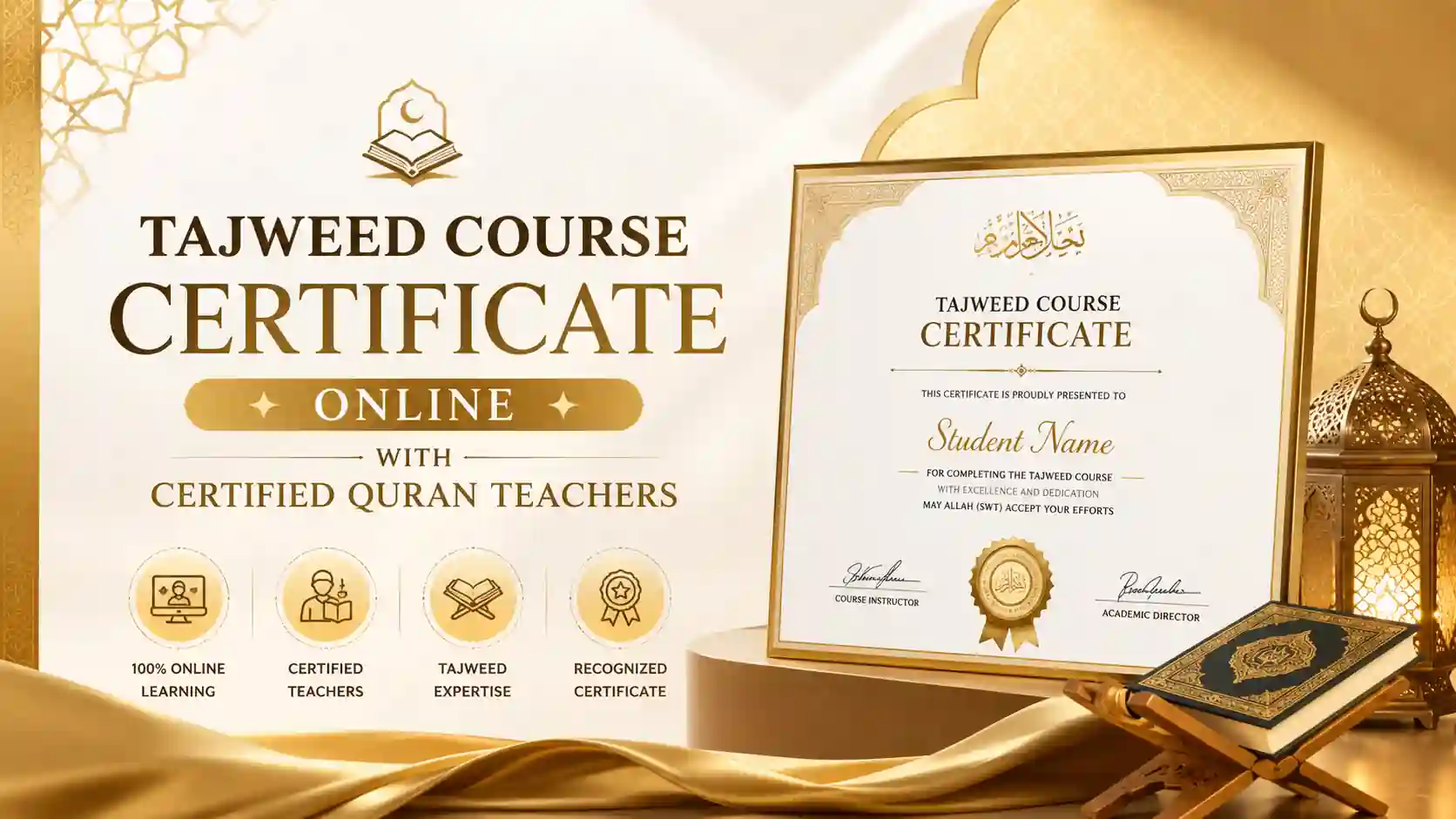
A tajweed course certificate online is issued after you finish a structured Tajweed program and pass a live oral assessment with a qualified teacher. Many mosques, Islamic centers and weekend schools accept it as proof of verified study, not self-study or video watching.
What makes a Quran Ijazah different?
A quran tajweed ijazah course leads to a higher credential. You recite the complete Quran, or a full riwaayah, usually from memory, to a teacher who holds their own Ijazah. That teacher then grants you a sanad: a documented chain of transmission that reaches back to the Prophet ﷺ.
The certificate shows you have learned. The Ijazah shows you can pass it on. At Quran Beauty Online, the same student can earn both, at different stages.
Hams Letters in Tajweed Complete Guide for Quran Recitation
Why does a tajweed course certificate matter?
A tajweed course certificate turns the intention to recite correctly into something a teacher has checked. Without formal study and assessment, most students never know for sure whether their recitation is right. Here are 4 reasons it matters.
It follows the command to recite with Tarteel
Allah ﷻ says in the Quran: “And recite the Quran with measured recitation (Tarteel).” (Surah Al-Muzzammil, 73:4). Tarteel depends on understanding and applying the rules of Tajweed. A tajweed course certificate shows you have studied those rules with a teacher and been checked on them.
It gives you confidence to recite in front of others
Many Muslims read the Quran with quiet doubt about their pronunciation and hesitate to recite in Salah or in front of family. A live oral assessment replaces that doubt with feedback from a certified teacher who has heard you recite.
Understanding the Importance of Tuhfat al Atfal for Tajweed
It opens the door to teaching
The Prophet ﷺ said: “The best of you are those who learn the Quran and teach it.” (Bukhari). A recognized quran recitation certificate or Ijazah gives you verified standing to teach children, adults or community groups.
It is an act of worship
The Prophet ﷺ also said: “The one who is proficient in the Quran is associated with the noble, righteous scribes.” (Bukhari and Muslim). Improving your recitation is worship, not only an academic goal.
Who is this program designed for?
It is designed for anyone who recites the Quran and wants to recite it correctly, from complete beginners to students ready for Ijazah.
| Student Type | Starting Point | Program Goal |
|---|---|---|
| Complete Beginner | No Tajweed knowledge | Certificate after foundations + rules |
| Intermediate Learner | Can read but has errors | Certificate after correction + refinement |
| Advanced Student | Solid Tajweed foundation | Ijazah in Hafs an Asim or Ten Qiraat |
| Aspiring Teacher | Wants to teach Quran | Certificate or Ijazah for credibility |
| Sisters | Prefer female teachers | Female-scholar-led certification track |
| Parents / Kids | Family learning | Structured, age-appropriate curriculum |
Beginners do not need any Arabic. Your teacher assesses your level in the first session and builds the program around where you are now, not around a generic syllabus.
Explore more about Online Tajweed Course for Sisters with Female Teachers
What does the tajweed course curriculum cover?
The curriculum has 7 stages, taught in order from your first lesson to the oral assessment. Here is what the advanced tajweed eLearning course covers.
Foundation: what Tajweed is and why it matters
The first module explains what Tajweed means and why, according to most scholars, applying its rules is an obligation for every Muslim who recites the Quran. You also learn the difference between Lahn Jalee (a major mistake that changes the meaning) and Lahn Khafee (a minor mistake that affects quality).
Islamic Special Religious Education for Quran and Islamic Learning
Makharij Al-Huruf: where every letter comes from
Makharij is the base of every other rule, and informal learning often skips it. You learn where each of the 28 Arabic letters originates: the throat, the tongue, the lips or the nasal passage. Step-by-step instruction, audio demonstration and repetition continue until each sound comes without effort.
Sifaat Al-Huruf: what makes each letter unique
Every Arabic letter has permanent and temporary characteristics that change how it sounds in context. This module separates correct pronunciation from approximate pronunciation. Many intermediate learners find the source of long-standing errors here.
Major and Minor Mistakes in Tajweed Every Reciter Must Fix
Noon, Meem and Tanwin rules
Noon Saakin and Tanwin have four rules: Idhar, Idgham, Iqlab and Ikhfa. Meem Saakin has three. You practice each rule in real Quranic words from the first session of the module, never in artificial isolation.
Qalqalah, Madd and elongation rules
Qalqalah applies to five letters. Madd has several types, including Madd Tabee’i, Madd Munfasil, Madd Muttasil and Madd Laazim. Your teacher corrects you in real time in every session. These rules control the rhythm and flow of your recitation.
Explore more about Best Islamic Online Courses for Quran Arabic and Islamic Studies
Advanced rules: Tafkheem, Tarqeeq and Waqf
This stage covers the heaviness (Tafkheem) and lightness (Tarqeeq) of letters, the rules for Laam and Ra’, and the full rules of Waqf (stopping) and Ibtida’ (starting) that decide how you pause and resume.
Full recitation practice and formal assessment
In the final stage you apply every rule to longer Quranic passages while your teacher corrects you, until your recitation meets the assessment standard. The assessment is always oral and live, never a written test.
Master Arabic Qalqalah Letters and Recite the Quran Correctly
How does the tajweed course certificate assessment work?
The assessment is oral and live, and it is conducted directly with your certified teacher. It is the only format that checks the quality of your actual recitation.
You recite to your teacher. Your teacher listens, corrects errors and checks that you apply every Tajweed rule to the required standard. Tajweed has been transmitted this way for over 1,400 years, from teacher to student, voice to voice.
For the tajweed course certificate online, you recite selected passages with all studied rules applied correctly and consistently. For the online quran ijazah program, you recite the complete Quran, or the complete riwaayah, without error, to a teacher whose own Ijazah is documented and verified.
A written multiple-choice test can show that you know the rules. A live oral assessment shows that you can recite them.
Explore more about Online Hifdh Program for Quran Memorization and Revision
Is an online tajweed course certificate recognized in the USA?
Usually yes, if it comes from a program with Ijazah-holding teachers and a live assessment. Recognition depends on who issued the certificate, not on whether you studied online or in person. Mosques and Islamic centers ask who issued it and whether that teacher holds an authenticated Ijazah.
At Quran Beauty Online, every teacher who issues a tajweed certification online holds a verified Ijazah with a documented, traceable sanad. That chain gives the certificate its religious authority, and it is the first thing to verify when you choose any Tajweed certification program.
Explore more about 7 Proven Steps to Master Noon Sakinah Rules in Tajweed
What qualifications must a teacher have to issue a valid tajweed certificate?
The teacher must hold their own Ijazah with a documented, unbroken chain of transmission back to the Prophet ﷺ. This is the basic requirement of authentic Quranic scholarship, not a formality.
The sanad shows that the teacher’s recitation was approved by a qualified teacher before them, who was approved by the teacher before them, back through the generations. Without it, a certificate is an opinion, not an authenticated credential.
The teacher must also hold Ijazah in the specific riwaayah they certify. A teacher with Ijazah in Hafs an Asim can certify Hafs. The ten qiraat ijazah certification needs a teacher with verified Ijazah in each of the ten paths, which is why few online programs can offer it.
At Quran Beauty Online, every certifying teacher meets both requirements. Their sanad is available for review before you enroll.
Basic Rules of Tajweed in English for Quran Recitation

Hafs an Asim or Ten Qiraat: which certification path is right for you?
Start with Hafs an Asim. Move to the Ten Qiraat only after you have completed Hafs.
Hafs an Asim tajweed ijazah: the standard path
The hafs an asim tajweed ijazah covers the most widely recited riwaayah in the world. It is the version in most printed Qurans and in most mosques across the USA and UK, and across much of the Arabic-speaking world. It is the right starting point for nearly every student.
Completing your Hafs Ijazah lets you teach, lead recitation and continue into the Ten Qiraat if you choose. It is a complete credential on its own.
Different Types of Quran Recitation Explained Clearly
Ten Qiraat ijazah: for advanced students only
The ten qiraat ijazah certification covers all ten authenticated methods of reciting the Quran. Each has its own rules and its own chain of transmission back to the Prophet ﷺ. It takes a long time and suits only students who have already completed their Hafs Ijazah.
Quran Beauty Online offers the Ten Qiraat Ijazah through teachers who hold it themselves.
Explore more about Learn Tajweed Online at Your Own Pace
How long does it take to earn a tajweed course certificate?
It depends on your starting level, how often you attend and how consistently you practice between classes. Realistic ranges:
- Complete beginners attending 2 to 3 sessions per week with daily practice typically reach certificate-ready level within several months.
- Intermediate learners often finish in a few months, depending on how many errors need correction and what type they are.
- The Ijazah takes longer. Reciting the full Quran to a qualified teacher with every rule applied consistently typically takes a dedicated student 1 to 2 years.
Your teacher assesses your level in the first session and gives you an estimate based on your actual recitation.
Quran Ahkam Tajweed Rules for Correct Quran Recitation
Can a tajweed course certificate qualify you to teach Quran?
Yes, and the credential decides how much you can teach.
A quran recitation certificate from a qualified program is the baseline many mosques, Islamic schools and weekend programs in the USA ask for before they let someone teach recitation. It shows your recitation meets a defined, assessed standard.
A Quran Ijazah goes further. It is formal permission to transmit the Quran to others through an authenticated chain. If you want your students’ recitation to join a verified chain back to the Prophet ﷺ, you need the Ijazah.
For a community class or weekend school for children, the certificate is usually the right starting credential. For formal recitation teaching at a scholarly level, the Ijazah is the standard.
What Is Makhraj in Tajweed? A Complete Beginner’s Guide
How to enroll at Quran Beauty Online?
Enrolling takes 5 steps:
- Visit the course page at Quran Beauty Online and review the programs, teacher profiles and level options.
- Choose your path: the foundational tajweed course certificate online, or the full Ijazah program in Hafs an Asim or the Ten Qiraat.
- Book your free trial. A certified teacher assesses your recitation and recommends the right program for your level.
- Select your schedule. Sessions run across all major US time zones, at many times through the day and week.
- Start learning. Sessions are live and one-on-one on Zoom, and they are recorded for review. Your teacher corrects your recitation in real time.
You can also read student reviews on Trustpilot before enrolling to see what students say about teacher quality, scheduling and recitation progress.
Conclusion
A tajweed course certificate is a verified record that a qualified teacher heard your recitation and confirmed your Tajweed. For many students it is the first stage before an Ijazah, teaching, or both.
Quran Beauty Online offers Ijazah-certified teachers, live one-on-one instruction and oral assessment at every level, from complete beginner to Ten Qiraat, for students across the world. Start with one free session so a teacher can check your recitation and recommend the right path.
Book your free trial at Quran Beauty Online today and take the first step toward reciting the Quran the way it was revealed.
Frequently Asked Questions
Can I enroll in a tajweed course certificate program with zero Arabic knowledge?
Yes. The foundational program starts with Arabic letter recognition, basic pronunciation and articulation points, then moves into the Tajweed rules. You do not need any prior knowledge of Arabic reading or grammar.
Are there female-only tajweed course certificate programs available for sisters?
Yes. Women are taught only by certified female scholars who hold their own authenticated Ijazah. Every session is private and one-on-one.
What’s the difference between a free online Tajweed course and a certified program?
Free resources such as YouTube channels, PDFs and apps are useful for exposure. They offer no teacher interaction, no real-time correction, no assessment and no recognized credential. A certified program gives you live correction from a qualified teacher, a structured curriculum and a certificate or Ijazah that mosques and Islamic institutions recognize.
What are the fees for tajweed course certificates and Ijazah programs at Quran Beauty Online?
Pricing depends on the number of sessions per week and the program you choose. Full pricing is on the Pricing page at quranbeautyonline.com. A free trial session is available before you commit.
How do I verify that a tajweed certification program has an authentic chain of transmission?
Ask the program for the teacher’s sanad before you enroll. Every link in the chain should be named and verifiable. A legitimate Ijazah program will share this documentation. If a program cannot or will not, treat that as a red flag.
Does a tajweed course certificate improve my pronunciation even if I’ve been reciting for years?
Yes, often significantly. Many long-term reciters have pronunciation habits that nobody has ever formally corrected. Live one-on-one sessions with a certified teacher identify those habits and fix them one by one, which informal recitation rarely does.