Begin Your Quran Journey Today
Book a FREE trial class with a certified Quran teacher. No payment, no commitment.
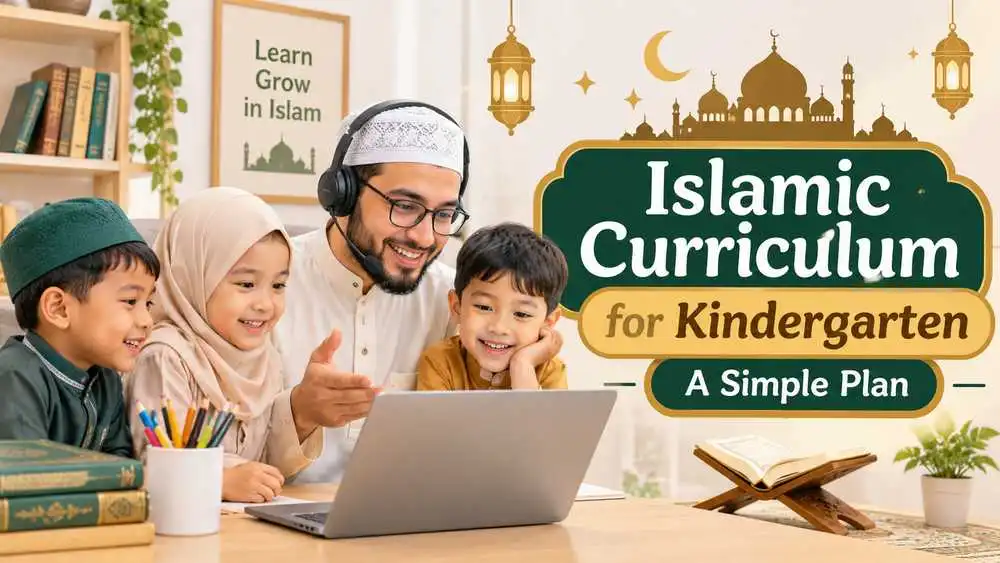
An Islamic curriculum for kindergarten provides a nurturing introduction to Islamic beliefs, Quran learning, and good manners. Children aged five and six learn best through stories, songs, and play, so short daily lessons are more effective than long sessions. Whether planning at home or in the classroom, you’ll find this guide helpful to know what to teach, how to schedule it, what activities are appropriate for children aged 5, and how to monitor progress without getting overwhelmed.
What Is an Islamic Curriculum for Kindergarten?
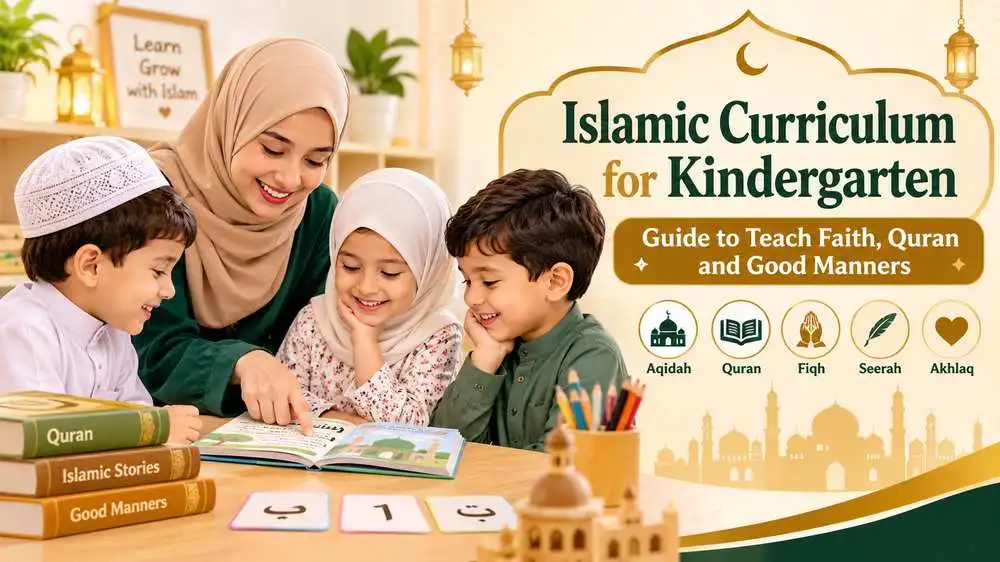
Islamic curriculum for kindergarten is an easy-to-implement plan for the teaching of faith, Quran skills, prayer, and good manners to young children in short daily lessons.
It is similar to an Islamic preschool curriculum; basic Islamic beliefs are first, then the Quran, then daily practices and character, one small step at a time.
Why Early Islamic Education Matters for Young Children
The importance of Islamic education from a young age is because habits and love for faith are formed during the first years of life.
Early childhood development thrives on repetition and delight, and early childhood spiritual development in early childhood s nurtured daily through small actions, such as saying bismillah before eating. Consistent acts come with an Islamic curriculum for kindergarten.
What Subjects Should Be Included in a Kindergarten Islamic Curriculum?
The five subjects are the subject matter of a kindergarten Islamic curriculum and are to be taught in tiny steps as follows:
| Subject | What children learn |
|---|---|
| Aqidah | Allah is One |
| Quran and Arabic | Letters and short surahs |
| Fiqh | Duas, wudu and salah |
| Seerah | Stories of the prophets |
| Akhlaq | Manners and kindness |
Teaching Aqidah to Kindergarten Children: Introducing Allah and the Basics of Iman
Begin with one thought: Allah is One; He created everything, and He loves us.
Children learning about allah best through what they see, such as rain, trees, and food.
Then, teach the six articles of iman (faith) one a week and the five pillars of Islam after the basics seem familiar.
This is the first block of any Islamic curriculum for kindergarten.
What Is a Sanad in Islam? Meaning, Types and Importance
Quran and Arabic Learning: Introducing Letters and Basic Recitation
The first step is the learning of the 28 letters with short vowels, then the study of the quran recitation for beginners.
Letters and vowels and short joining are learned in the Noorani Qaida online course.
Help from a live teacher since each sound is corrected in real time.
Continue this series of an Islamic curriculum for kindergarten with a couple of letters per week.
What Does Islam Say About Judgement Day? Signs and Events
Short Surahs for Kindergarten Children: Memorization and Simple Meanings
Start with surah al fatiha, then surah al ikhlas, surah al falaq and surah an nas as they are short and are frequently used in prayers.
| Surah | Verses | Simple meaning |
|---|---|---|
| Al-Fatiha | 7 | Praise and guidance |
| Al-Ikhlas | 4 | Allah is One |
| Al-Falaq | 5 | Asking Allah for protection |
| An-Nas | 6 | Asking Allah for protection |
Our Quran memorization course keeps each new portion short and welcomes children from age 6.
Memorization fits an Islamic curriculum for kindergarten best in tiny portions.
Islamic Knowledge for Kids at Every Age and Stage
Teaching Fiqh Through Daily Duas, Wudu, and Basic Islamic Practices
Teach fiqh in practice; little duas, simple acts of wudu, and basic acts of salah basics a little here, a little there.
- Bismillah before eating and alhamdulillah afterwards.
- Perform wudu: hands, mouth, nose, face, arms, head, and feet.
- Learn the five prayers that are said daily and pray with parent.
In the Islamic curriculum for kindergarten, the practice of Islam should be taught before the rules.
Seerah Stories for Kindergarten: Introducing the Prophets and Their Lessons
Read some short stories about the prophets, one story for each lesson: Nuh and patience; Ibrahim and trust in Allah; Yusuf and forgiveness; Muhammad and kindness.
Islamic story is effective if presented in a gentle voice with the picture, then followed by 1 question at the end.
For young eyes, visual learning resources, such as picture books, are essential to keep their eyes on the story; Islam is the curriculum that is carried by the story in kindergarten.
What Is Isnad and Matn? Understanding Hadith Science
Islamic Values and Akhlaq: Building Good Manners from an Early Age
Give one akhlaq and adab at a time, one practice for each, daily:
| Manner | Daily practice |
|---|---|
| Salam | Greet the family when you enter |
| Respect for parents | Say please and thank you |
| Honesty | Tell the truth after a mistake |
| Sharing | Share a snack |
These manners turn an Islamic curriculum for kindergarten into character.
How to Create a Balanced Islamic Homeschool Schedule for Kindergarten
Make a schedule of short blocks (10-15 minutes) throughout the day:
- Morning: letters or one short surah.
- Mid morning a story or an aqidah lesson.
- Afternoon: an activity of play.
- Prayer times: Basics of salat with family.
- Evening: Dua + Manners recap.
Remember to modify the timing, so the Islamic curriculum fits with other subjects in the kindergarten.
Play-Based Islamic Learning Activities for 5-Year-Olds
5-year-olds learn best through doing; provide hands-on learning activities like crafts and 5-year-olds’ games:
- Hunt for hijaiyah lettersdoing;d the house.
- Construct a mosque using blocks.
- Perform wudu by using a toy.
- Fill in a daily prayer chart.
Play keeps an Islamic curriculum for kindergarten joyful.
Can I Recite Quran on My Period?
How to Adapt an Islamic Kindergarten Curriculum to Local School Requirements
Make adjustments by assigning Islamic studies as a separate block next to compulsory courses. Follow four steps:
- Refer to your local requirements for core subjects and hours.
- Embed Islamic lessons before/after other lessons.
- Connect similar skills, e.g., letters, counting, and islamic storytelling
- Maintain a straightforward record of activities.
Islamic Studies for 5 Year Olds Complete Learning Guide
Choosing Islamic Books, Learning Materials, and Online Educational Resources
Select books with pictures, short flash cards and an interactive educator instead of lengthy text or unsupervised video.
| Resource | Best for |
|---|---|
| Picture storybooks | Stories of the prophets |
| Letter flashcards | Hijaiyah letters |
| Audio recitation | Listening |
| Live online lessons | Correction |
Our Arabic language course uses stories, repetition and short quizzes for children, which suits an Islamic curriculum for kindergarten better than older-grade texts.
How to Track a Kindergarten Child’s Progress in Islamic Studies
Track progress by setting one weekly goal and using one simple checklist:
- Choose one of the goals for each week, for example, a new letter or surah.
- Write down the letters, surahs, duas, and manners learned.
- Have your child demonstrate this.
- Seek feedback from the teacher on a weekly basis.
- Celebrate each milestone.
Monitoring maintains an Islamic curriculum for kindergarten on track.
Islamic Special Religious Education for Quran and Islamic Learning
Book a free trial class
Start tonight with bismillah before dinner and one short surah. Then book a free trial class so a teacher can set your child’s level and plan.
Why trust this guide? Quran Beauty Online teaches live one-to-one classes with native Arabic teachers trained in Al-Azhar.
Ms. Dalia Abdelazim Khatab specializes in beginner students, and Ms. Nameer Abdelhamid Mahros holds a B.A. from Al-Azhar’s Faculty of Arabic Language and has taught since 2017.
FAQ About Islamic Education for Kindergarten Children
Is an Islamic curriculum for kindergarten possible without speaking Arabic?
Yes, it is possible for a child to start in kindergarten an Islamic curriculum that is not taught in Arabic. They can learn Arabic letters and sounds, with lessons being explained in English. Teachers can pick up the pace of introduction of surahs, duas and Islamic concepts according to the pace of each child.
Can I choose a male or female teacher?
Yes. A male or a female teacher can be requested during the registration. Prior to the start of classes the academy can discuss your choice and the instructors who may be available, so that your child and family can find an arrangement that suits everyone during their time of learning.
How much do online classes cost?
Prices for monthly plans vary from $28 to $70, depending on the number of classes. There are between 2 and 5 live classes each week, each being 30 minutes long. You should check with the academy to ensure fees and plans are available before making a commitment.
Is there a free trial class?
Yes. There is no card required and the first class is free. For those who opt for a paid plan, the academy claims that they’ll provide a 7-day money-back guarantee. Check the terms before you register to make sure you know the conditions.