
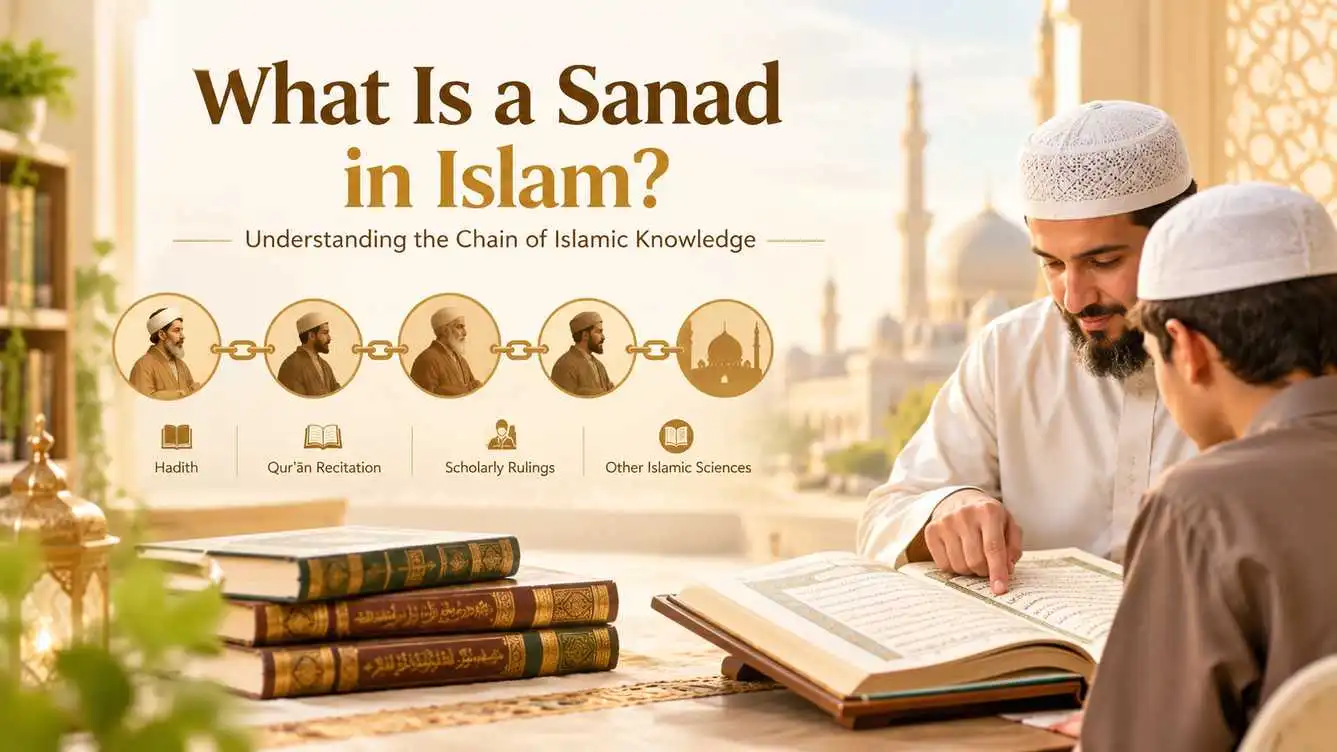
What Is a Sanad in Islam? It is the continuous flow of narrated names or teachers from a piece of religious knowledge, such as a Hadith, or a recitation of the Qur’ān, or a scholarly ruling, to the place where it comes from. Each sanad is made to be checked, on a case-by-case basis, rather than accepted on faith. This guide provides an explanation of the sanad definition, the various types of sanad, and why it is still relevant to Islamic learning today.
What Is a Sanad in Islam?
In essence, what is a Sanad in Islam? A documented, uninterrupted chain of transmitters along which knowledge, likened to the recitation of the Quran or hadith, flows from generation to generation. The sanad used in Islam means “support” from the Arabic verb “sanna,” which is used to validate or invalidate the authenticity of a narration.
What Is the Linguistic and Technical Meaning of Sanad?
The word “sanad,” meaning in islam something elevated and reliable” in Islam, is used by Arabs to describe a person whose word is reliable. In the sense of Hadith sciences, sanad does not mean the hadith text per se, but it means the list of narrators that come before the hadiths.
What Is the Difference Between Sanad, Isnad, and Matn?
In some instances, Sanad and Isnad are used interchangeably, with a few scholars making a distinction between the two. Usually one talks about the chain itself when one speaks of sanad; what is isnad is really the act of attributing the report to the chain.
Every Hadith consists of two parts, the sanad, which refers to the chain of narrators, and the masanad and matn tn, the form or content of the Hadith. The quickest way to comprehend what a Sanad is in Islam according to the term of what we call in the tradition of the Hadith
to understand the three of them together. The fastest way to understand What Is a Sanad in Islam, according to the term of what we call in the tradition of the Hadith, is to understand the three terms together.
| Term | Meaning | Role in Hadith Studies |
|---|---|---|
| Sanad | The chain of narrators or teachers through whom Islamic knowledge or a Hadith has been transmitted. | Shows the sequence of individuals responsible for transmitting the report from its original source. |
| Isnad | The act of attributing or linking a report to its chain of narrators. | Focuses on connecting the Hadith or report to the individuals who transmitted it. |
| Matn | The actual text, wording, or content of the Hadith. | Represents the message or information being transmitted through the chain. |
In simple terms: The Sanad identifies who transmitted the knowledge, the Isnad refers to the process of linking the report to that chain, and the Matn is the actual content of the Hadith.
Why Is Sanad Important in Islamic Scholarship?
Sanad is important because it made the transmission of sanad of hadith a science that can be verified and checked, rather than simply word of mouth. Authors tested the memory, honesty, and possible contact with the next narrator for each narrator, and assigned a rating to each report based on the strength of the hadith chain of narration.
This system enabled generations of scholars to distinguish truthful from false reports with genuine rigor. If there were no sanad, Islamic scholarship would not have a way of verifying the truthfulness of Prophetic (as) guidance from later added inventions.
How Is Sanad Used to Verify Prophetic Hadith?
The process of verification by sanad adheres to a predictable template, which has been worked out by the scholars over the centuries:
- Trace all narrators by name back to the Prophet ﷺ.
- Examine the reliability of each narrator: memory, honesty and reputation of other narrators.
- Verify a possible link between each of the narrators and the preceding one.
- Compare the sanad with other chains with the same or similar matn.
- Based on these findings, classify the hadith as authentic, fair, weak or fabricated.
How Do Hadith Scholars Evaluate a Sanad?
Scholars assess a sanad of a hadith by a clearly established set of criteria that are applied to each link:
- Continuity (Ittisal): ascertainment of whether each narrator met the one preceding him/her directly.
- Integrity (ʿAdalah): confirming the narrator’s moral uprightness and honesty.
- Accuracy (Dabt): the ability of the narrator to remember and repeat the report accurately.
- Lack of concealed faults (ʾIllah): ruling out minor faults only noticed by experts.
- Freedom from irregularity (Shudhudh): making sure the report doesn’t contradict stronger narrations.
Quran Memorization Course Online
What Are the Types of Sanad in Hadith Studies?
There are several types of sanad, depending upon the length of the chain, according to hadith scholars. If no narrators are missing in a Muttasil (connected) sanad, then a Munqati’ (broken) sanad is where one or more links are missing.
When a Mursal sanad is recorded, it omits the Companion and goes from the Successor to the Prophet ﷺ; a Mu’allaq (hanging) sanad omits the earliest narrators altogether. All the categories have an impact on the weight that scholars apply to the hadith when answering What Is a sanad in Islam about that particular hadith.
What Is a Continuous Sanad and Why Does It Matter?
A sanad, or Muttasil, is a continuous chain of teachers who are connected with each other without any breaks. It is valued by scholars because a continuous transmission allows for the easier verification of reports.
Continuous sanad is a chain of qualified teachers for Quranic recitation, which indicates that the reciter has memorized the reading in such a way that it has been transmitted to him by an uninterrupted chain of qualified teachers, thereby enhancing confidence in the accuracy of the transmission and preservation of the reading.
What Does Islam Say About Judgement Day? Signs and Events
What Are High and Low Sanads (Sanad ʿĀlī and Nāzil)?
A high sanad (ʾĀlī) has fewer narrators between the person who narrates it to you and the Prophet ﷺ, the scholars find this to be stronger because there is less room for errors. So when a low sanad (Nāzil) has more links in the same chain.
it is a longer and less direct route to the same source. Not all of them are weak, as all Nazil chains may be perfectly authentic, but ʿĀlī chains have always been valued and sought after by the travellers, scholars. This is evident in every discussion concerning What Is a Sanad in Islam at a high and comparative level.
What Is Isnad and Matn? Understanding Hadith Science
What Is the Relationship Between Sanad and Quranic Ijazah?
A ijazah sanad for the Qur’ān is the basis for an Ijazah in the Qur’ān. what is ijazah, Ijazah is a formal permission, which is given by the teacher once he has verified the student’s recitation. This record of teacher-to-teacher transmission, which takes the student’s learning back through the generations, is the sanad; the Ijazah is an official authorization in light of this verified transmission.
Can I Recite Quran on My Period?
Is Sanad Limited to Hadith and the Quran?
No, sanad is not just the recitation of hadith and the Quran but also in other branches of Islamic study. Their own chain of reasoning is followed to earlier authorities for the fiqh rulings, Tafsir interpretations, and even some of their devotional practices.
When a serious student enquires: What Is a Sanad in Islam, the candid reply is that it is a field by no means. This is why the scholars who issued the sanad certificate have multiple lines for different Islamic sciences.
Islamic Studies for 5 Year Olds Complete Learning Guide
Why Is Sanad Considered Important for Preserving Islamic Knowledge?
Sanad is regarded as a central document, as it is the one that has safeguarded Islamic knowledge from centuries of possibilities of getting distorted. Each of the names in the chain has individual responsibility: A teacher’s name is directly associated with his or her accuracy when passing it on.
This built-in test would prove to be much more effective at preventing careless or even dishonest transmission than any single written record would. Conserving this system is one of the most evident and useful answers to What Is a Sanad in Islam and why it has survived for 1400 years without change.
Islamic Special Religious Education for Quran and Islamic Learning
What Are Common Misconceptions About Sanad and Isnad?
The first is the notion that sanad and isnad are always and everywhere used in a strict and universal way, which is actually not the case, since most scholars use them interchangeably. Another is that all chains with a “sanad certificate” now are as strict as classical chains’ verification in the past, where standards may differ from one institution to another.
Others mistake a short chain for automatic weakness; a Nazil sanad can be equally authentic as a shorter ʿĀlī sanad. It is important to remove these misunderstandings if anyone wants to give himself the correct answer to the question. What Is a Sanad in Islam?
Best Islamic Online Courses for Quran Arabic and Islamic Studies
How Does Sanad Remain Relevant in the Age of Digital Islamic Knowledge?
Today Sanad is still present in the way that several concrete practices have continued with the tradition in modern learning:
- The chains are now recorded and verified through video sessions in online Ijazah programs.
- Students can view a teacher’s lineage in published sanad records before they enroll.
- Digital hadith databases cross-reference chains, which previously needed to be done by physical manuscripts.
- The teacher remains directly accountable because his/her name is bound to a public sanad that relates to the transmission.
Revelation Recording and Memorisation of the Holy Quran Guide
How Can You Study or Obtain a Continuous Sanad Today?
Here’s the general path for how to obtain sanad in Quran recitation or Hadith transmission:
- Master the underlying subject first: solid Tajweed for Quran or strong Hadith fundamentals.
- Find a certified teacher with a documented, verifiable chain of their own.
- Complete the required recitation or study to the teacher’s satisfaction, in full.
- Receive the Ijazah, which formally adds your name to the sanad chain.
- Maintain accuracy in everything you transmit, since your own reputation now carries the chain forward.
Why must muslims pray 5 times a day?
Learn Quran With a Verified Sanad
Choosing the right teacher matters when pursuing Quranic recitation and Ijazah. Look for qualified instructors who can explain their training, demonstrate a documented chain of transmission, and provide direct correction throughout your learning journey. Studying through live, one-on-one instruction gives you the opportunity to build accurate recitation under consistent teacher supervision and understand the scholarly tradition behind your sanad.
If you’re ready to strengthen your Quran recitation and work toward an Ijazah with sanad, book your free trial class and begin learning with a qualified teacher today.
Frequently Asked Questions
What is a sanad in Islam?
Sanad is a line of teachers or narrators through which Islamic knowledge is passed on. It links a student to qualified teachers in Quranic recitations from one generation to the next. It provides a documented chain of transmission and helps establish how the recitation was received.
What is the difference between sanad and isnad?
The word sanad is used to denote the lineage of teachers through which knowledge or the recitation of the Quran was passed on. Ijazah is the official permission given by a qualified teacher who has assessed the student. The Ijazah documents the permission in Quran study, while the sanad records the line of transmission.
How can I obtain a Quran Ijazah with sanad?
The usual requirements for obtaining a Quran Ijazah include studying with a qualified teacher, memorizing or reading the Quran accurately, and completing the required memorization or recitation. The teacher will assess the student and, if qualified, issue an Ijazah and record the chain of transmission.
Why is a continuous Quran sanad important?
A continuous sanad shows that Quranic recitation was passed through an uninterrupted chain of teachers and students. It provides a clear record of how the recitation has been received and taught from generation to generation.