

Table of Contents
Why must muslims pray 5 times a day? Every day, Muslims perform Salah five times. This act of worship is the most consistent and central in Islam. But why five times? Why at these specific moments? What is the deeper meaning behind this practice that shapes the daily lives of nearly two billion Muslims worldwide? The answers connect to a remarkable night in history and influence every moment of a believer’s life. Let’s dig deep into this topic and explore the details.
The Quranic Verses That Command the 5 Daily Prayers
The Quran does not list the five prayers by name in a single verse. Instead, it references Salah repeatedly throughout — over 700 times in various forms — establishing it not as a single instruction but as a constant, living thread running through the entire revelation.
Several key verses establish the obligation directly:
Surah Al-Baqarah 2:238 “Maintain with care the prayers and the middle prayer, and stand before Allah devoutly obedient.” The middle prayer referred to here is understood by scholars to be Salat Al-Asr, and the specific mention of it signals the importance of protecting every prayer, not just the convenient ones.
You can read the full verse and translation on Quran.com to understand the command to guard the prayers.
Surah Hud 11:114 “Establish prayer at the two ends of the day and at the approach of the night. Indeed, good deeds do away with misdeeds.” This verse points to Fajr, Maghrib, and Isha — three of the five prayers — by their time periods.
Surah Al-Isra 17:78 “Establish prayer at the decline of the sun until the darkness of the night and the dawn of dawn. Indeed, the recitation of dawn is ever witnessed.” This verse covers Dhuhr, Asr, Maghrib, Isha, and Fajr across its description of the day’s movements.
Surah Ta-Ha 20:14 “Indeed, I am Allah. There is no deity except Me, so worship Me and establish prayer for My remembrance.” This is perhaps the most direct statement of Salah’s purpose in the entire Quran.
Since Salah is closely connected to Quran recitation, beginners may also benefit from understanding how many Juz are in the Quran and how the Quran is divided for regular reading.
The Story of How the 5 Daily Prayers Were Ordained in Islam
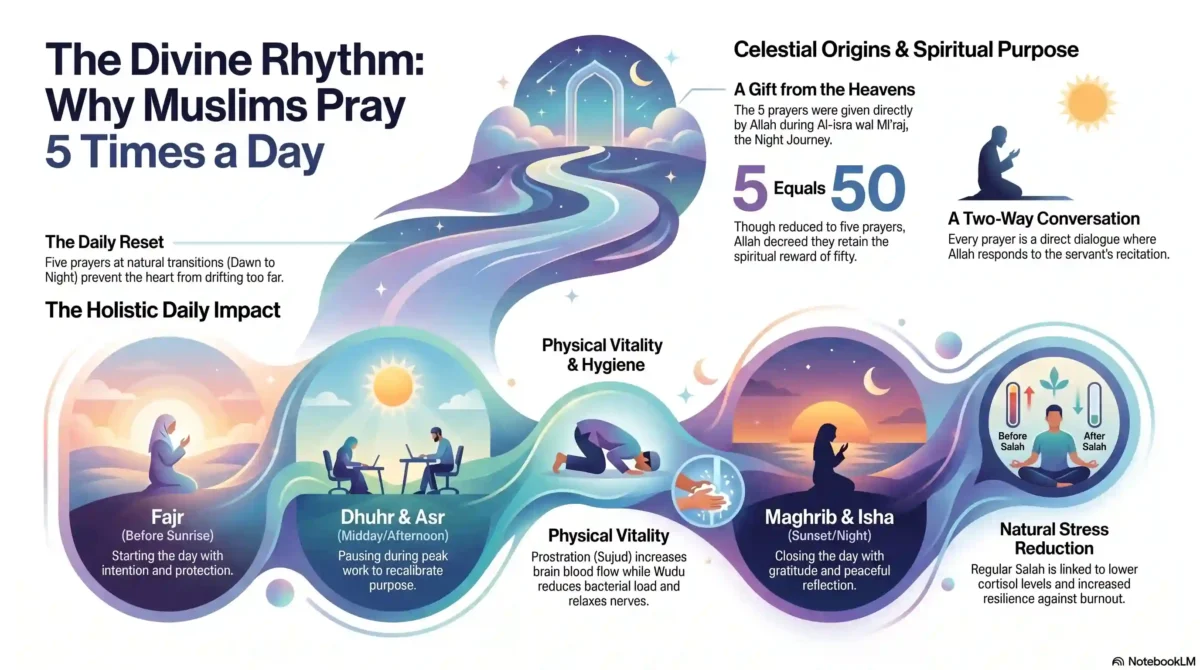
The five daily prayers hold a unique status in Islam. Unlike all other commandments, which were delivered via the Angel Jibreel (Gabriel), the prayers were given directly by Allah to the Prophet Muhammad ﷺ during the night of Al-Isra wal Mi’raj (The Night Journey and Ascension).
This historic event unfolded during Aam al-Huzn (the Year of Grief), a time when the Prophet ﷺ was at his lowest human point, having just lost his beloved wife Khadijah and his protective uncle Abu Talib, alongside facing brutal rejection in Ta’if.
Readers who want to verify the narration of the five prayers during Al-Isra wal Mi’raj can review the hadith in Sahih al-Bukhari.
The Journey and the Gift
- The Isra: The Prophet ﷺ was miraculously transported from Makkah to Masjid Al-Aqsa in Jerusalem, where he led all previous Prophets in prayer.
- The Mi’raj: He ascended through the seven heavens to the Sidrat al-Muntaha (the Lote Tree of the Uttermost Boundary)—a point so high that even Jibreel could not pass.
There, beyond the limits of creation, Allah commanded fifty daily prayers.
A Mercy Negotiated
As recorded in Sahih Al-Bukhari, on his descent, the Prophet ﷺ met Prophet Musa (Moses), who urged him to return and ask for a reduction, knowing humanity could not bear such a heavy burden.
The Prophet ﷺ went back and forth until Allah reduced the requirement to five daily prayers. Yet, out of divine generosity, Allah decreed:
“I have passed My order and have lessened the burden of My worshippers.”
The five daily prayers retain the spiritual reward of fifty. Ultimately, they are not a burdensome obligation, but a gift of mercy negotiated with love at the highest point of the heavens.
Why Must Muslims Pray 5 Times a Day — Spiritual Wisdom Explained
The honest answer to this question is the simplest one: because Allah ﷻ commanded it, and that alone is sufficient for a believer. But Allah ﷻ rarely commands without wisdom — and the wisdom behind the five daily prayers runs deep.
Salah is remembrance, not ritual. Allah ﷻ says in Surah Ta-Ha: “Establish prayer for My remembrance.” The human heart is forgetful. The world is loud and relentless. Without regular interruption, an entire day — an entire life — can pass without a single genuine moment of awareness of Allah. The five prayers are divine interruptions, placed at the natural transitions of the day, to pull the heart back before it drifts too far.
It establishes the relationship between servant and Lord. Every prayer begins with Surah Al-Fatiha, which is described in Hadith as a conversation between the servant and Allah ﷻ. When you recite “It is You we worship and You we ask for help”, Allah responds directly. The prayer is not a monologue — it is a dialogue. Five times a day, the door to that conversation is opened.
It is the measure of the believer’s day. The Prophet ﷺ said: “The first thing the servant will be held accountable for on the Day of Judgment is the prayer. If it is sound, the rest of his deeds will be sound. If it is corrupt, the rest of his deeds will be corrupt.” (Tabarani) Salah is not one act among many — it is the act by which all other acts are measured. A day built around prayer is a day built around Allah ﷻ. Everything else falls into place around that centre.
It is a cleansing, not just a duty. The Prophet ﷺ asked his Companions: “If a man had a river at his door and bathed in it five times a day, would any dirt remain on him?” They said no. He replied: “That is the example of the five prayers — through them Allah wipes away sins.” (Bukhari and Muslim) Each prayer is a reset — a wiping of the slate, a return to purity before the day continues.
If you want to understand the meaning of Salah, Islamic worship, and daily Muslim practices in a deeper way, our Islamic Studies course online can guide you step by step.
The Physical and Mental Benefits of Praying Five Times a Day
Modern research has increasingly confirmed what Muslims have lived for fourteen centuries. Salah is not just spiritually nourishing — it benefits the body and mind in measurable, documented ways.
Physical Benefits
- Low-Impact Exercise: Standing, bowing, and sitting in Salah provide 10 to 20 minutes of moderate physical activity five times a day, supporting cardiovascular health and blood pressure regulation.
- Musculoskeletal Strength: Prostrating (Sujud) at least 34 times daily strengthens the neck, back, and limbs. Notably, Sujud uniquely increases blood flow to the brain.
- Hygiene & Relaxation: The pre-prayer ritual of Wudu (ablution) minimizes bacterial load while naturally relaxing the nervous system to lower stress.
Mental & Psychological Benefits
- Stress Reduction: Studies show Salah significantly lowers cortisol (stress hormone) levels. By focusing exclusively on worship, the mind gets an emotional reset that prevents anxiety accumulation.
- Enhanced Well-Being: A systematic review links regular prayer to increased hope, resilience, happiness, and a stronger desire to live—even among patients recovering from illness.
- Built-in Mindfulness: In a fast-paced world, the five daily prayers act as a vital, non-prescription defense against burnout, offering structured moments of stillness, purpose, and connection.
How the Five Prayers Structure a Muslim’s Entire Day
Rather than a rigid schedule, the five daily prayers align with the natural cycle of light, work, and rest, structuring the believer’s day around divine connection.
- Fajr (Before Sunrise): Starts the day with intention rather than distraction, placing the believer under Allah’s explicit protection before the world makes its demands.
- Dhuhr (Midday): Provides a mandatory pause at the peak of work and distraction, forcing a recalibration of purpose before returning to daily tasks.
- Asr (Late Afternoon): Arrives when energy dips and focus wavers. Singled out in the Quran for extra care, missing it is warned against as a severe, negligent loss.
- Maghrib (Just After Sunset): Marks the conclusion of the day’s labor with gratitude, prioritizing remembrance before evening meals or rest.
- Isha (Night): Acts as the final deed before sleep, ensuring the day is perfectly bookended in the presence of Allah.
What Happens Spiritually When You Miss a Prayer?
Muslims often ask about the consequences of missing a prayer out of quiet guilt. The reality carries deep spiritual weight, but also immense divine mercy.
- Abandonment vs. Missing a Prayer: The Prophet ﷺ warned that the habitual abandonment of Salah edges a person toward disbelief. However, occasionally missing a prayer due to sleep, forgetfulness, or temporary negligence is fundamentally different from abandoning it entirely. As the Prophet ﷺ stated:
“Whoever forgets a prayer or sleeps through it, its expiation is to pray it when they remember.” (Bukhari)
- The Spiritual Cost: When a prayer is missed, the believer loses that specific moment’s cleansing, divine conversation, protection, and barakah (blessing). While a makeup prayer fulfills the obligation, it cannot fully recover that exact time’s unique spiritual rewards.
- The Heart that Cares: Remorse over a missed prayer is a sign of a living heart. Sincere believers may stumble occasionally, but they immediately make it up with regret. The danger lies only in habitual neglect without concern. If you feel the guilt, your heart still cares—and that is the perfect place to rebuild.
How to Build a Consistent Five-Daily Prayers Routine
Bridging the gap between knowing the importance of Salah and actually praying consistently requires a realistic, step-by-step approach.
- Start Small and Build: If you struggle with all five, do not try to fix everything overnight. Commit to one prayer on time, with focus, every single day without exception. Once that habit becomes unshakeable, add the next.
- Anchor Prayers to Your Routine: Tie each Salah to an existing daily trigger. Link Fajr to your wake-up alarm, Dhuhr to your lunch break, Asr to leaving work or school, Maghrib to sunset, and Isha to your bedtime routine.
- Leverage Technology: Use prayer apps (like Pillars, Muslim Pro, or Athan) to send automated Adhan notifications for your exact location. This removes the excuse of not knowing the time and creates external accountability.
- Remove Friction: Prepare in advance by keeping Wudu when possible, having a clean prayer mat accessible, and knowing the Qibla direction in your regular spaces. Eliminating these small barriers prevents procrastination.
- Protect Fajr First: Fajr is often the hardest to maintain, but guarding it sets the tone for the entire day. Sleep early, set multiple alarms, and make Fajr non-negotiable; the remaining four prayers will naturally become easier.
- Seek Companion Accountability: Praying with others creates shared discipline and normalizes the habit. Whether at a local masjid, with family at home, or alongside a friend, utilizing a community structure makes consistency vastly easier.
- If you struggle with consistency, you may also like our guide on learn Tajweed at your own pace online, especially if you want gradual Islamic learning without pressure.
Frequently Asked Questions
1. why must muslims pray 5 times a day and not more or less?
The five prayers were ordained directly by Allah ﷻ during the night of Al-Isra wal Mi’raj. Originally, fifty prayers were prescribed, but through a series of intercessions involving Prophet Musa عليه السلام, they were reduced to five — each carrying the reward of ten.
2. Are the five daily prayers mentioned by name in the Quran?
No, the names and exact timings of the five prayers are established through the Sunnah of the Prophet ﷺ.
3. What is the punishment for not praying in Islam?
The scholarly position is that deliberately and permanently abandoning Salah is among the gravest acts in Islam. For someone who misses prayers occasionally due to forgetfulness or difficulty, the prescribed remedy is to make them up as soon as remembered.
4. Can Muslims pray all five prayers at once?
Under normal circumstances, each prayer must be performed within its prescribed time window. However, Islamic jurisprudence allows combining certain prayers (Dhuhr with Asr, Maghrib with Isha) during travel, illness, or other genuine hardship. This allowance is itself a demonstration of Islam’s built-in mercy for the believer.
5. How long does it take to pray all five daily prayers?
Each prayer takes between 5 and 15 minutes, depending on pace and the number of optional Rakats added. The five obligatory prayers combined take approximately 20 to 30 minutes total per day.
Deepen Your Connection to Islam — Start Learning at Quran Beauty Online Today
At Quran Beauty Online, our certified teachers help students of all levels build that understanding. Whether you want to learn the correct recitation of Salah, deepen your Tajweed, understand the Arabic of what you recite in prayer, or simply reconnect with your faith through structured Islamic learning, we are here to guide you, one lesson at a time.