

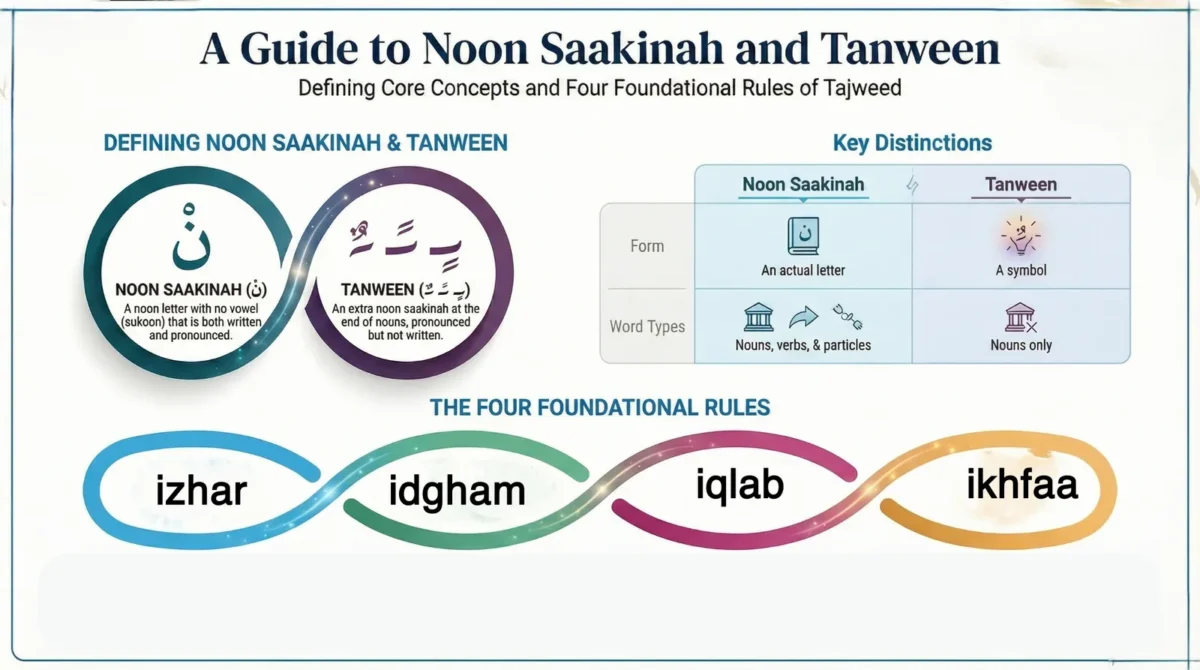
When you start learning Tajweed, mastering the Noon Sakinah Rules is one of the biggest milestones. These rules make your recitation smoother, more beautiful, and closer to how the Prophet ﷺ recited the Quran. They apply both to noon sakinah (ن without a vowel) and tanween (double fatha, kasra, or damma). Understanding them step by step will give you confidence every time you read the Quran.
Before going deeper, how familiar are you right now with basic Tajweed terms like izhar, idgham, iqlab, and ikhfa?
What Is Noon Sakinah and What Is Tanween?
- Noon Sakinah: The letter ن that has no vowel on it (sukoon) or appears at the end of a word without a harakah.
- Tanween: The “double vowel” signs in Arabic (ــًـ , ــٍـ , ــٌـ) that sound like adding an “n” at the end of the word.
Whenever a noon sakinah or tanween is followed by another Arabic letter, one of the four Noon Sakinah Rules applies: Izhar, Idgham, Iqlab, or Ikhfa. These are what people mean when they say “rules of noon sakinah and tanween.”
Can You Read Quran Without Tajweed A Complete Beginner Guide
Why Do Noon Sakinah and Tanween Share the Same Rules?
Both noon sakinah and tanween create an “N” sound in Arabic, even though one is a letter (ن) and the other is just a sign on the word. Since Tajweed deals with sound and articulation, anything that produces the “N” sound is treated the same.
That’s why the Noon Sakinah Rules always mention “noon sakinah or tanween” together, and why the same four rules apply to both.
Online Tajweed Course for Sisters with Female Teachers
The 4 Rules of Noon Sakinah at a Glance
Here are the four main Noon Sakinah Rules you must recognize while reading:
| Rule | Basic Meaning | What Happens to the “N” Sound |
|---|---|---|
| Izhar | Clear pronunciation | You read “N” clearly, no nasal stretch |
| Idgham | Merging | “N” merges into the next letter |
| Iqlab | Changing / flipping | “N” flips into a hidden “M” sound |
| Ikhfa | Hiding / partial concealment | “N” is slightly hidden with nasal sound |
What Is Izhar Halqi and When Do You Apply It?
Izhar literally means “to make clear.” Izhar Halqi means you pronounce the “N” sound clearly when it is followed by any of the six throat letters:
ء هـ ع ح غ خ
When you see noon sakinah or tanween followed by one of these letters, you:
- Pronounce the “N” sharply and clearly.
- Do not stretch the sound and do not make ghunnah (nasal hum).
This is the simplest of the Noon Sakinah Rules, because you are just “reading normally” with clear articulation.
Explore more about Online Tajweed Course for Sisters with Female Teachers
What Is Idgham and How Does Merging Work in Tajweed?
Idgham means “to merge” or “insert one sound into another.” In Tajweed, it happens when noon sakinah or tanween is followed by one of the letters in the word يَرْمَلُون (Yarmaloon):
ي ر م ل و ن
In idgham tajweed, the “N” sound disappears and is merged into the following letter, creating a single, blended sound. This merging can happen in two ways: with ghunnah and without ghunnah, which are two sub‑rules inside the Noon Sakinah Rules.
Explore more about online tajweed course
Idgham With Ghunnah vs Without Ghunnah
From the Yarmaloon letters, they are divided into two groups:
- Idgham with Ghunnah: ي ن م و
- Idgham without Ghunnah: ل ر
- Idgham with Ghunnah (ي ن م و)
- You merge the “N” sound into the next letter.
- You hold a nasal sound (ghunnah) for about two counts.
- It feels like a soft “hum” through the nose while pronouncing the next letter.
- Idgham without Ghunnah (ل ر)
- You still merge the sound, so the “N” is not heard.
- But you do not hold any nasal sound; you read it quickly and clearly.
This difference inside idgham tajweed is very important for clean, accurate recitation, and it’s a core part of the Noon Sakinah Rules.
you can Learn Tajweed Online at Your Own Pace
What Is Iqlab and How Does Noon Change into a Hidden Meem?
Iqlab means “changing” or “flipping.” In Tajweed iqlab, if noon sakinah or tanween is followed by the letter ب (baa), the “N” sound flips into a hidden “M” sound.
What you do in iqlab tajweed:
- Change the “N” sound into a meem sound.
- Close your lips gently as if pronouncing م.
- Keep a soft nasal ghunnah for two counts before pronouncing ب clearly.
This unique “N → hidden M” transformation is why iqlab is one of the most interesting Noon Sakinah Rules.
explore more about Top Online Quran Classes with Tajweed for USA Learners
What Is Ikhfa and How Do You Pronounce It Correctly?
Ikhfa means “hiding” or “concealing.” In ikhfa tajweed, the “N” sound is neither fully clear (like izhar) nor fully merged (like idgham). Instead, you partially hide it and pronounce a soft nasal sound for two counts.
Correct ikhfa pronunciation when noon sakinah or tanween meets an ikhfa letter:
- The tongue hovers near the point of articulation of the next letter but does not fully touch.
- You produce a nasal ghunnah for about two beats.
- Then you complete the next letter clearly.
This makes ikhfa feel like a “half‑hidden N” with a strong nasal character.
explore more about ijazah in Quran
What Are the 15 Letters of Ikhfa in Tajweed?
There are exactly 15 letters of ikhfa in Tajweed:
ت ث ج د ذ ز س ش ص ض ط ظ ف ق ك
Whenever noon sakinah or tanween is followed by any of these letters, you apply the ikhfa rule and hide the “N” sound with nasalization.
These 15 letters are neither throat letters (izhar) nor Yarmaloon letters (idgham) nor ب (iqlab). So all remaining letters naturally fall under ikhfa in the Noon Sakinah Rules.
How Do You Identify the Correct Noon Sakinah Rule While Reading Quran?
A simple step‑by‑step way to apply the Noon Sakinah Rules while reading:
- Find the “N” sound
- Look for noon sakinah (نْ) or any tanween at the end of a word.
- Check the next letter
- If it’s one of the throat letters → Izhar.
- If it’s in Yarmaloon → Idgham (decide with/without ghunnah).
- If it’s ب → Iqlab.
- If it’s one of the 15 ikhfa letters → Ikhfa.
- Apply the right sound treatment
- Clear, merged, flipped, or hidden with nasalization.
Reading like this turns the rules of noon sakinah and tanween into a practical skill instead of pure theory.
explore more about online Quran hifz
Common Mistakes in Noon Sakinah Pronunciation
Learn these typical mistakes so you can avoid them from the start:
- Mixing izhar and ikhfa: making a nasal sound where the “N” should be totally clear.
- Forgetting ghunnah in idgham with ghunnah or ikhfa, so the recitation loses its Tajweed depth.
- Over‑stretching ghunnah in short places, turning every noon sakinah into a long humming sound.
- Not flipping correctly in iqlab, either keeping an “N” instead of a hidden “M”, or closing the lips too early and losing clarity on ب.
As you practice, listen carefully to expert reciters to compare your application of the Noon Sakinah Rules.
explore more about our courses
Simple Quran Examples for Each Noon Sakinah Rule
Here is how examples usually work (you can later look them up in the Mushaf or audio recitations):
- Izhar: A word ending with tanween followed by a throat letter, where the “N” is heard clearly.
- Idgham with Ghunnah: Noon sakinah followed by ي or م, where the sound merges and you hear a nasal hum.
- Idgham without Ghunnah: Noon sakinah followed by ل or ر, merged but without nasal hold.
- Iqlab: Tanween followed by ب, where the “N” becomes a hidden “M” before ب.
- Ikhfa: Noon sakinah followed by any of the 15 ikhfa letters, sounding like a half‑hidden N through the nose.
Building your own list of favorite examples from the Mushaf is one of the best ways to truly master the Noon Sakinah Rules.
How Can Beginners Memorize the Noon Sakinah Rules Easily?
Here are beginner‑friendly strategies used in many Tajweed programs:
- Memorize the group names first: Izhar, Idgham, Iqlab, Ikhfa.
- Link each rule with a short keyword:
- Izhar = clear
- Idgham = merge
- Iqlab = flip
- Ikhfa = hide
- Use memory aids like Yarmaloon for idgham letters and a chart for the 15 ikhfa letters.
- Practice small Quran passages repeatedly, focusing on one rule at a time (for example, one week just for ikhfa).
The more you practice in real recitation, the more natural the Noon Sakinah Rules become.
Daily Practice Checklist for Noon Sakinah Recitation
Use this as a simple daily routine to build strong Tajweed habits:
- Recite 1–2 pages of Quran slowly, only focusing on noon sakinah and tanween.
- For every “N” sound you meet, pause mentally and identify: Izhar, Idgham, Iqlab, or Ikhfa.
- Listen to an experienced reciter of the same passage and compare rule by rule.
- Record yourself once a week and review places where you misapplied the rules of noon sakinah and tanween.
- Keep a small notebook or digital note where you write new examples for each rule: ikhfa, idgham tajweed, iqlab, and izhar.
Following a checklist like this transforms theoretical knowledge of Noon Sakinah Rules into consistent, confident recitation.
Conclusion
Mastering the Noon Sakinah Rules—izhar, idgham, iqlab, and ikhfa—turns your recitation from “just reading” into true Tajweed, where every “N” sound is treated with care and precision. Once you understand how noon sakinah, tanween, ikhfa tajweed, idgham tajweed, and iqlab tajweed work together, the Quran feels easier to read and more beautiful to listen to.
If you want structured guidance, live feedback, and step‑by‑step practice on these rules, you can book a Tajweed session and start your personalized learning journey at Quran Beauty Online today, so that every time you read the Quran, your Noon Sakinah Rules are correct and confident from the first page.
FAQ
Are Noon Sakinah Rules the same in all Quran styles (qiraat)?
In beginner Tajweed courses based on the Hafs narration, the Noon Sakinah Rules explained here apply consistently; advanced students may later learn small differences in other qiraat.
Do Ifak Hakiki and Ikhfa Haqiqi refer to the same rule?
In many teaching contexts, “Ikhfa Haqiqi” or similar terms describe the standard ikhfa of noon sakinah and tanween, while Meem Sakinah has its own separate rules (like Ikhfa Shafawi).
Can I rely only on written rules without a teacher?
Written guides to noon sakinah and tanween rules are very helpful, but listening to qualified reciters or working with a teacher is strongly recommended to correct subtle errors in ghunnah and articulation.
How important are these rules for Tajweed certification?
Any structured Tajweed program considers Noon Sakinah Rules foundational and will test your ability to recognize and apply Izhar, Idgham, Iqlab, and Ikhfa accurately.