
When you ask, “what is isnad and matn?” here’s the short answer: They are the two components every hadith is composed of: the chain of narrators and the text. Students learning the science of hadith must be able to evaluate the authenticity of hadith and be able to make a judgment on the authenticity of hadith. This guide will guide you through each part and how scholars test them as well as where you can study them properly.
What is isnad and Matn Mean in Hadith Studies?
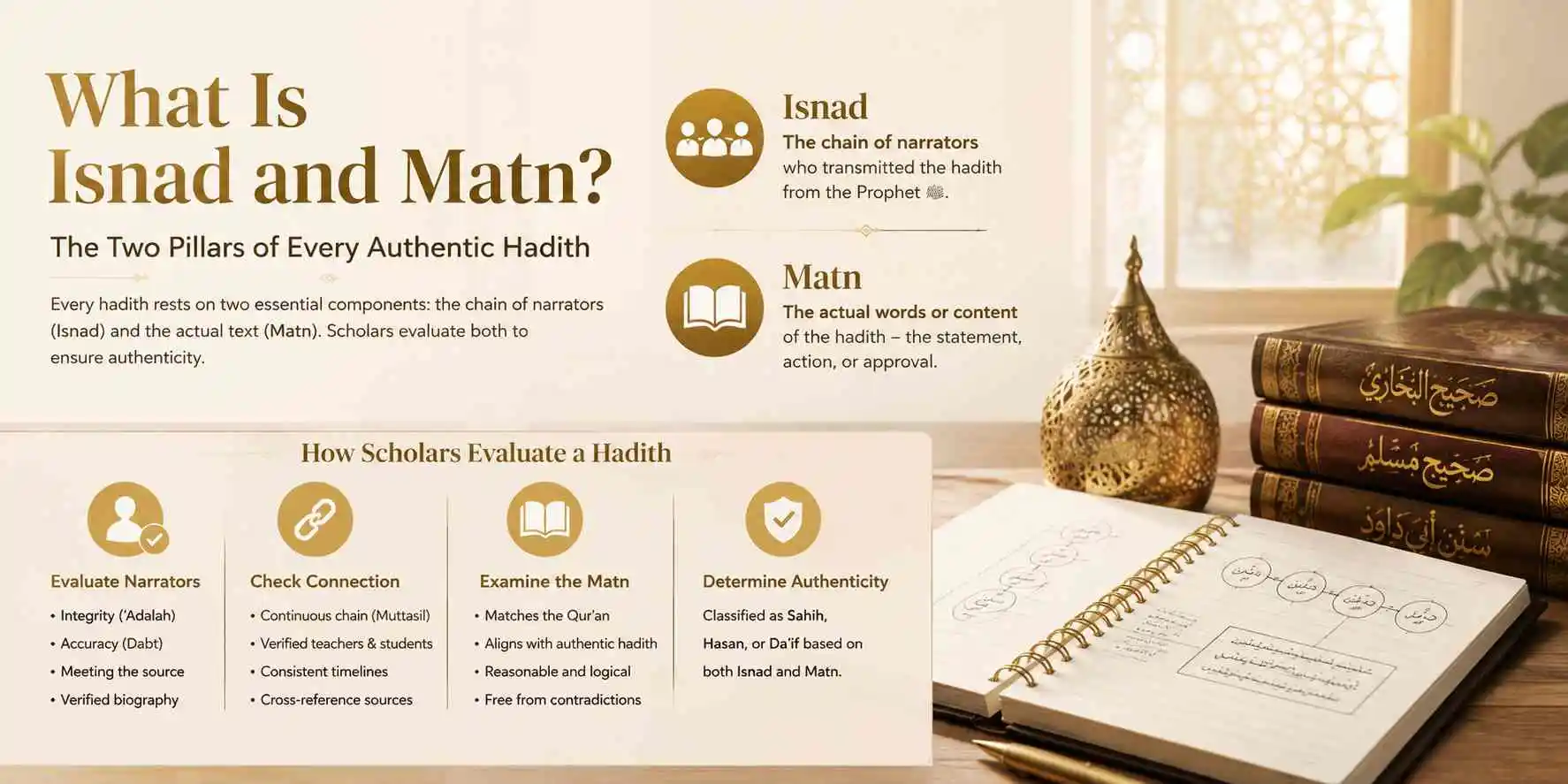
The meaning of “isnad” is “chain of narrators,” which are the people who relayed a hadith to the Prophet (saws) one after the other. The actual words or words used in the narration, the statement, action, or approval itself have matn meaning.
Together, Isnad and Matn are the subject of ilm al hadith, which studies not only what was said but also who reported it. The pair of what is isnad and matn is the starting point of every serious response to what is isnad and matn; each of these two is not sufficient with regard to the hadith verification.
What Do Isnad and Matn Look Like?
isnad meaning is a list of names that reads, “Narrated by X, from Y, from Z, who said the Prophet said…” The isnad immediately follows the sentence to be attributed to the Prophet. In all classical books of hadith, the full narration of the hadith comes first, followed by the text.
This is the first practical thing to be learned when coming to the knowledge of what is isnad and matn; recognizing this layout.
What Is the Difference Between Isnad, Sanad, and Narrator?
The terms ‘isnad’ and ‘sanad’ are used interchangeably most of the time to describe the chain of narration, but ‘isnad’ refers to ‘attributing’ and ‘sanad’ to ‘support,’ two angles on the same chain. It consists of one person (Rawi) as narrator.
Sanad differs from isnad more in terms of the language used, classical scholars talk about sanad and matn as much as isnad and matn. In the practice of hadith studies, the two terms should be used interchangeably.
| Term | Arabic | Literal sense | Technical sense in hadith studies | Example in a hadith report |
|---|---|---|---|---|
| Sanad | السند | “Support, backing” | The chain itself: the ordered list of transmitters from the final reporter back to the Prophet or Companion. | “A ← B ← C ← D” (the whole sequence) |
| Isnād | الإسناد | “Attribution, ascribing” | The act of attributing or tracing a report through its transmitters to its source; often used interchangeably with sanad for the chain. | Citing: “A narrated from B, from C, from D…” |
| Rāwī / narrator | الراوي | “One who narrates” | A single individual transmitter within the chain; plural: ruwāt. | “A”, “B”, “C”, or “D” individually |
| Matn | المتن | “Text, wording” | The actual wording or content of the report, distinct from its chain of transmitters. | “The Prophet said: ‘…’” |
Why Did the Isnad System Become Important in Hadith Transmission?
As hadiths were passed on orally over many centuries before they were put to writing, and it was easy to fabricate them, the isnad system was established. isnad in islam, no one could make a statement without verification, which is why isnad has become a method of development.
If there were no named chain, a claim referring to the Prophet could not be verified or trusted, and early scholars went great distances to verify the reliability of one narrator. Hence the importance of the question of what is isnad in hadith and what is matn in hadith, which the student of hadith first asks.
How Do Hadith Scholars Evaluate Narrators in an Isnad?
Each narrator is judged by a pre-established suite of tests before being accepted into the chain.
- Muslim, sane, mature, and morally upright is the definition of a person who is ‘adalah’ (integrity).
- Dabt: memorized or recorded the report correctly (precision)
- The meeting with the source: meeting the person they tell about.
- Biographical information for birth, death, and travelling confirmed by checking the dates against those who they say they met
This process of narrator verification by narrator is what makes it possible to verify hadiths.
How Do Scholars Determine Whether an Isnad Is Connected?
The scholars are able to establish a connected isnad (muttasil) by establishing it with the narrator in front of him by verifying every narrator and hearing him from him without interruption.
- Look at each narrator’s former teachers and students and verify.
- Verify that the duration of a story’s events is not inconsistent with the time of its narrator’s life.
- To flag for any missing link for further investigation
- When you come across a similar hadith chain of narration in multiple books, cross-reference them.
If there is a broken link anywhere, then the entire island is broken, even if the main seems to be solid.
What Is Matn Criticism and How Does It Work?
Matn criticism deals with the text of hadiths alone, aside from their chain, to see whether the wording is sound. It examines the matn against the Quran, other authentic hadiths, basic history, and basic reason
Even if the report has a good isnad, it is identified as a contradiction in comparison with these. What is meant in hadith is an important step, as much as the isnad, and most people who stop asking about the isnad and matn do not bother to ask about the meaning.
Quran Memorization Course Online
Does an Authentic Isnad Always Mean a Hadith Is Authentic?
If the matn does not withstand criticism, then it cannot be a sound basis to make a hadith authentic. Technically, a chain can be connected and trustworthy, and yet there is a defect (illah) or irregularity (shadhdh) in the text, which only a close matn analysis will show. That is why we must apply both parts at once and not separately to the question of what is isnad and matn.
How Are Hadith Classified as Sahih, Hasan, or Da’if?
According to the degree to which the isnad and matn of the hadiths fulfill the conditions for full authenticity, they are classified as sahih, hasan, or da’if.
- Sahih (authentic): The transmitting of a chain, straight and accurate narrators, that there is no irregularity or defect.
- Hasan (good): same conditions as above, but one narrator is not quite as precise
- Da’if (weak): weak chain, unreliable narrator, or a flawed matn.
This grading is the actual product of all the authenticity of the hadith process.
Why must muslims pray 5 times a day?
What Is Isnad-Cum-Matn Analysis?
Isnad-cum-matn analysis (ICMA) provides an historical approach to the question of what is isnad and matn, and how different versions of the hadith developed in parallel relate to one another. It was developed by scholars such as Harald Motzki, who analyze the changes in wording across various chains of transmission that carry the same report, regarding the changes as evidence of the history of the transmission.
Revelation Recording and Memorisation of the Holy Quran Guide
How Does Traditional Hadith Criticism Compare With Modern Academic Approaches?
The traditional critical approach is based on the narrator records of classical scholars and the modern academic approach is complemented by a set of historical-critical tools such as isnad-cum-matn analysis.
- Traditional: teachers, students, teachers, and students and teachers as narrators by way of biographical dictionaries and named teacher-student links.
- Academic: makes the comparison of two or more chains of the same report to determine when the earliest source occurred.
- Modern goal: classify a hadith in terms of its respective strength for application in religious life
- Cultural goal: to conserve and pass on heritage and knowledge. Professional goal: to relive the past for study purposes.
The two still rely on the same raw material, isnad and matn.
Best Islamic Online Courses for Quran Arabic and Islamic Studies
How Can a Beginner Analyze a Hadith Step by Step?
A beginner analyzes a hadith by applying what is isnad and matn in practice, separating the chain from the text and checking each in order.
- Write out the full chain of narrators, name by name
- Look up each narrator’s reliability in a biographical dictionary (kutub al-rijal)
- Confirm the chain is connected with no missing links
- Compare the matn’s wording against the Quran and other authentic hadiths
- Check the hadith’s existing grading in a recognized collection before concluding anything yourself
Islamic Special Religious Education for Quran and Islamic Learning
What Are the Most Common Mistakes When Studying Isnad and Matn?
The most common mistake when studying what is isnad and matn is judging a hadith by its matn alone and skipping the isnad entirely.
- Ignoring the chain : trace the full hadith chain of narration first
- Trusting a hadith because it “sounds right” : check matn criticism, not tone
- Treating hasan and da’if the same : each carries a different religious weight
- Skipping narrator biographies : verify ‘adalah and dabt before accepting any chain
Islamic Studies for 5 Year Olds Complete Learning Guide
What Are the Best Sources for Studying Isnad and Matn?
The best sources are the classical collections themselves, paired with a structured course and a qualified teacher.
- Sahih al-Bukhari and Sahih Muslim, the two most rigorously verified collections
- Biographical dictionaries of narrators (kutub al-rijal) for checking ‘adalah and dabt
- A structured Islamic studies course that walks through isnad and matn with guided practice
A qualified instructor catches misreadings self-study misses, especially the narrator-grading errors that trip up anyone learning what is isnad and matn on their own.
Can I Recite Quran on My Period?
Ready to study Hadith sciences
Quran Beauty Online’s Islamic Studies course covers Hadith alongside Aqeedah, Fiqh, and Seerah, with Ijazah-certified tutors guiding students across US time zones in live, one-on-one sessions. Start with a free trial class (no card required) and build a guided foundation in hadith sciences instead of piecing it together alone.
Ready to study Hadith sciences with expert guidance? Join Quran Beauty Online for live Islamic Studies classes and build a stronger foundation in Isnad, Matn, and Hadith methodology.
Frequently Asked Questions
What is the difference between sanad and isnad?
Isnad is the chain of narrators who passed on a hadith, and matn is the hadith text/content of the hadith. When evaluating the authenticity, weakness, and defects of a narration, hadith scholars look at both components.
Why is isnad important in hadith studies?
The importance of Isnad is that it helps scholars to examine the process in which one person passed it on to the next. The examination of narrator reliability and teacher-student relationships and continuity allows scholars to evaluate if the transmitted chain is correct in terms of the authentication standards for the hadiths.
Can a hadith have a reliable isnad but still be considered weak?
Yes. If a reliable and connected isnad is obtained, then this does not necessarily mean that all the hadiths are authentic. In addition, scholars look at the matn and question anything that appears irregular, or there may be hidden defects. Even with seemingly trustworthy transmitters, a narration may need to be further analyzed.
Can beginners study Isnad and Matn without a teacher?
For beginners, it is possible to study the rudiments of isnad and matn without any qualified guidance, but of course with it, it is very helpful. A good teacher can elucidate technical terms, explain how to evaluate narrators, and explain common pitfalls, as well as assist students in using hadith criticism responsibly and accurately.