Begin Your Quran Journey Today
Book a FREE trial class with a certified Quran teacher. No payment, no commitment.
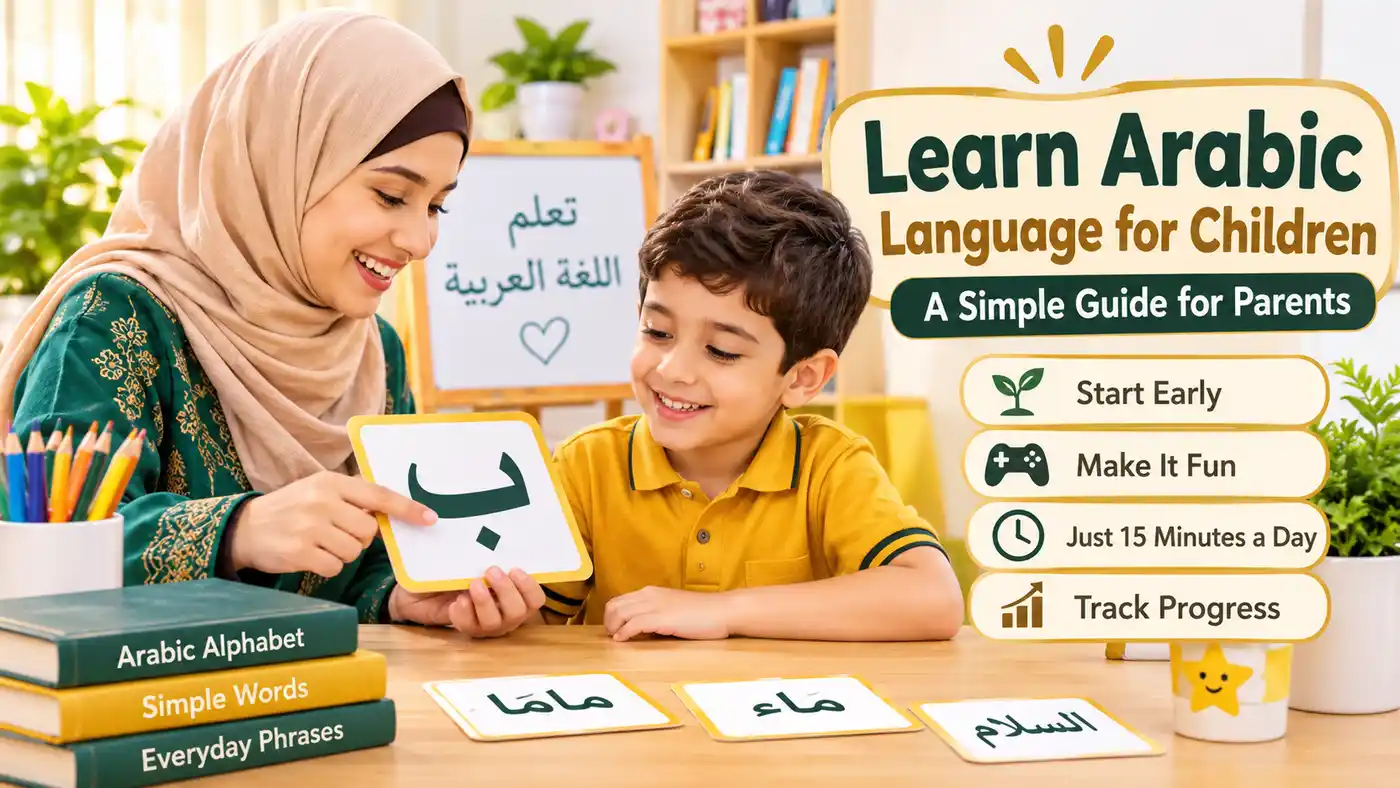
One of the questions parents ask when they want to learn Arabic language for children is where to start. The answer is quite straightforward: begin early, go short on the sessions, and ensure each lesson is played. Learning sounds, letters, and phrases can be learned much faster when it is a game, and a few minutes a day will make a difference. The best starting age, the alphabet, daily routines, tools, and progress tracking are all explained in this guide.
Why Is Early Childhood a Good Time to Learn Arabic?
There’s a good reason for starting early: If a child hears a foreign language from birth, he’s likely to be bilingual.
According to a University of Washington scientist writing for the World Economic Forum, a second language isn’t confusing to children and may be beneficial to attention and problem-solving. Language development in early childhood and bilingual language development are therefore connected, and parents who learn a language for children use this window well.
What Is the Best Age for Learn Arabic Language for Children?
The optimum age is as early as possible (children aged 2–10 most benefit).
The issue remains hotly debated; whether there is a hard cutoff, but one study indicates a gradual decline in learning ability throughout adulthood.
In a good plan to learn the Arabic language for children, it is based on the following, which is according to the age:
| Age | Main focus |
|---|---|
| 2 to 5 | Songs, sounds and Arabic nursery rhymes |
| 6 to 8 | Letters, short vowels and first words |
| 9 to 12 | Reading, writing and short sentences |
Should Children Learn Modern Standard Arabic or a Spoken Dialect First?
Most children will begin with Modern Standard Arabic, the formal form used in books.
The grammar of Classical Arabic is shared with the grammar of the Quran, and dialects are spoken forms that are learned from the family.
| Your goal | Start with |
|---|---|
| Read books and school texts | MSA |
| Understand the Quran | MSA, then Classical Arabic |
| Talk with relatives | The family’s dialect |
Our Arabic language course teaches MSA and Quranic Arabic, not dialects.
How Can Children Learn the Arabic Alphabet and Its Different Sounds?
Teach the alphabet in 5 small steps, 1 sound at a time to learn the Arabic language well for children.
- Read a few letters in turn with clear pronunciation of the Arabic letters.
- Practice sounds that are not included in the English alphabet, e.g., ع, ح,ح and q. This is an application of Arabic phonetics.
- The short vowels are added: fatha is like “a” and kasra is like “i.”
- Identify the beginning, middle, and end sounds and letter shapes of each letter.
- Read 2-letter words.
The Noorani Qaida online course follows this path with short drills.
How Can Children Develop Arabic Reading and Writing Skills Step by Step?
Children learn to read and write in 5 steps, beginning with the hand and the voice as the final step:
- Trace letters in the air, sand, or on paper.
- Write simple right-to-left letters.
- Do repeated writing practice of each letter shape (Arabic).
- Write short words that have vowel signs.
- Listen to a teacher read a short line each day. This helps develop listening skills in Arabic.
How Difficult Is It to Learn Arabic Language from Zero
What Are the Best Arabic Words and Everyday Phrases for Children to Learn First?
Use greetings, family words and polite phrases as a starting point, as children use these phrases daily.
The first words help to learn arabic language for children step by step. When they feel comfortable, introduce items from the home.
| Arabic | Sound | Meaning |
|---|---|---|
| السلام عليكم | as-salamu alaykum | Peace be upon you |
| شكرًا | shukran | Thank you |
| نعم / لا | na’am / la | Yes / no |
| ماما / بابا | mama / baba | Mom / dad |
| ماء | maa’ | Water |
How Can Parents Make Learning Arabic Fun Through Games, Stories, and Songs?
To make Arabic enjoyable, parents can make every lesson a mini game, story or song:
- Sing Arabic Nursery Rhymes in the car and during bath time.
- Learn Arabic with educational games, e.g. matching of letters.
- Read children’s picture books and have your child identify words.
- Give small prizes, such as stickers, for new words.
These are the habits that make interactive language learning a part of everyday life, and learn arabic language for children without stress.
How Long Does It Take to Learn Arabic Language At Home
Which Arabic Learning Apps and Digital Tools Can Help Children Practice?
Games to practice letter, sound, and word recognition help children to practice during the lessons but are best used between lessons.
An app can only check the answer that has been tapped; therefore, the most effective way to learn arabic language for children is to use apps along with a teacher.
| Tool type | Best for |
|---|---|
| Letter-tracing apps | Writing practice |
| Picture-and-sound games | Vocabulary |
| Audio songs and stories | Listening |
| Live online lessons | Pronunciation correction |
How Can Online Arabic Lessons Support Children’s Language Development?
Online lessons facilitate development by providing the child with live feedback, a consistent structure, and a teacher who responds at their rate.
When searching for a learn arabic language for children online app, check for these features:
- A teacher who listens to all sounds and corrects errors right away.
- No group pace to follow, only one-to-one classes.
- Storytelling, repetition, and brief quizzes.
- Weekly progress checkpoints.
All 4 are available in live 30-minute Zoom classes with Quran Beauty Online.
Online Conversational Arabic Classes for Beginners
How Can Parents Teach Arabic at Home Without Speaking It Fluently?
Parents can instruct Arabic at home without needing to be fluent; they can learn along with their children and corrections can be left to teachers:
- Read the same letters and words your child reads.
- Read and repeat with native speaker audio.
- Have your child share the learning with you.
- Do not criticize effort, just praise it.
Even without fluency, you can learn arabic language for children as a family routine.
Importance of Arabic in Islamic Studies Essential Guide
How Much Time Should Children Spend Practicing Arabic Each Day?
Short is better 15 minutes a day is enough to keep new words fresh in people’s minds, and a few minutes of songs and games for younger children is enough.
Along with the live classes, you can have 30 minutes of classes 2-5 per week and steadily learn the Arabic language for children.
How Can Parents Track Their Children’s Progress in Learning Arabic?
Parents can track progress when they learn arabic language for children with one small weekly goal and one simple check:
- Pick a few new letters or words each week.
- Ask your child to say or read them aloud on the weekend.
- Keep a checklist of letters, words and vowels known.
- Ask the teacher for weekly feedback.
- Celebrate milestones, such as a first read word.
Learn Arabic Grammar for Understanding Quran Clearly and Deeply
What Are the Common Challenges of Learning Arabic as a Second Language?
Common challenges are new sounds, right-to-left writing, vowel marks and low motivation, and each has a simple fix:
| Challenge | Simple fix |
|---|---|
| Unfamiliar sounds | Daily listening and teacher correction |
| Right-to-left writing | Trace with a finger first |
| Vowel marks | Teach fatha and kasra early |
| Low motivation | Games, songs and short sessions |
Book a free Arabic trial class
Helping a child learn Arabic does not require complicated activities or long study sessions.
Start with familiar words, introduce letters gradually, and make time for short reading, listening, and speaking exercises.
Regular practice at home, supported by suitable lessons, can help children build their skills step by step.
Quran Beauty Online provides live, one-to-one Arabic classes with native Arabic teachers.
Ms. Nameer Abdelhamid Mahros holds a B.A. from Al-Azhar’s Faculty of Arabic Language and has taught since 2017.
Mr. Osama Maged is an Ijazah-certified Quran teacher with over 8 years of experience in Quran recitation, Tajweed, memorisation, Arabic Language and Islamic Studies.
He uses interactive teaching methods and personalised lessons to help children and adults learn with confidence.
book a free Arabic trial class to introduce your child to the learning experience. A teacher can assess their current level, discuss their goals, and help identify a suitable starting point.
Frequently Asked Questions About Learning Arabic for Children
Can my child choose a male or female teacher?
Yes. There are options to choose a male or female teacher at the time of registration. Before confirming the class and starting lessons with the teacher you have selected, the academy can outline which teachers are available for your child, age, level and schedule.
Do teachers explain lessons in English?
Yes, using English when necessary to explain instructions, new words and grammar. Teachers can progressively incorporate more Arabic into activities as children grow in confidence, to ensure lessons are understood and that there is adequate opportunity for children to build listening and speaking skills at their own comfort level.
How much do online Arabic classes cost?
The prices of online Arabic classes depend on the provider, the duration of the classes, and the frequency of the classes per week. Do not sign up for a plan until you have determined the number of live sessions that come with it, and if it offers one-on-one classes, and the registration fees or other fees involved in the plan before you sign up.
Is it too late to learn Arabic language for children over 10?
No. Children aged over 10 can still learn Arabic and improve by using appropriate lessons and practicing them regularly and getting support and encouragement. They can also learn at a different rate and have different learning targets, but this does not mean that they will not acquire valuable language skills in the long run.
Is there a free trial class?
The academy has a free trial lesson, with no need to use a payment card to experience it. Before making a paid decision, get in touch with the team to check for existing trial offers and refund policies, such as eligibility and the duration of the trial.