Begin Your Quran Journey Today
Book a FREE trial class with a certified Quran teacher. No payment, no commitment.
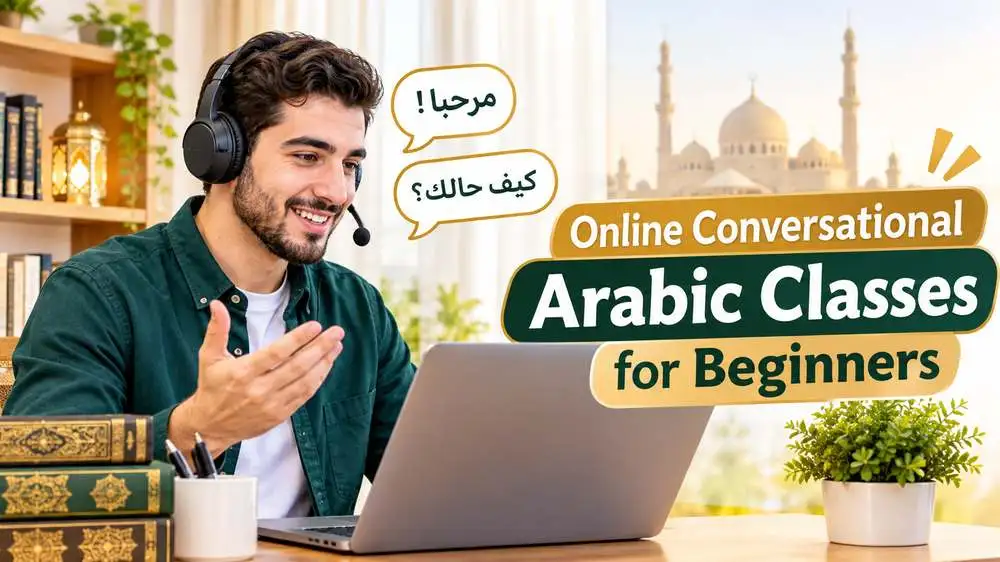
Online Conversational Arabic Classes enable you to learn conversational arabic online without having to learn the grammar tables first. You will learn greetings, questions and everyday expressions with a live teacher who corrects you on the spot! In this guide, you’ll learn what these classes involve, which dialect you should choose, how to practice in between the classes, and how fast you can progress to become a real conversationalist.
What Are Online Conversational Arabic Classes?
Online Conversational Arabic Classes are REAL, teacher-led classes for learning to speak and understand Arabic in a conversation rather than learning grammar. Talk from the first session, referring to phrases that can be used that same day. These lessons are appropriate for anyone who wishes to communicate not just to read.
Understanding Spoken Arabic and Modern Standard Arabic
The moden standard Arabic is the written form of Arabic that is used in news and speeches, and the spoken form is the everyday Arabic that is used in conversation. The formal arabic language beginners remains the same throughout the region, although spoken Arabic varies from place to place. The majority of conversational lessons concentrate on speaking Arabic before introducing formal vocabulary.
Which Arabic Dialect Should Beginners Learn First?
Beginners should learn the appropriate dialect that they will be able to communicate with most of the people they will meet with. If there’s no preference, the Egyptian Arabic is a good place to start since it’s widely understood in film and television.
| Dialect | Best For | Notes |
|---|---|---|
| Egyptian Arabic dialect | General use and wide understanding | Common first choice |
| Levantine Arabic dialect | Talking with friends and family from the eastern Mediterranean | Soft and melodic |
| Gulf Arabic dialect | Work and relationships in the Gulf region | Distinct vocabulary and sounds |
Once you choose, the lessons themselves shape how you speak.
Importance of Arabic in Islamic Studies Essential Guide
How Online Conversational Arabic Classes Help You Speak Naturally
Online Conversational Arabic Classes will teach you to speak naturally because you will be speaking in every class and any mistakes will be corrected immediately. The following are the primary advantages of:
- More speaking time: You speak rather than silently study.
- Instant feedback: Your teacher corrects your pronunciation as it is occurring.
- Natural phrasing: Hear what the natural speakers of Arabic actually say.
- Flexibility of time: Study from home when it fits you.
These benefits are noticeable very early in your first lessons.
Learn Arabic Grammar for Understanding Quran Clearly and Deeply
What Do Beginners Learn in Their First Arabic Conversation Lessons?
Beginners start with common arabic greetings , introductions, simple questions and numbers in their first lessons. These are some of the most basic Arabic greetings that you will know:
| Arabic | Pronunciation | Meaning |
|---|---|---|
| السلام عليكم | as-salamu alaykum | Peace be upon you |
| مرحبا | marhaba | Hello |
| صباح الخير | sabah al-khayr | Good morning |
| كيف حالك؟ | kayfa haluk? | How are you? |
| شكرا | shukran | Thank you |
These phrases build the foundation for the skills in the next section.
What Is Noor Al Bayan? Learn Quran Reading Step by Step
Essential Arabic Speaking and Listening Skills for Beginners
The basic skills are to speak in short sentences, comprehend slow speech, to ask questions, and to respond naturally. Beginners are found to be engaged in four aspects:
- Listen to speech in Arabic (to comprehend slowly and clearly); catch key words.
- Sentence building: Use words to make short correct sentences.
- Use questions and answers to request and answer.
- arabic communication skills: Arabic polite phrases (asking someone to repeat etc.).
Once you can hear sounds properly, you have to be able to pronounce them properly.
Best Way to Learn Fusha Arabic Ultimate Beginner Guide

Common Arabic Pronunciation Challenges for English Speakers
The hardest sounds for English speakers are ع, ح, خ, and ق, because English has no exact match for them. Arabic pronunciation improves with repeated listening and correction:
| Letter | Name | Tip |
|---|---|---|
| ع | ayn | Tighten the throat gently and voice the sound |
| ح | haa | Make a soft, breathy sound from the throat |
| خ | khaa | Make a light throat-clearing sound |
| ق | qaf | Say a “k” from deeper in the back of the throat |
Mastering these sounds also makes it easier to speak without fear.
Arabic language origin tree Complete Guide to Its History
How to Build Confidence When Speaking Arabic
Encouraging through frequent speaking even with simple sentences, and accepting errors as a learning process. Follow these steps:
- Use phrases that you will use in your conversations.
- Regularly talk out loud, including to oneself.
- Have your teacher pretend to be in actual situations.
- Record yourself and listen to your recordings.
- Tolerate and persevere with errors.
When practice follows practice, confidence will increase at the greatest rate.
Learn Arabic Online Classes with Qualified Tutors
How to Practice Arabic Conversation Between Online Lessons
Doing the exercises between lessons helps you to memorize and reinforce the new words, phrases, and sentences, and listen to short recordings of them every day. Here are the steps for practising conversation in Arabic:
- Do the phrases in the lesson within 1 day.
- Say them out loud for 10 minutes.
- Stand by and listen to short sentences and repeat them.
- Discuss with a friend who is one of the native Arabic speakers that you know.
- Give new words to write in a notebook and correct weekly.
No matter how much you know, you should always work in a way that reflects your goals.
How to Choose the Right Learning Approach for Your Arabic Goals
Decide which strategy aligns with your purpose, be it travel, work, family or faith. Follow these steps:
- Explain your reason for speaking Arabic.
- Match the goal with a dialect or with the formal language.
- Select either private lesson or group.
- Ensure teacher provides verbal feedback.
- To explore the different choices for Online Conversational Arabic Classes, and then book a trial lesson.
If your goals include the Quran, a Quran memorization online program can complement your spoken Arabic study. Many learners then ask how soon they will see results.
How Long Does It Take to Improve Your Arabic Speaking Skills?
It depends on lesson frequency, daily practice, and the dialect you choose, so there is no single fixed timeline. This table shows what shapes your progress:
| Factor | Effect on Progress |
|---|---|
| Lesson frequency | More regular lessons build skills faster |
| Daily practice | Short daily speaking beats occasional long sessions |
| Dialect choice | A focused dialect gives quicker everyday results |
| Prior exposure | Familiar sounds make pronunciation easier |
Most beginners notice basic conversation first, then smoother speech with steady practice.
Online Conversational Arabic Classes for Adults and Different Learning Goals
Online Conversational Arabic Classes suit adults because lessons adapt to busy schedules and personal goals. Common learner types include:
- Professionals: Learn workplace phrases and polite conversation.
- Travelers: Focus on directions, food, and daily needs.
- Family learners: Speak with relatives in their dialect.
- Faith learners: Build vocabulary alongside Quran study.
With goals this varied, here are answers to the most common remaining questions.
Start Speaking Arabic with Confidence
Quran Beauty offers online Arabic lessons with qualified teachers who help students develop practical speaking and listening skills. Whether you are a complete beginner or want to improve your pronunciation, lessons focus on everyday conversations, useful vocabulary, and personal feedback to help you communicate more naturally in Arabic.
Take the first step towards speaking Arabic with Quran Beauty. Join online conversational Arabic lessons tailored to your level and learning goals. Practice real-life conversations, improve your pronunciation, and learn at your own pace with guidance from a qualified teacher. Ready to start? Join Online Conversational Arabic Classes today, and explore our Quran memorization online program if you also want to study the Quran with a teacher.
Book a free trial class and begin building a stronger foundation for academic research.
FAQs
Are Online Conversational Arabic Classes Suitable for Complete Beginners?
Yes. Beginner lessons start with greetings, introductions, and simple everyday phrases, so no previous Arabic knowledge is required. Teachers adjust lesson difficulty to each student’s level, helping complete beginners develop speaking and listening skills gradually through regular arabic conversation practice.
Do I Need to Learn the Arabic Alphabet First?
No. You can start speaking Arabic using transliteration to understand pronunciation without learning the alphabet first. However, learning Arabic letters later helps you read words correctly, recognize sounds more accurately, and develop stronger speaking and reading skills.
Can I Switch Dialects Later?
Yes. You can switch Arabic dialects as your communication needs change. Many dialects share common vocabulary and grammatical features, making the transition easier. However, you will still need practice to understand regional expressions, pronunciation differences, and everyday conversational patterns.
Is Group or Private Learning Better for Speaking?
Private lessons provide more individual speaking time, direct correction, and lessons matched to your level. Group classes offer opportunities to hear different speakers and practice conversations with others. Your choice depends on your budget, learning preferences, and need for individual feedback.