
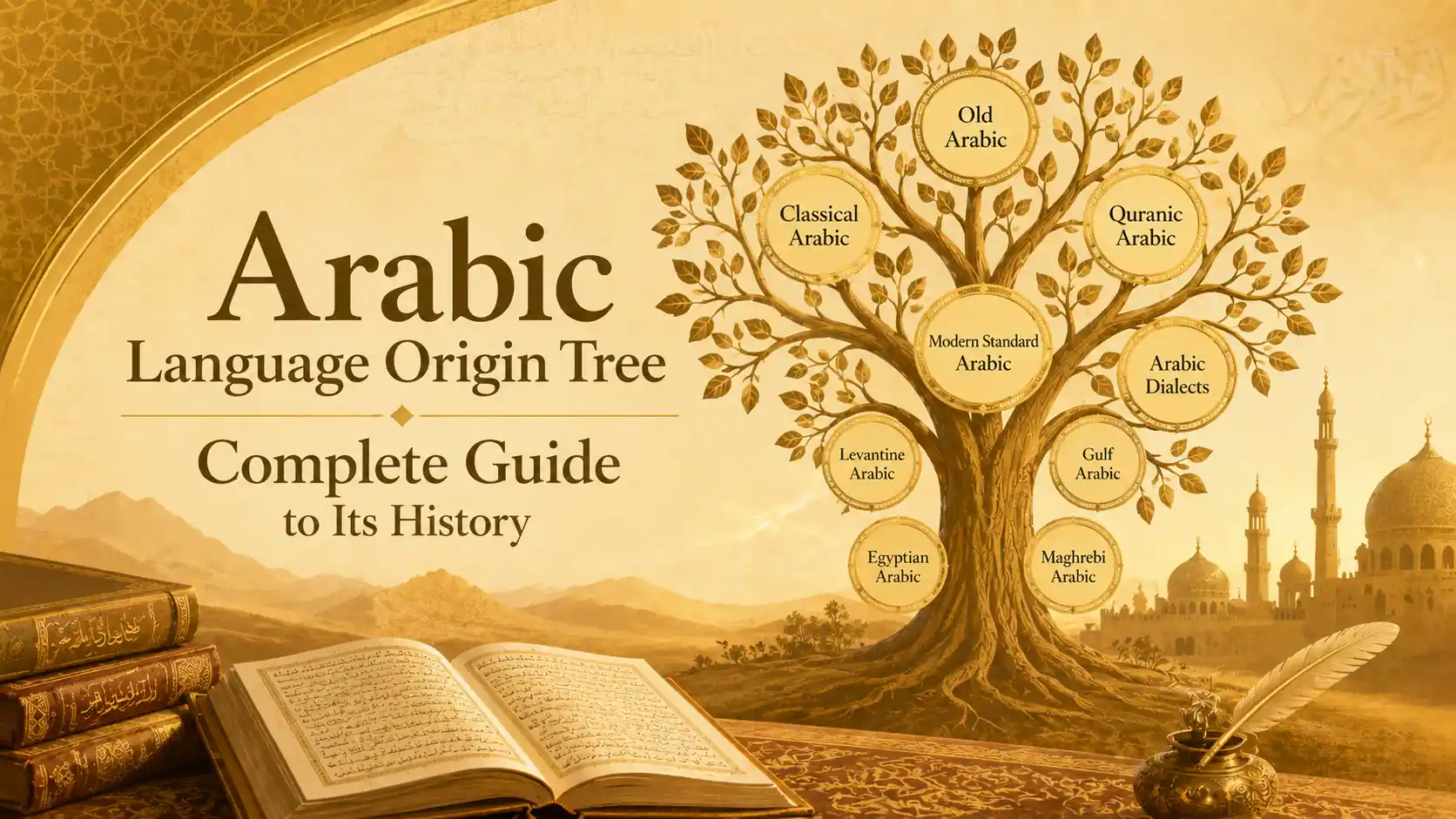
The Arabic language origin tree shows one of the most widely spoken languages of the world through thousands of years of Semitic history. Most speakers can only speak Arabic in terms of the Quran or everyday speech, not the actual roots or the history of the Arabic language that it comes from. This guide outlines the entire Arabic language origin tree, from Proto-Semitic origins to the Old Arabic inscriptions to the Modern Standard Arabic of today in simple terms and with source references.
What is the Arabic language origin tree?
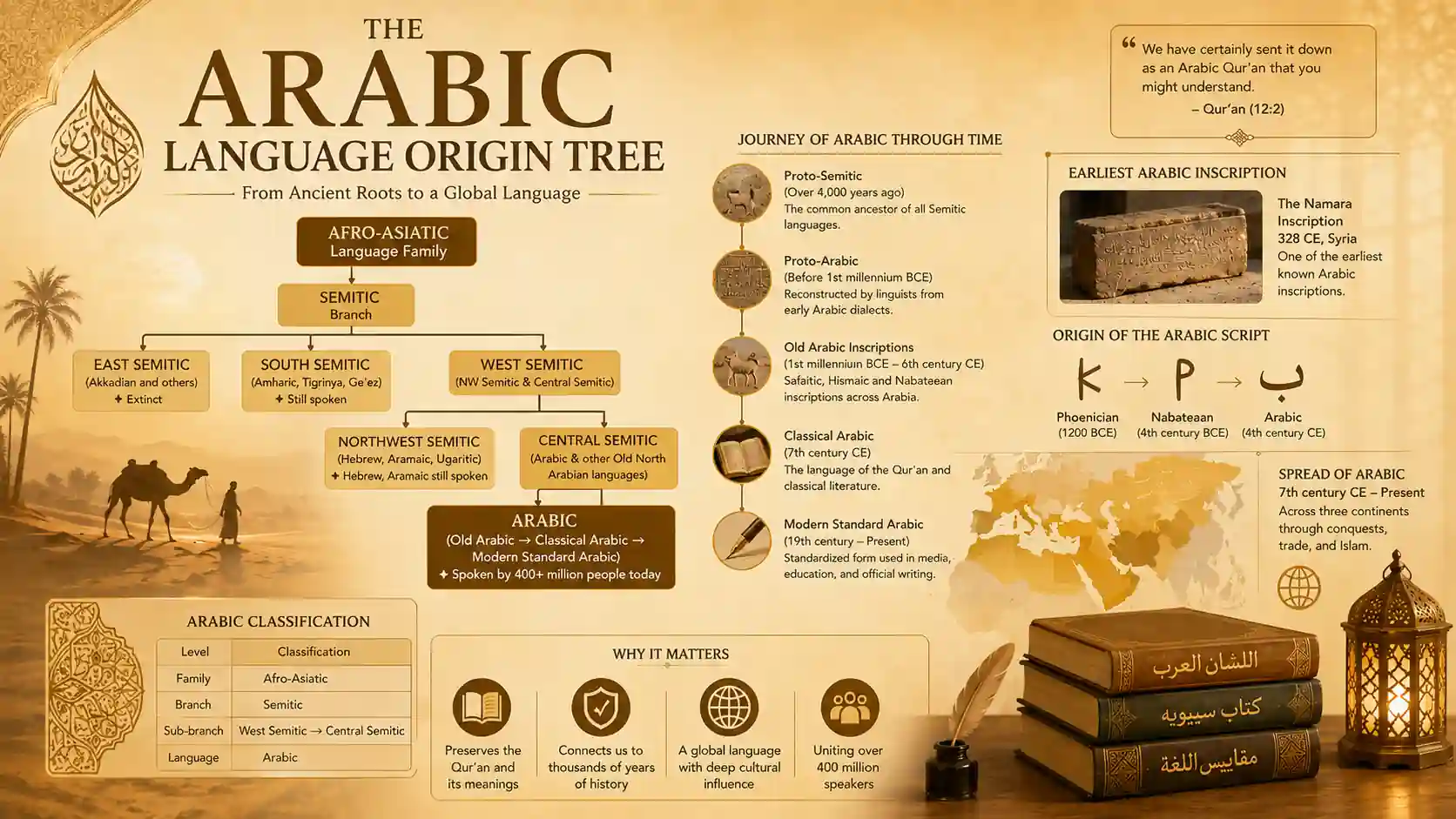
The Arabic language origin tree is the genealogy of the Arabic language, showing that it branched off from Proto-Semitic and then into several stages until it became the Arabic spoken today. It passes through Afro-Asiatic, Semitic, West Semitic, Central Semitic, and Arabic. Each branch is a gradual evolution of language and not an invention.
Where did Arabic originate?
The roots of Arabic are in the northwest of the Arabian Peninsula and the southern region of the Levant, where Old Arabic dialects were spoken and inscribed centuries before the advent of Islam. The earliest evidence is from rock inscriptions on the Syrian desert in the Safaitic and Hismaic languages. The language expanded south and eastward along with the migration of tribes across the peninsula.
Amazing 10 Facts About Arabic Language You Must Know
Is Arabic a Semitic language?
Yes, Arabic is a Semitic language and the most commonly spoken today. It belongs to the same Semitic family as Hebrew, Aramaic, Amharic, and Maltese, which have a common Proto-Semitic source. It is this common lineage that gives Arabic, Hebrew, and Aramaic similar roots and grammatical forms.
This classification is placed at the bottom of the Arabic language origin tree and is not a contemporary linguist’s opinion. It has been supported by the comparative philologists for more than 100 years, on the basis of common verb patterns, root structures, and cognate vocabulary for each of the major Semitic languages studied.
Explore our Arabic Language Course
What language family does Arabic belong to?
Arabic is a language of the Afro Asiatic arabic language family tree of languages and is in the Semitic branch of this family, but more specifically, in the Central Semitic sub-family. This makes the Arabic language more similar to the Aramaic and Canaanite family of languages including Hebrew than to South Semitic languages such as Amharic. This is the standard classification of Arabic in modern historical Arabic studies.
| Level | Classification |
|---|---|
| Family | Afro-Asiatic |
| Branch | Semitic |
| Sub-branch | West Semitic → Central Semitic |
| Language | Arabic |
Basic Arabic Lessons for Beginners Step by Step Guide
What is Proto Arabic?
Proto-Arabic is the reconstructed ancestor language in which the linguists explain some of the commonalities of the Old Arabic inscriptions before the time of common Arabic. It is not explicitly mentioned in any one text. To do the contrary, scholars reconstruct it by comparing the Safaitic, Hismaic, and early Nabataean-origin of arabic script side-by-side.
Reconstructing Proto-Arabic is important because it completes a significant branch on the Arabic language origin tree that fills the void between Central Semitic and the first fully attested Old Arabic dialects, giving us a record of sound changes and grammatical structures that existed in the language prior to inscriptions being carved into stone.
What is the difference between Classical Arabic and Modern Standard Arabic?
Classical Arabic is not a separate branch of the Arabic language origin tree but rather a shift in time and use. Classical Arabic is the language of the pre-modern texts and of the Quran. A simplified descendant of Classical Arabic, Modern Standard Arabic is used in news, education, and formal writing throughout the Arab world from the 19th and 20th centuries.
Best Way to Learn Quranic Arabic for Beginners Step by Step
How old is the Arabic language?
The age of the Arabic language is generally believed to be between 1,600 and 2,500 years, as a distinct branch of the language, although its deeper Semitic origin is much older, thousands of years. The arabic language roots are hard to trace exactly, as spoken language does not leave a trace behind, and only inscriptions are to be used:
- Common ancestor language: a few thousand years prior to the common era.
- Old Arabic dialect continuum: from early 1st millennium BCE onwards.
- The earliest known Arabic inscription: 4th century CE, on Namara.
- The standardization of classical Arabic: 7th century CE, with the Qur’an.
What is the oldest Arabic inscription?
The earliest widely accepted Arabic inscription is the Namara inscription in modern Syria dating from 328 CE. It is a Nabataean inscription celebrating the memory of an early Arab king named Imru al-Qays. It is the most significant pre-Islamic Arabic inscription found thus far, according to scholars.
In 1901 a stone of basalt was found containing the inscription and is now in the Louvre. It contains wordings that evidence grammatical characteristics that differ from Nabataean Aramaic and that are characteristic of true Old Arabic, not a borrowed Aramaic dialect.
How to Learn Basic Arabic Quickly: Beginner Guide
Did Arabic come from Nabataean script?
Yes, Arabic script originated from the Nabataean script, which in turn originated from the Aramaic script, which came to be used by the Aramaic people. Nabataean is also derived from Phoenician, one of the oldest alphabetic writing systems in history.
Why is Arabic related to Hebrew and Aramaic?
On the Arabic language origin tree, Arabic is related to Hebrew and Aramaic because all three originate from the same Central Semitic ancestor. This common heritage accounts for the similarities in the three-letter roots and the three-letter phrases they form, the similarities in the grammatical structures, and the common vocabulary in the three languages that developed independently for more than a thousand years.
Ace Your Arabic Test with Online Proficiency Classes
What is the Arabic language tree?
Arabic is represented as a real tree, one of a large number of trees under the umbrella of ‘Semitic.’ The major limbs are Proto-Semitic, which breaks into East Semitic (now extinct, including Akkadian), South Semitic (Amharic and Tigrinya), and West Semitic (NW Semitic, including Hebrew and Aramaic, and Central Semitic, including Arabic and older extinct North Arabian dialects).
How did the Quran affect Arabic?
The Quran fixed and spread Classical Arabic as a single standardized form across a rapidly expanding empire, well beyond its original Hejaz dialect base. Before this, Arabic existed as scattered regional dialects with no shared written standard. Its specific effects on the language were lasting and well documented by early grammarians:
- Standardized grammar rules that grammarians later codified into formal Arabic syntax.
- Preserved a single recitation-grade vocabulary across widely separated regions.
- Made Classical Arabic the shared literary language of law, science, and poetry for centuries.
- Anchored today’s Quran and Arabic language connection that still shapes religious education.
Online Arabic Classes for Adults – Learn Arabic from Home
What are the main Arabic dialects?
Most linguists agree that Arabic has five main dialects: Levantine, Egyptian, Gulf, Maghrebi and Iraqi. Over centuries of contact with Berber, Persian, Turkish and Coptic, the Arabic dialects evolved from Classical Arabic. Egyptian Arabic is the most widely known Arabic dialect as a result of regional films and media.
These dialects are not part of the formal classification tree as they were not codified or standardized intentionally. Modern Standard Arabic remains a common written medium between speakers of difficult-to-understand dialects, particularly in the news media and formal learning environments.
Is Arabic the oldest language in the world?
Although it might be repeated so much online, Arabic is not the oldest language in the world. Its ancestors are the Semites, older than both Akkadian and Ugaritic, and language families older than the Semites are Sumerian, which in turn predates them. Today, Arabic is a comparatively young language, as the oldest inscriptions, confirmed to the 4th century CE, are its earliest.
Earn an Accredited Certificate with Online Arabic Classes
How did Arabic spread across the world?
Arabic spread through military expansion, trade routes, and religious conversion following the rise of Islam in the 7th century CE. Within a single century it moved from a regional dialect to a language spoken across three continents. This arabic evolution followed a few clear, well-documented paths:
- Islamic conquests carried Classical Arabic across North Africa, the Levant, and Persia.
- Trade networks spread Arabic vocabulary into Swahili, Persian, Urdu, and Malay.
- Quranic education kept Classical Arabic alive as a liturgical language far outside native regions.
- Colonial-era borders later hardened modern standard arabic into a shared official language.
Explore our Online Quran, Arabic & Islamic Studies Courses
Learn Arabic With quran beauty Academy
At quran beauty Academy, our qualified Arabic instructors combine expertise in Classical Arabic and Modern Standard Arabic with structured, student-focused teaching. Our lessons connect Arabic history, grammar, vocabulary, and practical language skills, helping learners understand how the language developed while building confidence in using it today. Students learn through clear explanations, personalized guidance, and authentic linguistic foundations rather than memorizing disconnected rules.
Book a free trial class with quran beauty Academy and learn Arabic through structured lessons with qualified instructors.
FAQs
Where did Arabic originate?
Arabic originated in the Arabian Peninsula and surrounding areas, and first evidence of its use is in inscriptions found throughout Northern Arabia and the southern Levant. Within the wider Afro-Asiatic language family, linguists trace its roots back to the Semitic language family.
Is Arabic a Semitic language?
Yes, Arabic is a Semitic language of the Afro-Asiatic family of languages. It shares etymological links with other languages, including Hebrew and Aramaic, which share a shared ancient root. These connections account for similarities in words, word patterns and word formation across the languages.
What is Proto-Arabic?
Proto-Arabic is a reconstructed period of the Arabic language used by linguists to account for commonalities among recent and ancient varieties of Arabic and inscriptions. It was not preserved in a complete written language. A part of it has been reconstructed by the linguists from the comparison of the evidence found in Safaitic and Hismaic inscriptions and in early Arabic inscriptions.
What is the oldest Arabic inscription?
One of the oldest and most significant inscriptions of Old Arabic is the inscription on the Namara sarcophagus (328 CE). It is located in modern-day Syria and has linguistic characteristics that help shed light on the Arabic language prior to the establishment of Classical Arabic.
How did the Quran affect the Arabic language?
The Quran was an important factor in the preservation and dissemination of Classical Arabic in the Islamic world. It has affected both the Arabic language and its classical literature through its influence on the Arabic language, its vocabulary, and its grammar; it also aided in perpetuating Classical Arabic as a vital religious and scholarly language over the years.