Most people start with an Arabic textbook and get paralyzed by the first page when deciding whether to begin with letters, words, or grammar. Basic Arabic lessons for beginners are best taught in a logical sequence: sound, word, and sentence. If you have been looking for the best way to learn the Arabic language online or finding a comparison of all the different courses of learning Arabic for beginners you can find, this is what you will find in each course and what you should expect in each lesson of the course.
What are the basic Arabic lessons for beginners?
The common building blocks of basic Arabic lessons for beginners include the alphabet and sounds, common words, greetings, simple sentence structure, and pronunciation practice. Lessons in Arabic that teach beginners directly to grammar without teaching sounds and words are often used to teach students to recognize patterns without speaking the language.
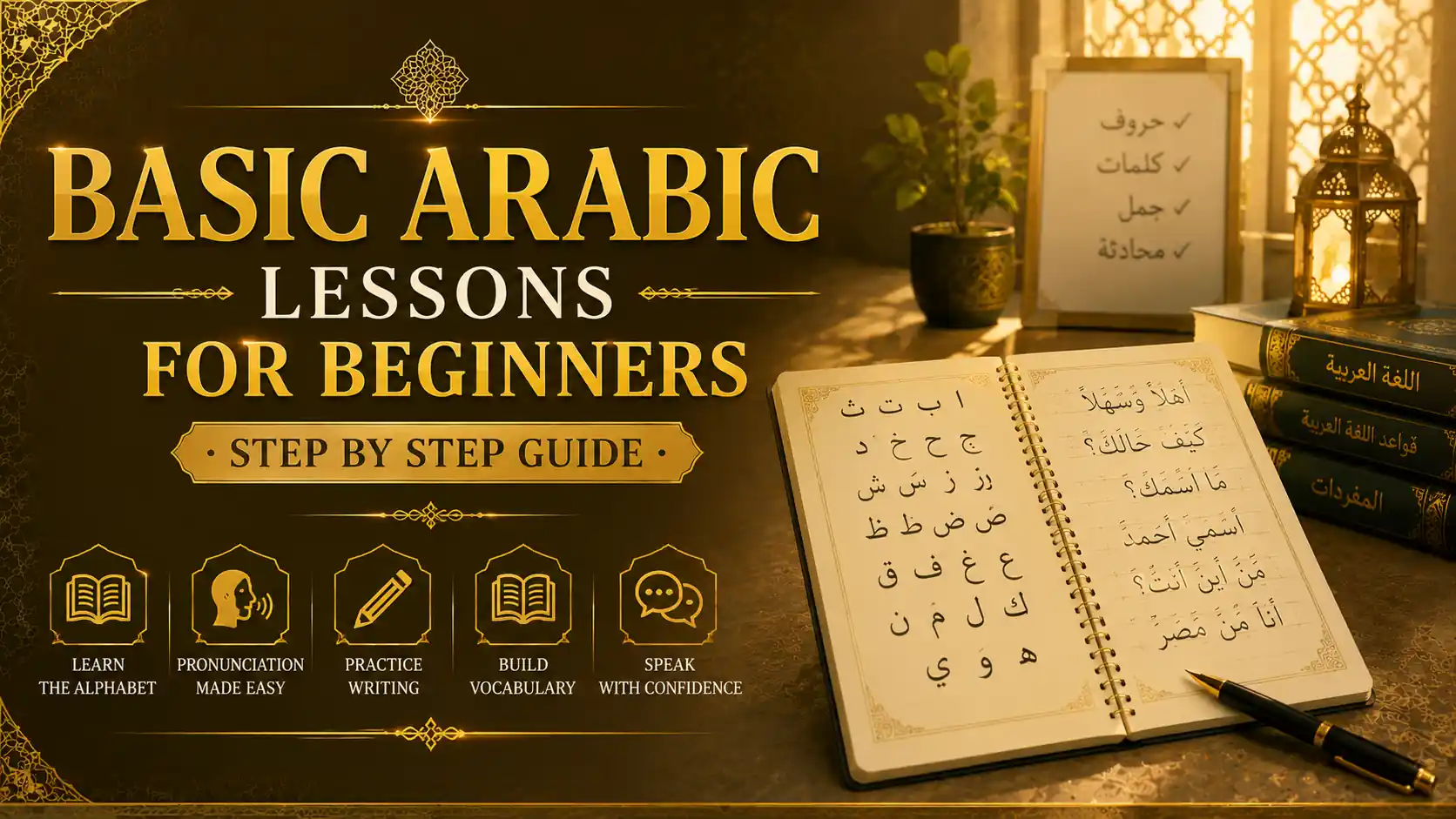
- A typical lesson sequence is as follows:
- Words that begin with a letter (alphabet) or sound (letter sounds)
- Words used frequently (numbers, colours, family words)
- Everyday expressions; greetings.
- Simple sentence and pronouns
- Practice in listening and pronunciation
How do I start learning Arabic from scratch?
You will begin to learn Arabic without any prior knowledge, starting with the sounds, as Arabic is a language that has some letters that don’t exist in the English alphabet:
- Memorize the 28 letters and how to say them.
- Learn letter recognition, as the letters have different shapes when they appear in different positions in a word.
- Read 20-30 words that are used regularly in everyday activities
- Begin to build basic 2-part sentences and/or 3-part sentences.
- Listen every day, even to 5 minutes of native audio!
Learn Arabic in English Step by Step for Complete Beginners
What should a beginner learn first in Arabic?
The Arabic alphabet and its proper pronunciation should be learned first by a beginner, because all subsequent skills, reading, writing, and speaking, rely on the ability to recognize letters properly. The common problem with basic lessons in Arabic is that they skip the alphabet for a faster way to “get to real Arabic” in a way that makes pronunciation more difficult to correct than to learn the first time.
How long does it take to learn basic Arabic?
After 3-6 months, most beginning learners master the basics of conversation, and it usually takes about a year to achieve the level of comfort in reading and writing. Not too surprisingly, beginner level Arabic courses that take place two or three times a week are a little quicker than those that happen simply once a week.
Explore more about Best Islamic Online Courses for Quran Arabic and Islamic Studies
Should I learn Arabic letters or words first?
Letters should come first, since Arabic words are built from a root-letter system where recognizing individual letters directly affects word recognition later. Trying to memorize whole words before knowing individual letter sounds usually means relearning pronunciation once the alphabet is properly covered.
What are the most common Arabic greetings?
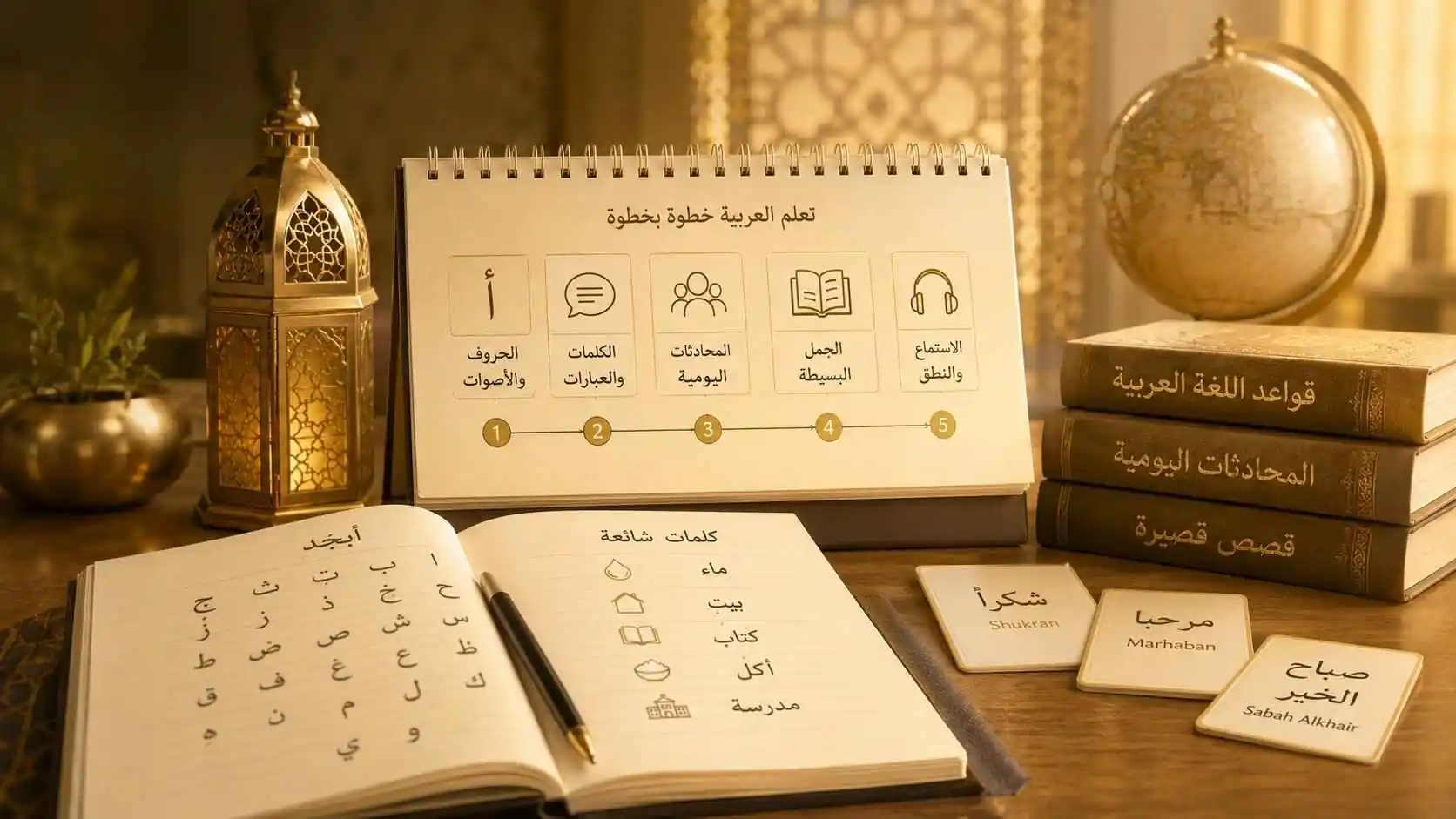
Here are the most basic Arabic greetings that every beginner should be able to pick up on the very beginning:
- As-salamu alaykum (peace be upon you), is the common greeting
- Mereh. Hello in general, informal (unofficial) terms.
- Sabah al-khayr (good morning)
- Masaa al-khayr (good evening)
- Shukran (thank you)
- Ma’a salama (goodbye)
These phrases provide the beginner with immediate, practical Arabic in the first lesson before grammar is introduced, encouraging the learner.
How do beginners practice Arabic pronunciation?
The best way to practice Arabic pronunciation is to isolate the sounds of Arabic letters and practice them first before trying to make full sentences, where there are individual sounds to master, and arabic language lessons for beginners are of utmost importance.
- Recognize sounds which are not present in the English language, such as ع, ح, and q
- Practise each sound individually and slowly, and then putting it together in words
- Record and listen to yourself and compare to native speaker audio.
- Say the word correctly each day until it seems natural.
- Have immediate feedback from the teacher; self-checking may not catch subtle errors
Best Way to Learn Quranic Arabic for Beginners Step by Step
Basic Arabic Lessons for Beginners: Week-by-Week Plan
| Week | Focus |
|---|---|
| 1-2 | Alphabet, letter sounds, and connections |
| 3-4 | Greetings and high-frequency vocabulary |
| 5-6 | Simple sentence structure and pronouns |
| 7-8 | Reading short texts aloud with correction |
What is the best way to learn Arabic sentence structure?
The most effective method for mastering Arabic sentence construction is to learn short, authentic sentences as opposed to memorizing tables of grammar constructions. In Arabic, the sentence structure is usually verb-subject-object, whereas in English it is subject-verb-object. This means that in formal writing, you will see this structure repeated in sentences if you see it in real sentences
What Arabic words should I learn first?
First, learn words related to everyday activities before words related to abstract concepts, as they are used first in conversation:
- Numbers 1 to 10
- Families (mom, dad, brother, sister)
- Things that are familiar (water, food, house, book)
- Basic verbs (go, eat, want, need).
- Event words (when, where, what, who)
How to Learn Basic Arabic Quickly: Beginner Guide
Can I learn Arabic by myself as a beginner?
Absolutely, it is possible to learn self-study, particularly the alphabet and basic vocabulary, but pronunciation is not easy to correct without others’ feedback. If most students attempt to learn Arabic lessons on their own, they will reach a point where they can no longer improve their reading skills, and their spoken Arabic will not improve, either.
Online Arabic Classes for Adults – Learn Arabic from Home
Is Modern Standard Arabic best for beginners?
Yes, MSA is in fact the most suitable language to start with when learning Arabic, as it is spoken in all Arabic-speaking countries and is the basis from which all regional Arabic dialects have developed. It is difficult, on the other hand, to begin with a particular dialect, since this makes formal reading and writing more difficult in the future.
How often should I study Arabic as a beginner?
Online Arabic classes for beginners: It is better to study Arabic in brief but frequent periods as opposed to long periods that are less frequent. It’s consistency that makes progress in most basic Arabic lessons for beginners, whether in class or outside of class, greater than a single 2 hour lesson each week.
Earn an Accredited Certificate with Online Arabic Classes
What are the best free Arabic learning resources?
Free resources are helpful for vocabulary and listening practice but do not take the place of live correction of pronunciation and grammar errors:
- Listening Practice in Arabic with native audio and podcasts.
- Vocabulary repetition flashcard apps!
- Children’s shows for slow and clear pronunciation in Arabic.
- Alphabet Tracing Sheets to Practice Handwriting for Free!
Tools should be used in combination with beginning classes and not in place of a teacher.
How do I start speaking Arabic quickly?
You start speaking Arabic quickly by prioritizing usable phrases over grammar accuracy in the first few weeks:
- Memorize 10 to 15 common phrases before worrying about full grammar rules
- Practice speaking in arabic speaking lessons for beginners those phrases out loud daily, even alone
- Join live conversation practice as early as possible, even with basic vocabulary
- Accept early mistakes as part of the process instead of waiting to “get it right” first
- Add new phrases gradually instead of trying to learn full sentences from scratch each time
Write Arabic Like a Pro with Online Writing Classes
Start With a Free Trial Lesson
beginner arabic classes work best when the lesson order matches how the language actually builds, sounds first, then words, then sentences, rather than jumping between topics randomly.
At Mubarak Academy, the best online arabic course for beginners is taught by native Arab educators with degrees from institutions like Cairo University and Beni Suef University, each with a minimum of five years of experience teaching non-native Arabic speakers specifically. Over 1,000 students from more than 20 countries have gone through the academy’s structured beginner path.
Reading about lesson order helps, but hearing correct pronunciation modeled live is what actually builds a beginner’s ear. Structured basic Arabic lessons for beginners work best with real-time feedback. Book a free trial class with Mubarak Academy’s best online arabic course for beginners and get placed at the right starting point, no card required and no obligation to continue.
FAQs
Is Arabic harder to learn than other languages for English speakers?
Because of its unique alphabet, unfamiliar sounds and sentence structure, Arabic is, in general, more difficult. But, as in the case of structured basic Arabic for beginners, the concepts are introduced slowly so that the learning process is much more approachable and students can gain confidence from the start.
Do I need to learn Arabic calligraphy as a beginner?
No, it is not required to learn Arabic calligraphy at the beginning of your studies. First recognize letters, write clearly, read simple words, and put together simple sentences. After you have your handwriting down, calligraphy is an art form that can be learned at a later stage.
Can children start these basic Arabic lessons too?
Yes, children can start basic Arabic lessons at an early age. Typically, lessons are modified for their attention span with shorter activities, interactive exercises, and visual learning tools without compromising the critical alphabet, vocabulary, pronunciation, and reading fundamentals.
What comes after finishing basic Arabic lessons for beginners?
Once students have mastered the beginner level lessons, they typically move on to intermediate-level grammar, longer texts, more extensive vocabulary, and conversational practice. There are also a lot of arabic for beginners course that include listening tasks and some Arabic dialects, while maintaining the development of MS Arabic skills for practical use.
What is the duration of basic learning of the Arabic language for beginners?
This will vary from person to person, based upon the study habits and regularity of the learner, but many people take 3 to 6 months to master the fundamentals. By practicing a little every day, regularly reviewing, and talking to a teacher, confidence and long-term language retention can greatly be enhanced.