

learn arabic in english step by step is one of the simplest methods for novices to develop confidence without feeling overwhelmed. With clear explanations in English and Arabic words and phrases, understanding the pronunciation, grammar, and vocabulary can be at a comfortable pace. A systematic learning program allows you to make consistent progress in your study of the Quran, your ability to speak and understand Arabic, or your personal or business use of the Arabic language.
How do I learn Arabic in English step by step?
You learn arabic in english step by step by mastering the alphabet, then pronunciation, then vocabulary, then grammar.
- Learn the Arabic alphabet and letter sounds first, using English transliteration only as a temporary bridge.
- Practice pronunciation daily with a tutor so Makharij (articulation points) get corrected early, not months later.
- Build core vocabulary through short, high-frequency words before tackling grammar tables.
- Add basic grammar, including sentence order, pronouns, and verb patterns, once reading feels comfortable.
- Read short texts aloud weekly to combine everything you’ve learned so far into real practice.
Explore more about Best Islamic Online Courses for Quran Arabic and Islamic Studies
What should I learn first in Arabic?
The first step is to learn the Arabic alphabet, as all other skills rely on it. Jumping straight to vocabulary and/or grammar without proper letter recognition will make it harder for everyone later. Alphabet, sounds, vocabulary, and grammar are the usual steps in traditional classes of the Arabic language at a community center.
This is the first step that is the base for everyone who wants to learn Arabic in english step by step and continue to the next steps.
Explore more about Online Hifdh Program for Quran Memorization and Revision
Is Arabic hard for English speakers?
The primary reason Arabic is more difficult for English speakers is the new alphabet and the right-to-left script. The grammar is logical as soon as you get the hang of the patterns, so it’s not really the language that is the problem but more the unfamiliar letters and sounds. The alphabet is learned in a few weeks with daily practice for most learners.
Explore more about 7 Proven Steps to Master Noon Sakinah Rules in Tajweed
How long does it take to learn Arabic step by step?
The typical amount of time required to learn Arabic in english step by step to a conversational and functional level is 6-12 months of regular weekly study.
- Weeks 1-4: Alphabet, sounds of letters and simple transliteration.
- Months 2-3: 200-300 high-frequency words and core pronunciation words.
- Months 4-6: beginning grammar, simple sentences, and beginning reading of simple texts.
- Months 6-12: consistent progress in vocabulary and reading fluency and ongoing feedback from the tutor.
Explore more about Learn Tajweed Online at Your Own Pace
Should I learn Arabic alphabet before grammar?
Yes, master the Arabic alphabet ahead of grammar, as you will not be able to read the grammar examples without first learning the alphabet. Most formal courses begin the first few weeks with only letters and sounds in the curriculum and then teach one grammar rule. It’s just an alternative way to learn arabic in english step by step without skipping.
Explore more about Top Online Quran Classes with Tajweed for USA Learners
What is the easiest way to learn Arabic for beginners?
The best method for beginners to learn the language of the Arabs is to have tutoring in the presence of the student and to practice the language daily, in small amounts. Pronunciation errors are easily picked up by a tutor, not by a self-study app or video. When people look for an app to learn Arabic online.
Explore more about Online Tajweed Course for Sisters with Female Teachers
Can I learn Arabic by myself in English?
Yes, you can learn Arabic without a tutor in English, through apps, textbooks, and free resources, but it will take longer. Self-study is suitable for the alphabet and simple vocabulary. Self-correcting difficulties with pronunciation and grammar nuance are more challenging, so a tutor is added later by the self-taught student.
Explore more about Can You Read Quran Without Tajweed A Complete Beginner Guide
What are the Arabic letters and sounds?
Arabic has 28 consonant sounds (letters), and vowels are indicated separately. The first change that English speakers make with letters is that they change their shape when they are at the start, middle, or end of words. The vowel sounds are represented by small marks called Harakat.
Explore more about Best Way to Learn Quranic Arabic for Beginners Step by Step
Do I need transliteration to learn Arabic?
Transliteration is good for the first few weeks but must be phased out as soon as possible when reading/seeing Arabic letters. It is only employed in very early lessons in most structured programs and is withdrawn in 2-3 weeks. It is important that you drop it on schedule so that you can pass through each step of how to learn Arabic in English, rather than use it as a shortcut.
Explore more about Words From Quran With Meaning For Easy Quran Understanding
How do I practice Arabic pronunciation?
You learn how to speak Arabic by repeating after a certified tutor and recording yourselves to compare with the tutor.
- Repeat immediately after your tutor, not in your mind.
- Make short videos of yourself and make a comparison to the tutor’s recitation.
- Pay attention to the position in the mouth or throat from which each letter is produced, known as Makharij.
- Work on difficult letter blends in isolation prior to combining with other letters in words.
Explore more about Revelation Recording and Memorisation of the Holy Quran Guide
How do I read Arabic right to left?
The Arabic language is read from right to left, beginning at the right side of the page and reading to the left.
- Begin each line with the last letter of the first word of that line.
- Read the words across the line from right to left.
- Many beginners get the order of reading numbers in Arabic wrong, reading it from right to left.
- To begin, work on short sentences with only one line, and then move on to paragraphs; direction becomes automatic.
Explore more about Online Hifdh Program for Quran Memorization and Revision
What comes after Arabic alphabet for beginners?
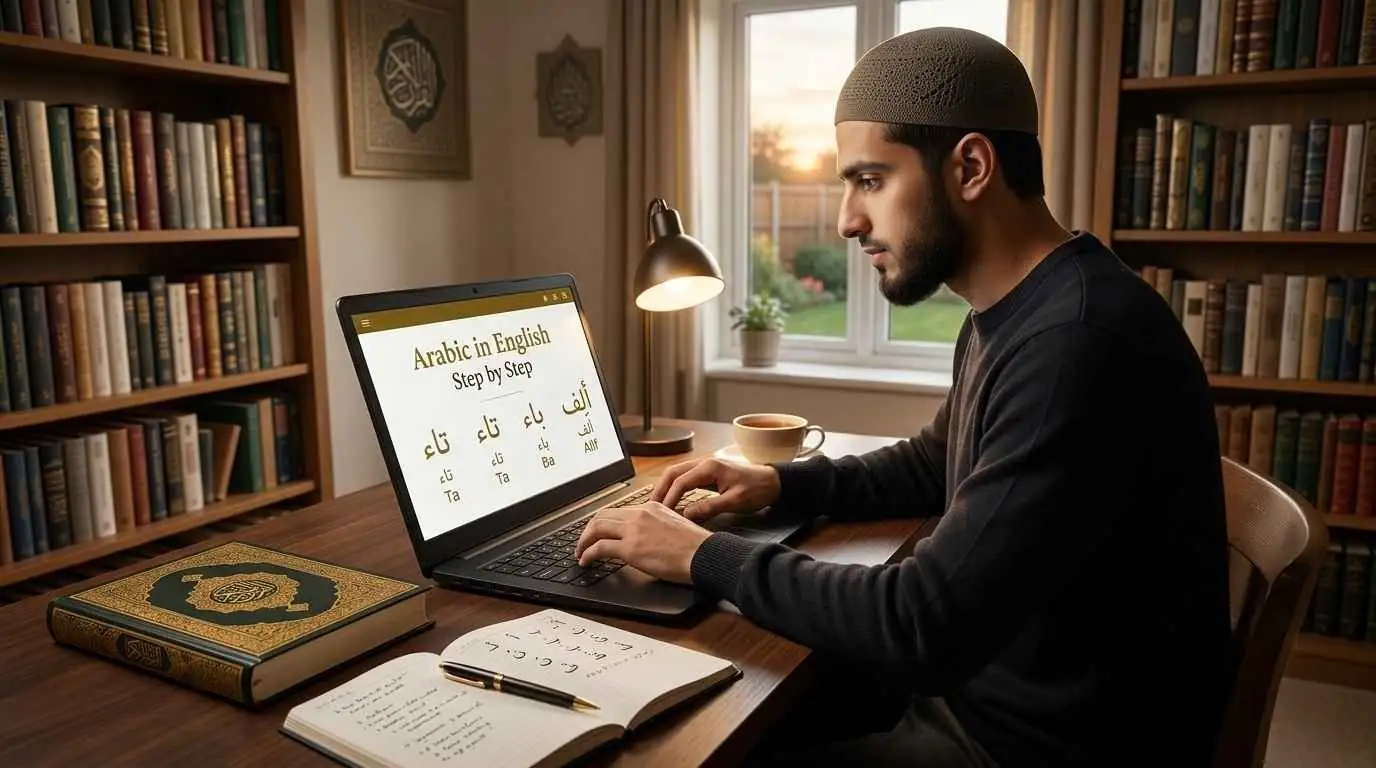
Beginners then progress to short vowel sounds, simple two- or three-word sentences, and basic vocabulary after the Arabic alphabet. Reading short connected words rather than individual letters and having sufficient vocabulary for basic greetings and questions. Grammar is kept to a minimum as the emphasis is on comfort in reading. This is one of the essential steps to learn Arabic in English step by step,.
Explore more about Quran Tajweed With English Translation for Easy Learning
How can English speakers memorize Arabic vocabulary faster?
English speakers memorize Arabic vocabulary faster by grouping words around shared three-letter roots instead of memorizing each word alone.
- Learn root patterns, since most Arabic words share a three-letter root with related meanings.
- Use spaced repetition apps for daily review instead of cramming vocabulary lists once a week.
- Attach new words to a sentence or image rather than memorizing isolated translations.
- Review vocabulary from your last live class before starting the next one, not just before a test.
Start Learning Arabic Step by Step Today:
Sequencing is the key in learning to learn Arabic in English step by step: alphabet, pronunciation, vocabulary, and grammar, all the while being corrected by the live teacher. Enroll in a complimentary class with Quran Beauty Online and receive a customized course with a personalized plan of learning that is designed based on your present level of proficiency in your first class. No card needed!
The Arabic teachers at Quran Beauty Online have more than five years of combined experience teaching Arabic from the alphabet and have been certified in Ijazah by the well-known Islamic institutes and trained by Al-Azhar. Book your free trial class with Quran Beauty Online and receive a personalized learning plan based on your current level. Learn Arabic with qualified teachers through live one-on-one lessons designed to help English speakers progress with confidence.
Frequently Asked Questions:
Are Arabic classes online as effective as in-person lessons?
Yes, online classes with an Arabic tutor are as effective as in-person classes, particularly live, interactive, and taught one-on-one. Students develop their speaking, reading, listening, and grammar skills all in one go as they practice regularly, receive feedback in real time, and are guided by personalized feedback.
What should I look for in arabic lessons online?
Select the best Arabic lessons online with live sessions, qualified tutors, English grammar lessons, and a syllabus from beginner to intermediate. A clear learning path enables you to make gains in language in a step-by-step manner, rather than through incomplete lessons or random video content.
Is there a specific arabic course for english speaking students?
Yes, there are many Arabic courses that are oriented towards English-speaking students. They teach grammar in English, gradually introduce vocabulary, and gradually develop confidence in reading, writing, and speaking Arabic and gradually develop thinking in the native language.
Can grammar resources like Quranic Arabic Explained replace a tutor?
Grammar materials such as Quranic Arabic Explained are very useful for learning the structure of the sentences and rules of the language. But they are no substitute for the tutor who can give immediate correction of pronunciation, answer questions as they come, and adjust lessons to suit your pace and objectives.
Is it worth trying to learn arabic language online instead of a local classroom?
Yes, learning Arabic online is flexible and convenient and is available with qualified teachers from anywhere. You’ll save travel time, have flexible lesson times, and get live interaction, pronunciation correction, and individual support throughout your learning journey.
What makes learning arabic as an english speaker uniquely challenging?
Learning Arabic as an English speaker can be difficult due to the new alphabet, right-to-left writing system, and different sounds. These challenges can be overcome with regular practice and systematic lessons, enabling students to develop confidence and fluency gradually.