Arabic is one of the oldest living languages in the world and one of the most widely used, but most people outside the Arab world have only limited knowledge of it. Below are some Arabic language facts about the Arabic language origin, the script, and why it is one of the most difficult languages to learn for an English speaker. Before you learn Arabic, you can find these 10 Facts About Arabic Language to learn some interesting facts about the Arabic language.
What Are 10 Facts About Arabic Language?
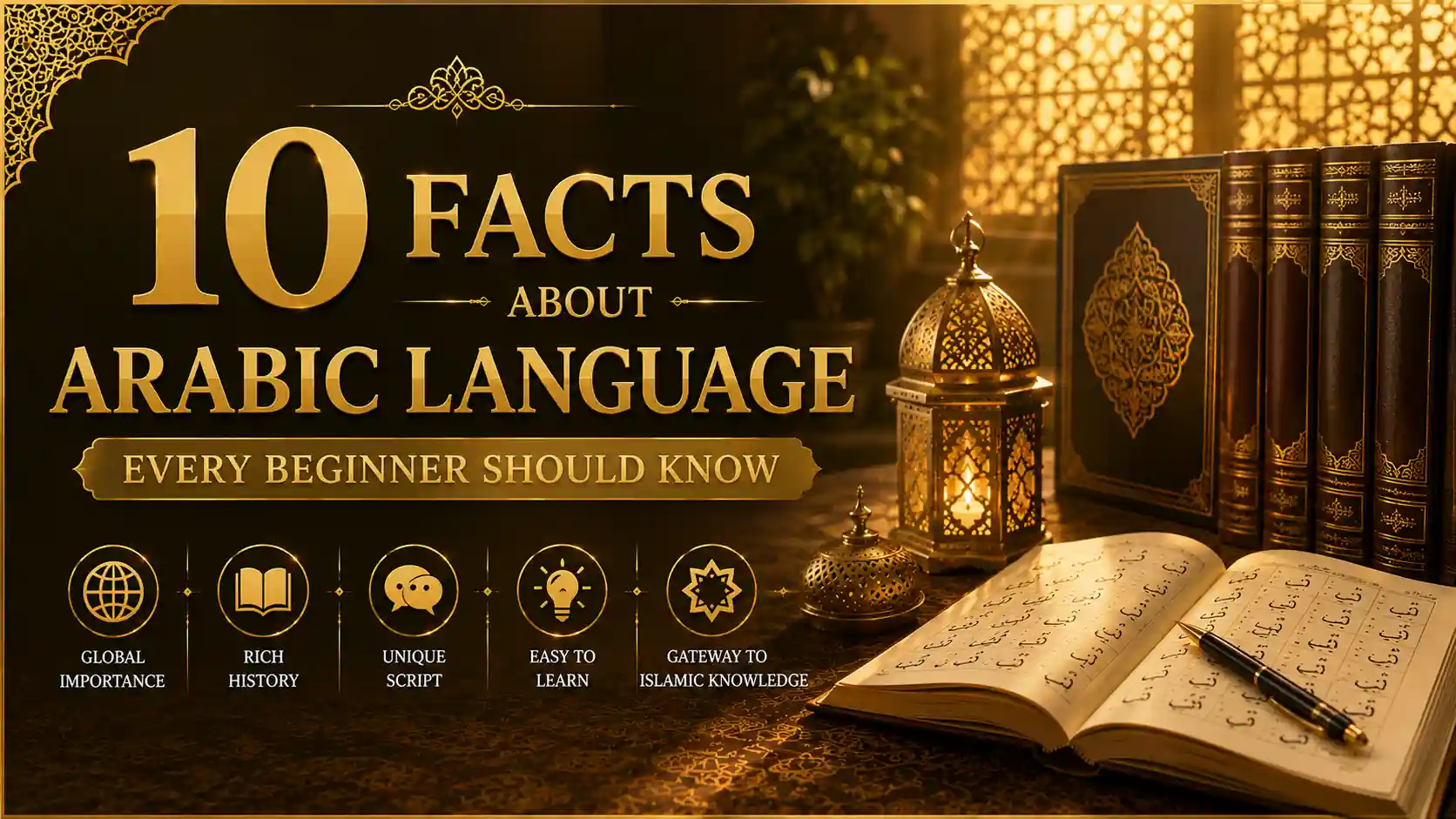
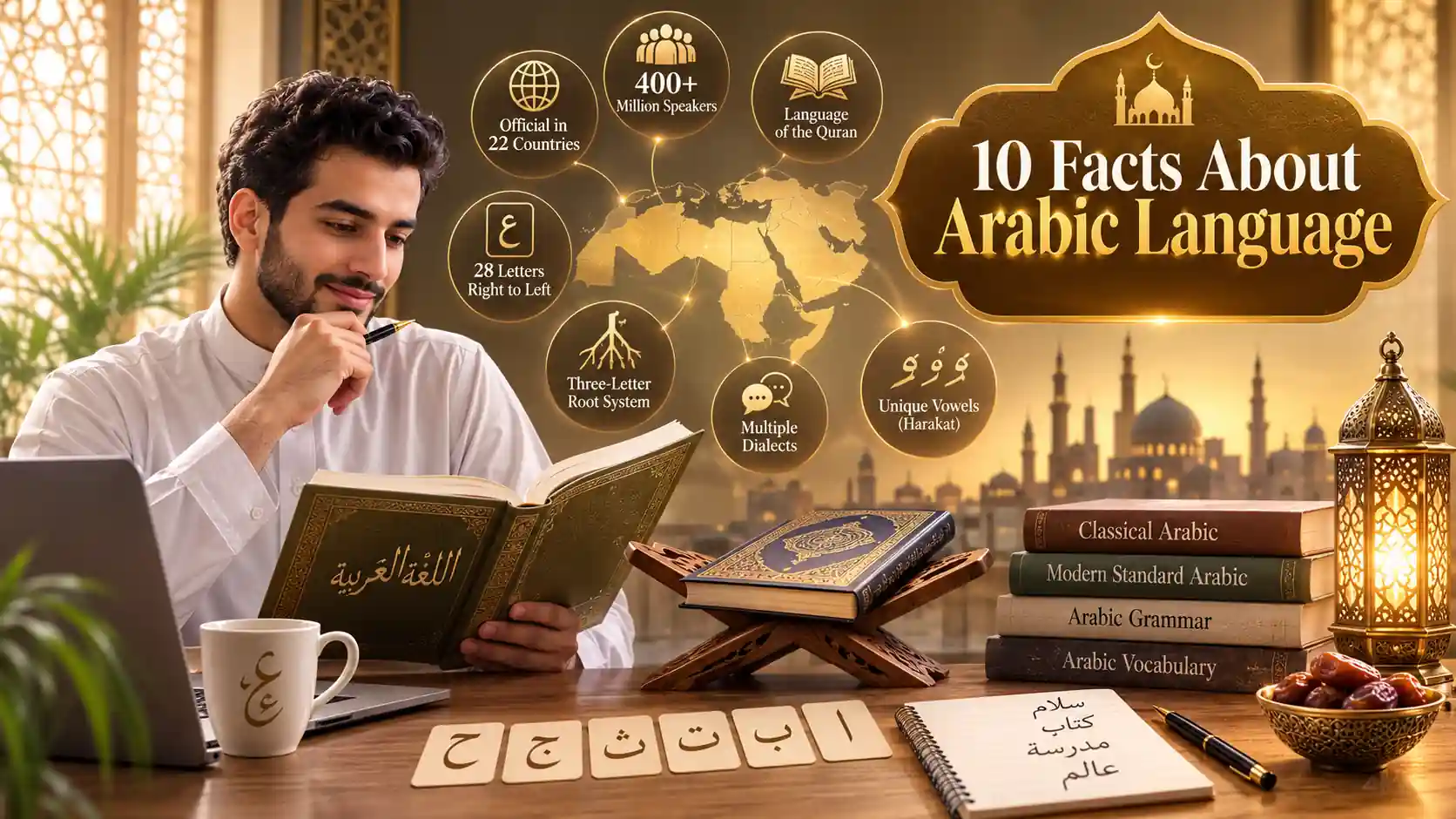
Arabic is a Semitic language with more than 400 million speakers and written in a right-to-left script of 28 letters. Before the details below, here are 10 quick facts about the Arabic language:
- There are approximately 400 – 420 million people in the world who speak Arabic.
- It’s the official language of 22 countries in the Arab League.
- It is a member of the Afro-Asiatic language family of Semitic origin.
- There are 28 letters, all consonants.
- It’s written and read from right to left.
- Short vowels are represented by a symbol, rather than a separate letter.
- Classical Arabic is not equal to Modern Standard Arabic.
- Five to six major dialect groups are spoken.
- The form of the Arabic letters varies according to their position in the word.
- It is the language of the Quran and 1.8 billion Muslims who practice it.
How Many People Speak Arabic Worldwide?
The total number of people who speak Arabic globally is about 400 to 420 million with approximately 310 million native speakers. It is the fifth most widely spoken language in the world after Mandarin, English, Hindi and Spanish. One of the most popular figures.
When it comes to 10 facts about Arabic language is of this speaker count, as it addresses one of the reasons why the Arabic language is important globally. The difference between total and native speakers is due to millions of people learning Modern Standard Arabic in school as a second language in addition to their local dialect.
How Many Countries Have Arabic as an Official Language?
There are 22 countries which use Arabic as their official language, all of them part of the Arab League. It covers all of Morocco in the west to Oman in the east and several other non-Arab League areas with official or recognized status. This range makes Arabic one of the most geographically widespread official languages, along with English and French.
Learn Arabic in English Step by Step for Complete Beginners
Is Arabic the Oldest Language in the World?
No, Arabic is not proven to be the oldest world language, but it is certainly one of the oldest languages now in use. The earliest known written form is from the 4th century CE, and the earliest known spoken forms are from the Arabian Peninsula centuries earlier.
It is not possible to declare one language as the “oldest,” as all the modern languages are derived from older languages. The only thing that can be documented as true about the history of the Arabic language is that it has been, and still is, used for over a thousand years in everyday life without significant changes in its written Classical form.
One of the more contested facts in the 10 Facts About the Arabic Language is that of the longest usage of Arabic versus the oldest usage of Arabic, as these are not synonymous.
Is Arabic a Semitic Language?
Yes, it is a Semitic language among many other Afro-Asiatic languages such as Hebrew, Aramaic, and Amharic. The Arabic language family helps to account for why Arabic shares grammar patterns and root-word structures with Hebrew, despite the two being written in different scripts. Arabic is one of the most closely related of the living languages to the reconstructed Proto-Semitic.
Explore more about Best Islamic Online Courses for Quran Arabic and Islamic Studies
How Many Letters Are in the Arabic Alphabet?
There are 28 letters in the Arabic alphabet, each of which has a consonant sound. These three letters (alif, waw, and ya) can also be used as long vowels. The lettering never capitalizes, unlike other alphabets like Latin, so this makes for a much easier script, but the shape of each letter changes according to its position within the word.
Explore our Arabic lessons for beginners
Why Is Arabic Written From Right to Left?
Arabic written from right to left is the same way as the ancient Semitic-based scripts from which it developed, such as Aramaic and Nabataean. Since the early writing systems of the region were carved or brushed from that side, for practical purposes related to the way the scribe held the tool, this tradition continued as the script developed.
Best Way to Learn Quranic Arabic for Beginners Step by Step
Does Arabic Have Vowels?
Yes, but short vowels are not written as letters in the alphabet; they are written using small marks called “harakat” that are written above or below letters in the alphabet. Long vowels are spelled with three of the regular letters of the alphabet, however, in contrast to short vowels. This is one of the reasons for the difficulty in mastering Arabic pronunciation for learners
the short vowel marks are typically omitted from everyday printed text (newspapers, novels, street signs, etc.) and must be determined by context and word forms. Most lists of 10 Facts About Arabic Language overlook it, but it is a fact that makes a lot of confusion among the newcomers.
How to Learn Basic Arabic Quickly: Beginner Guide
What Is the Difference Between Classical Arabic and Modern Standard Arabic?
The language of the Quran and pre-modern Arabic literature is classical Arabic, and the updated form of the language, known as Modern Standard Arabic (MSA), is utilized in news and books and formal speech today. MSA’s grammar is the same as that of Classical Arabic, as is its fundamental vocabulary,
but also includes technology, political, and scientific terms that were not used 1400 years ago. Both are foreign languages, and they are taught to students along with a local dialect. Before the reader digs deeper into 10 Facts About Arabic Language, it is important to understand the distinction, as most textbooks mix both without elucidating the difference.
Basic Arabic Lessons for Beginners Step by Step Guide
How Many Arabic Dialects Are There?
There are five to six major Arabic dialect groups, and dozens of local variations within each one. The main groups are:
- Egyptian Arabic, the most widely understood dialect due to Egypt’s film and media industry.
- Levantine Arabic, spoken in Syria, Lebanon, Jordan, and Palestine.
- Gulf Arabic, spoken across Saudi Arabia, the UAE, Kuwait, and neighboring states.
- Maghrebi Arabic, spoken in Morocco, Algeria, Tunisia, and Libya.
- Mesopotamian Arabic, spoken mainly in Iraq.
- Sudanese Arabic, spoken in Sudan and parts of Chad.
Speakers from different dialect groups often struggle to understand each other, which is why Modern Standard Arabic serves as the shared bridge across the Arab world. This dialect split is one of the more surprising entries in any list of 10 Facts About Arabic Language, since fluency in one dialect doesn’t guarantee understanding another.
Why Do Arabic Letters Change Shape?
Arabic letters change shape because the script is cursive, meaning most letters connect to the ones beside them within a word. Each letter can take up to four different forms depending on its position:
- Isolated form, used when the letter stands alone.
- Initial form, used at the start of a word.
- Medial form, used in the middle of a word.
- Final form, used at the end of a word.
Online Arabic Classes for Adults – Learn Arabic from Home
What English Words Come From Arabic?
Dozens of everyday English words trace directly back to Arabic, often through Spanish or Italian trade routes. Common examples include:
- Algebra, from al-jabr, meaning “reunion of broken parts.”
- Alcohol, from al-kuhl, originally a fine cosmetic powder.
- Coffee, from qahwa, via Turkish and Italian.
- Cotton, from qutn.
- Sugar, from sukkar.
- Sofa, from suffah, a raised platform or cushioned bench.
- Magazine, from makhazin, meaning storehouses.
Earn an Accredited Certificate with Online Arabic Classes
Is Arabic Difficult for English Speakers to Learn?
Yes, the US Foreign Service Institute ranks Arabic among the hardest languages for English speakers, requiring around 2,200 classroom hours to reach fluency. So how difficult is Arabic to learn compared to something like Spanish or French?
Roughly four times harder by FSI’s own estimate, mainly because of the new alphabet, unfamiliar grammar, and the gap between formal Arabic and the spoken dialects. Learners who focus on the alphabet and basic vowel sounds first tend to progress faster once they start building vocabulary.
Is Arabic the Language of the Quran?
Yes, the Quran was revealed in Classical Arabic, and that form of the language is still recited unchanged in prayer today. This religious role is a major reason Arabic spread so widely after the 7th century, since learning to read the Quran meant learning Arabic. It’s also why Classical Arabic has stayed remarkably stable for over 1,400 years, even as spoken dialects around it kept evolving.
Write Arabic Like a Pro with Online Writing Classes
What Is the Arabic Three-Letter Root System?
Most Arabic words are built from a three-letter (trilateral) root that carries a core meaning, which then gets reshaped into different words through fixed patterns. For example, the root k-t-b relates to writing, and from it come kitab (book), kataba (he wrote), and maktaba (library).
This root system is one of the most distinctive features of Arabic grammar, and it’s a major reason vocabulary builds up faster once a learner recognizes common roots. It’s also the fact that ties every other point in this list of 10 Facts About Arabic Language together, since roots shape the alphabet, the grammar, and the dialects alike.
Start Your Arabic Learning Journey Today
The ability to learn Arabic can be enhanced by using a systematic course of study that is structured according to the curriculum outline developed by skilled teachers. With a clear study plan, consistent feedback, and frequent speaking practice.
You build up your confidence more quickly than would be possible without these other elements. When you select qualified instruction, also, you will prevent yourself from making common errors and acquire correct pronunciation from the outset.
Interested in mastering the facts and beginning to communicate in Arabic? Take one free lesson with a native Arabic teacher and learn step-by-step in the beginner’s path to Arabic. You will gain confidence in reading, pronunciation, vocabulary, and conversation from your first lesson onwards.
FAQ
Can I learn Arabic without living in an Arabic-speaking country?
Yes. Many students can pick up the language without leaving their own country and do so by attending regular classes, listening to speech every day, reading simple texts, and conversing with native teachers online. Consistency is more important than location, particularly with a plan and practice available each week.
Which Arabic dialect should beginners learn first?
Modern Standard Arabic is the most appropriate choice for beginners since it is spoken in the Arab world and used in books, news and formal communications. Once a solid base is developed, a regional dialect can be learned to actualize personal and/or professional objectives.
How long does it take to learn Arabic?
This will vary according to your objectives, study plan, and background in other languages. After a few months of consistent practice, most beginners will already have developed basic communication skills, and most people will become fluent after a period of regular speaking, reading, writing, and listening practice.
Is Arabic grammar harder than Arabic pronunciation?
There are differences in the challenges of Arabic grammar and pronunciation, but beginners will find it easier to work on pronunciation by listening and repeating. Grammar involves knowledge of sentence construction, verb usage, and word origins and is a skill that progresses over time through frequent and systematic work and practice.
Can I learn Quranic Arabic and Modern Standard Arabic together?
Yes. Many pupils learn both simultaneously, as they use the same alphabet and some of the grammar rules. In addition to enhancing everyday reading ability, Modern Standard Arabic enhances understanding of the Quran and builds vocabulary through meaningful context, and Quranic Arabic strengthens the understanding of the Quran and enhances vocabulary.