The Quran has been transmitted through several channels, and there are different types of quran recitation, not because there was any dispute about the wording of it. Many readers understand the words as Hafs an Asim or Warsh an Nafi and think there is some inconsistency, but actually they are recitations of the same revelation verified by scholars and certified by the Qur’ain. This guide explains what different types of quran recitation are, the number of qiraat.
What Do Different Types of Quran Recitation Actually Mean?
These different types of quran recitation with tajweed are the various ways by which the Quran has been transmitted and recited from the time of the Prophet ﷺ, with a continuous chain of transmission. There are different Types of Recitation of Quran, commonly known as Qiraat, every one of which has its own Imam, narrators, and pronunciation.
Qira’at, Riwayah, Ahruf, and Tajweed: What Is the Difference?
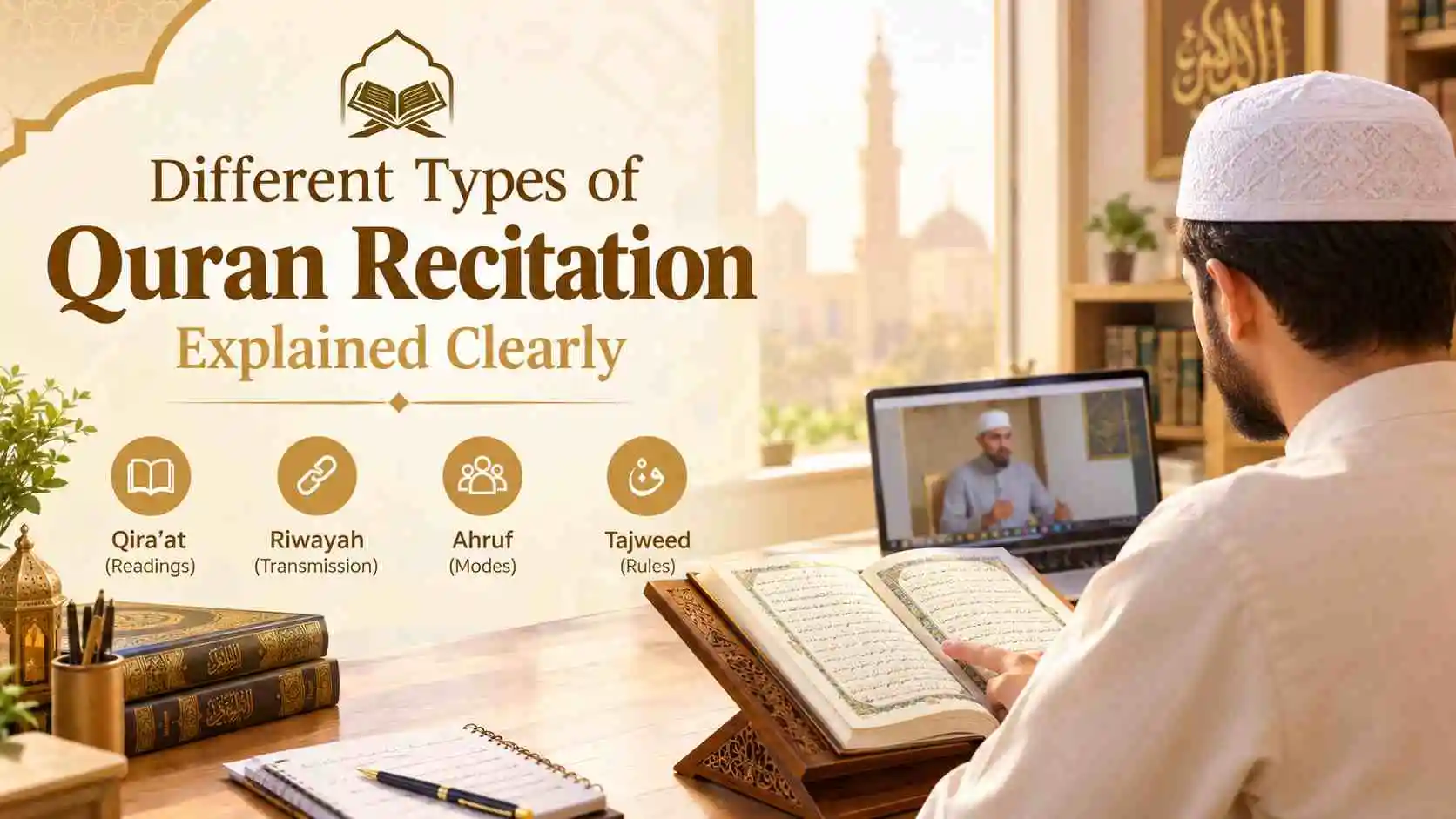
Qira’at, Riwayah, Ahruf, and Tajweed describe different aspects of Quranic transmission and recitation. Although these terms are often used together, they do not mean the same thing. Understanding the difference helps students recognize what a Qira’ah is, how a Riwayah is transmitted, what the Ahruf refers to, and how Tajweed applies during recitation.
| Term | What It Means | Simple Example |
|---|---|---|
| Qira’at | Recognized Quranic reading traditions transmitted through established chains | Qira’ah of Asim |
| Riwayah | A specific transmission of a Qira’ah through a narrator | Hafs from Asim |
| Ahruf | The broader modes of revelation mentioned in authentic Hadith | The Seven Ahruf |
| Tajweed | Rules governing correct pronunciation and recitation | Rules of Madd and Ghunnah |
How Many Authentic Quran Recitations Are There?
There are ten true Qira’at, which include the seven canonical Qira’at (Al-Qiraaat As-Sab’ah) and the three remaining Qiraaat (Al-Qiraaat Al-‘Ashr) that were said to be the missing Qiraat. There are other recitations mentioned by some scholars.
but they are not used in the main stream of recitation or printed copies and are less reliably transmitted. The study of qiraat quran in detail is indeed the study of these types of recitations of the quran and how each one of them was verified.
Join our Online Tajweed Course and learn to recite the Quran with confidence and accuracy.
The Seven Canonical Qira’at and Their Imams
The seven canonical Qira’at are so named according to their transmitting Imams, and not according to the area.
- Through Qalun and Warsh, Nafi’ (Madinah) told us.
- Ibn Kathir (Makkah) reported via Al-Bazzi and Qunbul.
- Abu Amr (Basra) related it from Ad-Duri and As-Susi.
- Ibn Amir (Damascus) narrated through Hisham and Ibn Dhakwan.
- Aasim (Kufa) recounted by Hafs & Shu’bah.
- He was narrated through Hamzah (Kufa) and Khalaf and Khallad.
- Al-Kisa’i (Kufa) narrated through Abul-Harith and Ad-Duri.
Enroll in our Islamic Studies Course Online and deepen your understanding of Islam from the comfort of your home.
The Three Additional Qira’at That Complete the Ten
The other three Qiraat are Abu Ja’far of Madinah, Ya’qub of Basra and Khalaf al-‘Ashir of Kufa. These are the same seven with the same thorough chain of narration, but less common today and outside of specialty circles. All ten make up the full recitation of quran in its entirety.
Join our Arabic Language Course and develop your speaking, reading, writing, and listening skills with experienced teachers.
How Qira’at Differ in Pronunciation, Vowels and Word Forms
There are subtle differences in the different types of quran recitation: The length of the vowel elongation (madd), whether the hamzah is pronounced or soft, and sometimes the vowel pattern of a word.
These quran recitation styles do not alter the meaning of any verse, only offer alternate renditions that have been verified of the same wordings being sent in different styles of quran recitation. The change is generally apparent in the first few verses with a trained ear.
Join our Online Quran Ijazah Course and earn authentic certification while mastering Quran recitation with qualified teachers.
Hafs and Warsh: Why Do They Sound Different?
The two most commonly used recitations today are those of Hafs and Warsh; the difference between hafs and warsh and all of them is primarily in the length of the madds and the pronunciation of the hamzah and a few word forms.
In general, the elongation in the Hafs and Asim is shorter, and the hamzah is crisp, while the elongation in the Warsh and Nafi is longer, and the hamzah is softer. Hafs an Asim is practiced in the majority of printed Mus’hafs in the world, while Warsh an Nafi is most prevalent in North and West Africa.
Join our Quran Memorization Course Online and memorize the Holy Quran with confidence through personalized guidance from qualified teachers.
How Recitation Speed Changes: Tahqeeq, Tarteel, Tadweer and Hadr
There are four known styles of quran recitation, not only what is preferred.
- Tahqeeq: slow and for learning and practicing the rules of Tajweed accurately.
- Tarteel: a measured, clear pace the style of tarteel quran recitation the Quran itself recommends for regular recitation.
- The medium rate of quran recitation speed between Tarteel and Hadr and is used in everyday recitation; it is called Tadweer.
- Tajweed Hadr: the quickest style; still follows Tajweed but with shortened elongation; used for quick revision.
Start learning Quranic Arabic with Noorani Qaida Online and build a strong foundation in correct pronunciation and Quran reading.
Why Were Different Quran Recitations Preserved?
Different kinds of quran reading were kept because each of them was proven as being authentic, and not created afterwards for ease of reading. Early scholars compared each Qira’ah orally and with reference to written copies to make sure that they did not lose anything or add anything. That is not the sole reason why the different types of quran recitation are historically important, along with being religious.
What Is Makhraj in Tajweed? A Complete Beginner’s Guide
How Scholars Determine Whether a Qira’ah Is Authentic
Scholars follow strict and specific criteria and, prior to accepting any recitation as genuine, will verify the authenticity of the recitation.
- A continuous, authenticated reportation chain of narration, starting from the Prophet ﷺ.
- The consistency of the Quran’s Arabic writing style (rasm).
- Correct, standard Arabic grammar and linguistic structures.
Quran Ahkam Tajweed Rules for Correct Quran Recitation
Where Are Different Quran Recitations Used Today?
Such diversity in the different types of quran recitation are not distributed equally around the globe, with Hafs an Asim being the dominant recitation and printed copies of the Quran in the majority of the Muslim world, Middle East and South Asia, and also in Turkey.
Wash an Nafi is the standard in most parts of North and West Africa including Morocco, Algeria and Nigeria, and parts of Mali. There are other Qiraats such as the Qalun that are still being taught in smaller pockets around the region, especially in Libya and Tunisia.
Basic Rules of Tajweed in English for Quran Recitation
Which Quran Recitation Should a Beginner Learn First?
Beginners should always begin with Hafs an Asim, it is widely taught, widely printed, and is the most compatible with the available learning resources. When it comes to learning quran recitations in this recitation first, it also becomes easier to locate a qualified teacher, as most of them are Hafs qualified teachers.
Top Online Quran Classes with Tajweed for USA Learners
How to Recognise the Recitation You Are Listening To
Recognizing a recitation comes down to listening for a few specific, consistent markers.
- Notice the length of vowel elongation longer, more melodic madd often signals Warsh.
- Listen for hamzah pronunciation softened hamzahs are a common Warsh trait.
- Check for slightly different word forms in specific verses, which vary by Qira’ah.
Tajweed Course Certificate Online With Certified Quran Teachers
Common Misunderstandings About Different Quran Recitations
The most common misunderstanding is assuming different types of quran recitation mean the text or meaning has changed it hasn’t; only verified pronunciation and transmission details differ. Another mistake is confusing Qira’at with regional accents, when each Qira’ah follows a documented chain of transmission and specific quran recitation rules. Some also assume only one recitation is “correct,” when in reality all ten are equally authentic.
Online Tajweed Classes for Sisters with Expert Female Quran Teachers
How to Start Learning Qira’at Correctly
Starting correctly means building a foundation before branching into multiple recitations.
- Master correct quran recitation pronunciation and Tajweed in Hafs an Asim first.
- Study the basic differences between Qira’at conceptually before attempting to switch.
- Work with a teacher holding a verified Ijazah in the specific Qira’ah you want to learn.
- Progress gradually most students spend years on one recitation before adding another.
Quran Tajweed With English Translation for Easy Learning
Learn Different Qira’at With Qualified Quran Teachers
Learning different types of Quran recitation requires more than memorizing pronunciation differences. A qualified teacher can explain the relationship between Qira’at, Riwayat, Ahruf, and Tajweed while correcting recitation according to an established transmission. Studying with experienced Quran teachers also helps students understand authentic differences without confusing them with mistakes or informal variations.
Ready to learn Quran recitation correctly? Start with a qualified Quran teacher and build your recitation skills through structured, guided lessons.
Frequently Asked Questions
Are the different Qira’at mentioned directly in the Quran itself?
No, the Quran does not name the specific Qira’at by their individual labels. The Seven ahruf and qiraat are mentioned in authentic Hadith, while the recognized Qira’at were later preserved and systematized by scholars through established chains of transmission and detailed scholarly criteria.
Can a single reciter switch between Hafs and Warsh in the same recitation?
In formal Quran recitation, a reciter should maintain one Riwayah consistently rather than switching between Hafs and Warsh during the same passage. Mixing features from different Riwayat without following an established scholarly method can lead to incorrect or inconsistent recitation.
Do all ten Qira’at appear in printed Mus’hafs?
No, printed Mus’hafs generally use one specific Riwayah rather than presenting all ten Qira’at together. Hafs an Asim is the most widely printed worldwide, while Warsh an Nafi is common in parts of North and West Africa, reflecting established regional traditions.
Is learning multiple Qira’at required for every Hafiz?
No, learning multiple Qira’at is not required for every Hafiz. A student can complete Quran memorization using one authentic Riwayah, such as Hafs an Asim. Studying additional Qira’at is an advanced field that usually requires strong memorization, Tajweed, and qualified instruction.