

One of the fastest methods to enhance a recitation that is flat, heavy, or unclear is the Hams Letters in Tajweed. These ten letters must be produced with a good “breathy” release, and often this is something that beginners don’t realize. This is a quality that aids in reading the Quran in a natural and correct manner. This guide will give a description of the Hams Letters in Tajweed rule, teach all 10 letters, explain makhraj for all letters, identify common errors, and include a quick quiz.
What Is Hams in Tajweed and What Does It Mean?
Hams in Tajweed refers to a sifah (characteristic) of the letters that are pronounced with a puff of air and the vocal cords remain relaxed during the pronunciation of such letters. Classical terms: the letters are also referred to as huruf al hams.
The Tajweed teaching of hams is one of the basic characteristics of Arabic letters, which is taught in parallel with makharij. By avoiding this airflow, a reading will sound stiff, and thus performing the Hams Letters in Tajweed from the beginning will create the foundation for a smooth and accurate recitation.
What Are the 10 Hams Letters in Tajweed?
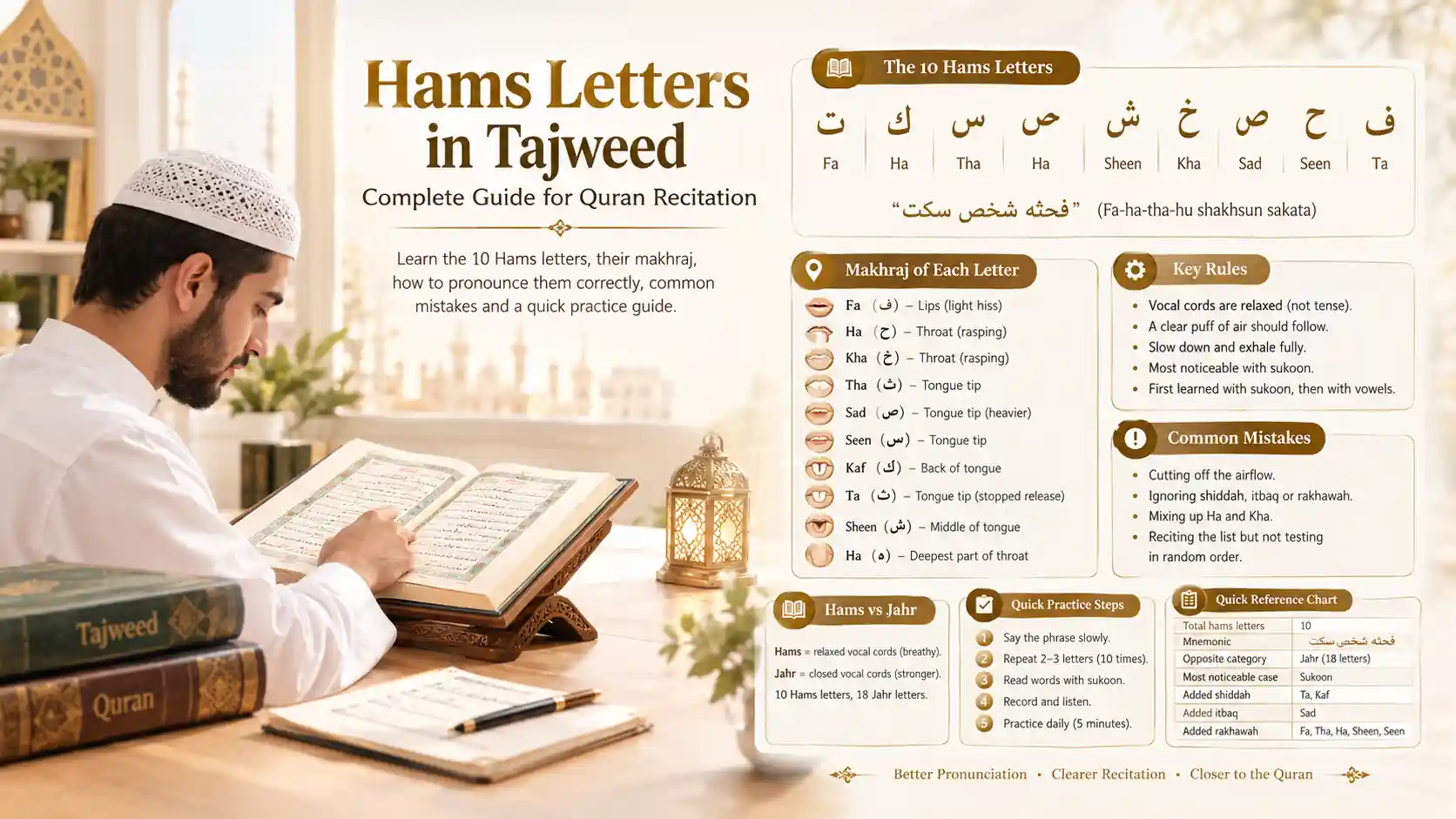
The 10 Hams Letters in Tajweed are memorized through the phrase “فحثه شخص سكت” (fa-ha-tha-hu shakhsun sakata) ten hams letters in Arabic packed into one sentence purely for recall.
| Letter | Sound |
|---|---|
| ف ح ث ه | Fa, Ha, Tha, Ha |
| ش خ ص | Sheen, Kha, Sad |
| س ك ت | Seen, Kaf, Ta |
Reciting this phrase daily locks the hams letters into memory before hams tajweed pronunciation drills begin.
Hamzatul Wasl and Hamzatul Qat Complete Tajweed Guide
How Does Hams Work With the Makhraj of Each Letter?
There are makhajs for each of the Hams Letters in Tajweed, and the airflow is different for each letter. Ha (ح) and Kha (خ) are made in the throat and have a rasping quality. Fa (ف) starts at the lip, giving a light hiss.
Tha, Sad, Seen, and Ta are positioned at the tip of the tongue, and Sheen is in the middle, while Kaf is placed further back. Ha (ه) is from the deepest part of the throat. The first step is to repair the makhraj so that the hams have some anchor to land on the air flow.
How Do You Pronounce Hams Letters Correctly?
The key thing in correct pronunciation is that the vocal cords are relaxed, not tense. A simple test: hold a hand near the mouth while saying a Hams Letters in Tajweed; a clear puff of air should follow it.
Those who are starting out tend to rush and cut off that flow. The way to overcome the majority of errors with this Sifah is to slightly slow down at each Hams Letter and exhale fully before the next letter of Tajweed.
Understanding the Importance of Tuhfat al Atfal for Tajweed
When Is Hams Most Noticeable During Quran Recitation?
The Hams letter is loudest when it is followed by a Hams letter with no vowel, as there will be no blocking of airflow that follows. If it has a vowel, the airflow is the same length but is less audible.
However, the Hams Letters in Tajweed are typically taught first with the skook letters as the reference point, before the letters with vowels, because it is easy to see the difference, and it helps the beginner to master the tajweed before moving to the letters that carry a vowel.
What Other Tajweed Characteristics Can Hams Letters Have?
There is no hams letter without a second sifah as well. Ta and Kaf make a stopped release sound (shiddah). Sad makes it a little heavier by giving it itbaq (a raised tongue). The rest Fa, Tha, HaHamsSheen, and Seen, form a pair of hams and a rakhawah (a flowing release). That is why there are no two Hams Letters in Tajweed that sound similar.rest,
Master Arabic Qalqalah Letters and Recite the Quran Correctly
Hams vs Jahr: What Is the Difference?
All Arabic letters are either hams or jahr, and the knowledge of hams and jahr makes both easier to learn. Jahr letters involve closing the vocal cords to produce a more powerful tone. Hams’ letters relax the cords, allowing the air to flow freely. Arabic consists of 28 letters, of which 10 are hams (jaahr is the one that has more).
The difference between hams and jahr (fa and ba) becomes obvious at a glance when compared with a jahr letter, like ba, and a hams letter, like fa.
Hams vs Jahr at a Glance:
| Feature | Hams (همس) | Jahr (جهر) |
|---|---|---|
| Meaning | Whisper | Sonority / voiced |
| Vocal cords | Relaxed — no vibration | Closed — vibrate |
| Airflow | Flows freely | Restricted, pressurized |
| Sound quality | Soft, breathy | Strong, resonant |
| Number of letters | 10 | 18 |
| Example letter | ف (fa) | ب (ba) |
| Example letter | هـ (ha) | ع (ayn) |
| Example letter | س (sin) | ز (zayn) |
| Mnemonic phrase | فَحَثَّهُ شَخْصٌ سَكَتَ | All remaining 18 letters |
How Can English Speakers Recognise Hams in Arabic?
English speakers have a voice/voiceless split that they are already accustomed to, like “v” versus “f. Although the articulation points of each consonant in English are different from those in Arabic, the voiceless English consonants have a similar breathy quality as the ham’s letters in Arabic.
It makes tajweed rules for beginners easier to learn because the rules are framed around a sound that is used in English every day.
How to Beautify Your Quran Recitation?
What Are the Most Common Mistakes With Hams Letters?
The most common error is that people often Hams Letters in Tajweed , making the flow of air vanish, particularly when performing sukoon. The second error is to use the same hams letter type for all the letters and ignore the shiddah, itbaq, or rakhawah that alters the appearance of the letters.
A third mixes up Ha and Kha because their makharij are near each other. A number of students are reciting the mnemonic but not testing the Hams Letters in random order, which means that they can recite the list, but they cannot tell, in the middle of a verse, which letter it is.
Quran Ahkam Tajweed Rules for Correct Quran Recitation
Hams Letters in Quranic Examples: How to Apply the Rule:
Use of hams letters in the examples of the Quran makes it a real reading skill because the sukoon cases are provided in the Quran in the natural way. Words that end with “fa” with “sukoon” should be preceded with a clear puff of air before the next word starts.
When reading words with Kaf or Ta under sukoon, the reader is tempted to cut the letter off short. The easiest way to use the Hams Letters in Tajweed rules in real words is to train the Hams Letters for each of the Hams Letters in a short passage first.
Different Types of Quran Recitation Explained Clearly
How to Practise Hams Letters Step by Step?
- Say it slowly, making sure there is airflow on each letter: “فحثه شخص سكت”.
- Choose two or three hams letters and repeat each 10 times, hand next to mouth.
- Read some words, marking the hams with sukoon first.
- Record the recitation and listen for any short breaths.
- Read the passage again the following day and compare.
Five minutes a day of the Hams letters in Tajweed is more effective for developing airflow control than one hour a week.
Join our Quran Memorization Course Online and memorize the Holy Quran with confidence through personalized guidance from qualified teachers.
Hams Letters Practice Test: Can You Identify Them:
Test yourself without looking back at the mnemonic:
- A word with Kha in the middle
- A word with Ta under sukoon at the end
- A word with Sad at the start
- A word with Ha as the final letter
Any letter that takes longer to spot needs more drilling using the routine above.
Join our Online Tajweed Course and learn to recite the Quran with confidence and accuracy.
Hams Letters Worksheet and Quick Reference Chart
| Category | Detail |
|---|---|
| Total hams letters | 10 |
| Mnemonic | فحثه شخص سكت |
| Opposite category | Jahr (18 letters) |
| Most noticeable case | Sukoon |
| Added shiddah | Ta, Kaf |
| Added itbaq | Sad |
| Added rakhawah | Fa, Tha, both Ha, Sheen, Seen |
Keep this chart nearby during practice to check any hams letter in seconds.
Join our Online Quran Ijazah Course and earn authentic certification while mastering Quran recitation with qualified teachers.
Start Improving Your Tajweed Today
Accurate Tajweed requires more than memorizing rules. Qualified Quran teachers can help learners understand the characteristics of Arabic letters, identify quran pronunciation rules mistakes, and apply each rule correctly during Quran recitation. With consistent practice, expert feedback, and a structured learning approach, students can develop stronger pronunciation and greater confidence in applying Hams and other Tajweed rules.
Ready to make your Quran recitation clearer and more accurate? Practice the Hams Letters in Tajweed regularly and learn with qualified Quran teachers who can listen to your pronunciation and provide direct correction. Structured Tajweed lessons can help you strengthen your makhraj, breath control, and overall recitation step by step.
Frequently Asked Questions
Is Hams the Same as a “Soft” Letter?
No. Hams describes the flow of breath when speaking the letter. “Soft” is a general word used to describe sound. Various characteristics may also be present in a Hams letter, such as Shiddah or Itbaq, which influence the strength, heaviness, and pronunciation of the letter.
Can a Letter Be Both Hams and Heavy?
Yes. Hams and heaviness are two different matters, so a letter may have both qualities. For example, Hams letters such as Kha and Sad may have more strength due to their additional qualities. Therefore, students should memorize each letter according to its complete set of Sifat al-Huruf.
Does Hams Change When a Letter Has a Vowel Instead of Sukoon?
With a vowel or Sukoon, Hams does not change. The airflow may be less noticeable when the letter has a vowel because the consonant sound blends with the vowel sound. Sukoon examples are simply easier for students to hear and practice the Hams quality.
How Long Does It Take to Master Hams?
This depends on the learner’s pronunciation ability, consistency, and access to correction. Many beginners can learn the 10 Hams letters within a few weeks with regular practice. Accurate pronunciation is usually learned more quickly when students are taught by a qualified Tajweed teacher who provides continuous feedback.