
Begin Your Quran Journey Today
Book a FREE trial class with a certified Quran teacher. No payment, no commitment.
Stop rules in Quran recitation tell you where to pause, where to keep going, and where a pause would change what a verse says. Small signs printed above the words carry most of these rules, so a reader who knows the 6 signs of the Madinah Mushaf can handle most pages. The hard part is the moment your breath runs out in the wrong place, and the one sign many readers skip without realizing it reverses a sentence.
What are the stop rules in Quran recitation?
Waqf is cutting your voice on a word long enough to take a breath, with the intention of carrying on. Restarting after it is called ibtida. Together they make up the waqf rules in tajweed, and they cover three questions: where you may stop, where you must not, and where you should begin again after the pause.
A related pause, saktah, is shorter, has no breath at all, and follows its own Quran rules of stopping in 4 fixed places. Every other stop on the page follows the stop rules in Quran recitation set out in the sections that follow, from the meaning-based types to the printed signs.
Why can a wrong stop change the meaning of a verse?
A wrong stop separates words that belong together, so the verse briefly says something it does not mean. Two examples make this clear. Stopping after لَا إِلَٰهَ says “there is no god,” the opposite of the full statement لَا إِلَٰهَ إِلَّا اللَّهُ. The two halves must always be joined.
In An-Nisa 4:43, stopping after لَا تَقْرَبُوا الصَّلَاةَ (“do not approach prayer”) drops the condition وَأَنتُمْ سُكَارَىٰ (“while you are intoxicated”). The command changes from a condition to a ban on prayer itself. This is why the Quran rules of stopping were written down by scholars and why printed copies mark the risky places.
Meem Saakin Rules in English for Quran Beginners
What are the 4 types of waqf by meaning?
Scholars divide stops into 4 types by how complete the meaning is: tamm (complete), kafi (sufficient), hasan (good) and qabih (poor). These categories are the base of the stopping rules in tajweed, and each one tells you two things: whether you may stop, and where to restart.
| Type | Meaning at the stop | Can you stop? | Where to restart |
|---|---|---|---|
| Tamm (complete) | Sentence and meaning are finished | Yes, the best place | The next word |
| Kafi (sufficient) | Sentence is finished, but the meaning links to what follows | Yes | The next word |
| Hasan (good) | The words make sense, but the grammar continues | Yes | An earlier word, unless it is the end of a verse |
| Qabih (poor) | The meaning is cut or changed | No | If breath forces a stop, an earlier word |
Think of tamm and kafi as the Quran full stop rules: you may stop and simply carry on from the next word. Hasan is closer to a comma, and qabih is a stop you avoid. An example of qabih is stopping after إِنَّ اللَّهَ لَا يَسْتَحْيِي in Al-Baqarah 2:26, which leaves the sentence saying something it does not mean.
Tajweed Classes Online for Kids with Expert Teachers
What do the stop signs in the Madinah Mushaf mean?
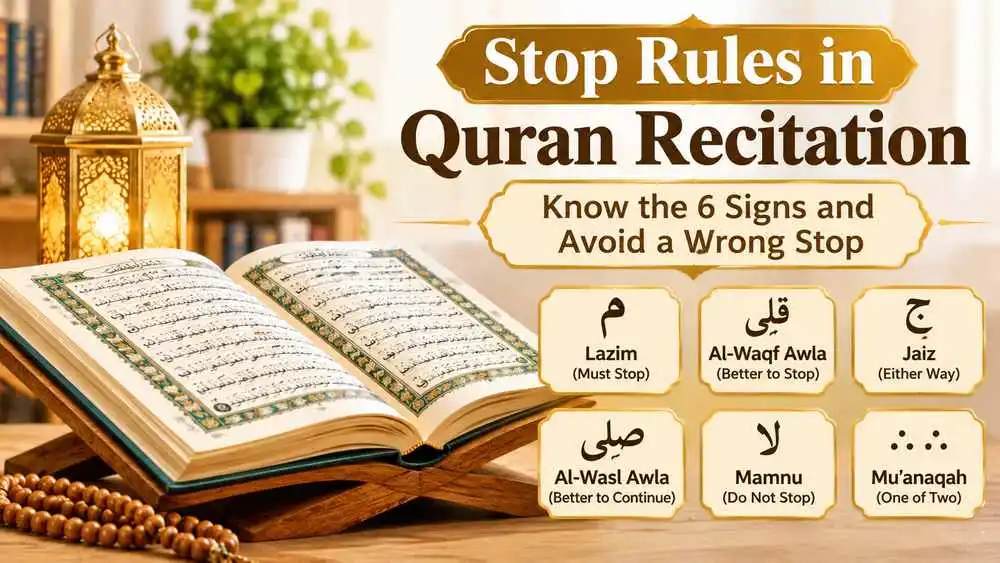
The Madinah Mushaf uses 6 tajweed stop signs, printed as small letters above the last word of a phrase. Each sign tells you whether stopping is required, preferred, equal, discouraged or limited to one of two places. Learn these 6 before anything else, since most Quran signs of stopping you meet will be one of them.
| Sign | Name | What it tells you |
|---|---|---|
| م | Lazim | You must stop |
| قلى | Al-waqf awla | Stopping is better |
| ج | Jaiz | Stopping and continuing are equal |
| صلى | Al-wasl awla | Continuing is better |
| لا | Mamnu | Do not stop |
| ∴ ∴ | Mu’anaqah | Stop at one of the two places, not both |
These 6 signs are the core stopping signs in tajweed. The sections that follow take them one at a time, starting with the strongest.
What does the meem sign (م) mean?
The meem sign (م) marks waqf lazim, the one stop in the waqf rules in tajweed you should never skip, because joining the two phrases would produce a wrong meaning. In Al-An’am 6:36, stop after يَسْمَعُونَ before reading وَالْمَوْتَىٰ يَبْعَثُهُمُ اللَّهُ. Without that stop, “the dead” would sound like part of the group that responds.
When can you choose to stop at ج, قلى and صلى?
Waqf jaiz is a permissible stop, and three signs show how much choice you have. With ج, stopping and continuing are equal. With قلى, you may continue, but stopping is preferred. With صلى, you may stop, but continuing is preferred. Both choices are correct at all three signs; the sign only tells you which one scholars favor.
Why should you avoid stopping at لا?
Waqf mamnu, marked لا, is a stop to avoid because it cuts a sentence and can leave an incomplete or wrong meaning. Typical places fall between a condition and its result, or between a verb and its object. If breath forces a stop there, go back one or two words and read the phrase again in full.
How does the three-dot sign (∴) work?
Mu’anaqah, the “embracing” sign, appears as two sets of three dots close together. You may stop at the first set or the second, but not at both. The best-known example is in Al-Baqarah 2:2: ذَٰلِكَ الْكِتَابُ لَا رَيْبَ ۛ فِيهِ ۛ هُدًى لِّلْمُتَّقِينَ. Stop after رَيْبَ or after فِيهِ, then read through the other mark.
Easy Way to Learn to Read Quran for Kids and Adults
Which extra signs appear in South Asian Mushafs?
Mushafs printed in India, Pakistan and Bangladesh add several tajweed rules stop signs that the Madinah Mushaf does not use. If your copy has a key at the back, check it first, because some printings define these signs slightly differently.
| Sign | Name | Common meaning |
|---|---|---|
| ط | Mutlaq | Absolute stop; better to stop |
| ز | Mujawwaz | Stopping is allowed, but continuing is better |
| ص | Murakhkhas | A long sentence; you may stop to breathe |
| قف | Qif | Stopping is recommended, but it is weaker than م |
Most of these overlap with the Madinah signs. The rule of thumb across all tajweed rules, stop signs included, is simple. When your copy and your teacher disagree, follow the copy you recite from and ask your teacher about the difference.
Hams Letters in Tajweed Complete Guide for Quran Recitation
What is saktah, and how is it different from waqf?
Saktah is a brief silence of 2 counts with no breath, while waqf includes a breath. It is the pause in the stopping rules in tajweed where taking air counts as a mistake. In the riwayah of Hafs, as recited in most of the Muslim world, saktah is required in 4 places, each marked with a small seen (س):
- عِوَجًا ۜ قَيِّمًا in Al-Kahf 18:1-2.
- مَرْقَدِنَا ۜ هَٰذَا in Ya-Sin 36:52.
- مَنْ ۜ رَاقٍ in Al-Qiyamah 75:27.
- بَلْ ۜ رَانَ in Al-Mutaffifin 83:14.
The most common error at these 4 places is taking a breath, which turns the saktah into a full stop.
Hamzatul Wasl and Hamzatul Qat Complete Tajweed Guide
How do you pronounce the last word when you stop?
When you stop, the last letter of the word loses its short vowel and takes a sukoon. This is one of the stopping rules in tajweed that applies at every pause, planned or forced. Two endings change more than that, and they are where most quran tajweed stopping rules mistakes happen:
- A word ending in fathatan (ـًا) is read with a long alif, so كِتَابًا becomes kitaabaa.
- A taa marbutah (ة) is read as a soft haa, so رَحْمَةً becomes rahmah.
Advanced readers also learn rawm and ishmam, two lighter ways of ending certain words, which a teacher can demonstrate in one lesson.
Join our Online Quran Ijazah Course and earn authentic certification while mastering Quran recitation with qualified teachers.
How do you restart after a stop?
Restart (ibtida) from a word where the phrase makes sense on its own. The waqf rules in tajweed treat the restart as seriously as the stop, because starting on the wrong word can break the meaning just as badly. The right restart depends on why you stopped, so use these 4 steps:
- Decide whether the stop was planned or forced by breath.
- After a tamm or kafi stop, which follow the Quran full stop rules, continue from the next word.
- After a forced stop or a hasan stop in mid-verse, go back to the start of the phrase.
- Never begin on a word that depends on the one before it, such as a pronoun or an object.
These are the Quran tajweed stopping rules readers forget most often, because a forced stop feels like an accident rather than a decision.
Join our Quran Memorization Course Online and memorize the Holy Quran with confidence through personalized guidance from qualified teachers.
How can you manage your breath during recitation?
Manage your breath by taking a full breath at verse ends and planning the next stop sign before you start a long phrase. Breath control turns stop rules in Quran recitation from a list you memorize into a habit you can rely on:
- Take a full breath at the end of a verse or at a stop sign.
- Glance ahead to the next sign before you start a long phrase.
- Recite at an even pace instead of rushing the end of a sentence.
- If you run short, stop on the last complete word with a sukoon, then restart from the beginning of the phrase.
- Repeat long verses slowly, adding a few words per breath each week.
Verse ends are your safest breathing points, which is why short verses are the best place to build the habit.
How to Beautify Your Quran Recitation?
What mistakes do readers make with waqf?
Five mistakes cause most problems with the Quran tajweed stopping rules, and each one has a quick fix. Most of them come from reading word by word instead of phrase by phrase, or from ignoring the Quran signs of stopping when breath runs short.
| Mistake | Fix |
|---|---|
| Stopping mid-phrase | Plan your breath before long verses |
| Stopping at a لا sign | Go back one or two words and read the phrase in full |
| Breathing during a saktah | Hold the silence for 2 counts without taking air |
| Restarting on the wrong word | Go back to the beginning of the phrase |
| Stretching the last letter | End it briefly with a sukoon |
The stop at لا and the forced restart are the two a listener notices fastest, because they change the meaning of the sentence.
How can beginners learn the stopping signs?
Beginners learn the stopping signs in tajweed fastest a few at a time, starting with م and لا, which carry the most risk. Next come the three choice signs, the three-dot sign, and any other tajweed rules, stop signs and marks your copy uses. A short surah read daily teaches more than a chart of tajweed stop signs.
A practice plan for stop rules in Quran recitation
This plan uses one short surah and takes about 10 minutes a day. It starts with the Quran full stop rules, so you learn where a complete stop is safe, and then adds the signs that ask you to choose or continue:
- Pick a short surah and circle every stop sign in pencil.
- Write the meaning of each of the tajweed stop signs in the margin.
- Recite slowly, pausing only where the sign allows it.
- Record yourself and compare it with a teacher or a trusted reciter.
- Repeat the same surah for 3 days before you add a new one.
Our online tajweed course covers pausing and starting points at the intermediate level, so you can practice these signs with live feedback.
Do you want someone to check where you stop? At Quran Beauty Academy, Ijazah-certified tutors, many of them Al-Azhar graduates, teach live 30-minute one-on-one classes. They correct your stops, restarts and breathing as you recite. Book your free trial class to meet your tutor and get a level assessment.
Where should you start?
Start with the Quran signs of stopping in Al-Fatihah and the last 10 surahs of the Quran, since you recite them daily. Mark every sign in pencil, read each surah for 3 days, and check your restarts. When you want a teacher to hear it, book a free trial class and recite those surahs to your tutor.
Frequently asked questions about the Quran rules of stopping
Do stop rules in Quran recitation apply in prayer?
Yes. The same stop rules in Quran recitation apply in prayer as outside it, because a wrong stop changes the meaning wherever you recite. In prayer, choose shorter passages if you struggle with breath, so you can pause at verse ends and signs without stopping in the middle of a phrase.
Are the stopping signs part of the revelation?
No. The stopping signs in tajweed were added later by scholars of recitation to help readers keep the meaning while they pause. The revealed text itself is unchanged; the signs sit above it like punctuation. This is also why different printings sometimes place a sign differently, or use a different sign for the same place.
Can you stop in the middle of a verse where there is no sign?
Yes, if the words before the stop make sense on their own. An unmarked place usually means the scholars saw no special reason to stop or continue there. If the meaning is complete, carry on from the next word; if it is not, go back to an earlier word when you restart.
Can you stop at the end of every verse?
Yes. Most teachers allow a stop at the end of every verse, even when the meaning continues into the next one. If a لا sign sits on the last word of a verse, you may still stop there. Restarting from the next verse is acceptable, though some teachers prefer you continue when the link is strong.