
Losing fluency in the recitation of the Quran is considered worse than not knowing its meaning, so if you can recite fluently, but don’t understand, now is the time to Learn Arabic Grammar for Understanding Quran for meaning, not just polish Tajweed. Nahw and Sarf are the two sciences which make it possible to identify the meaning of the words in Arabic scattered in the book, word by word, without waiting for someone else to translate.
How to Learn Arabic Grammar for Understanding Quran?
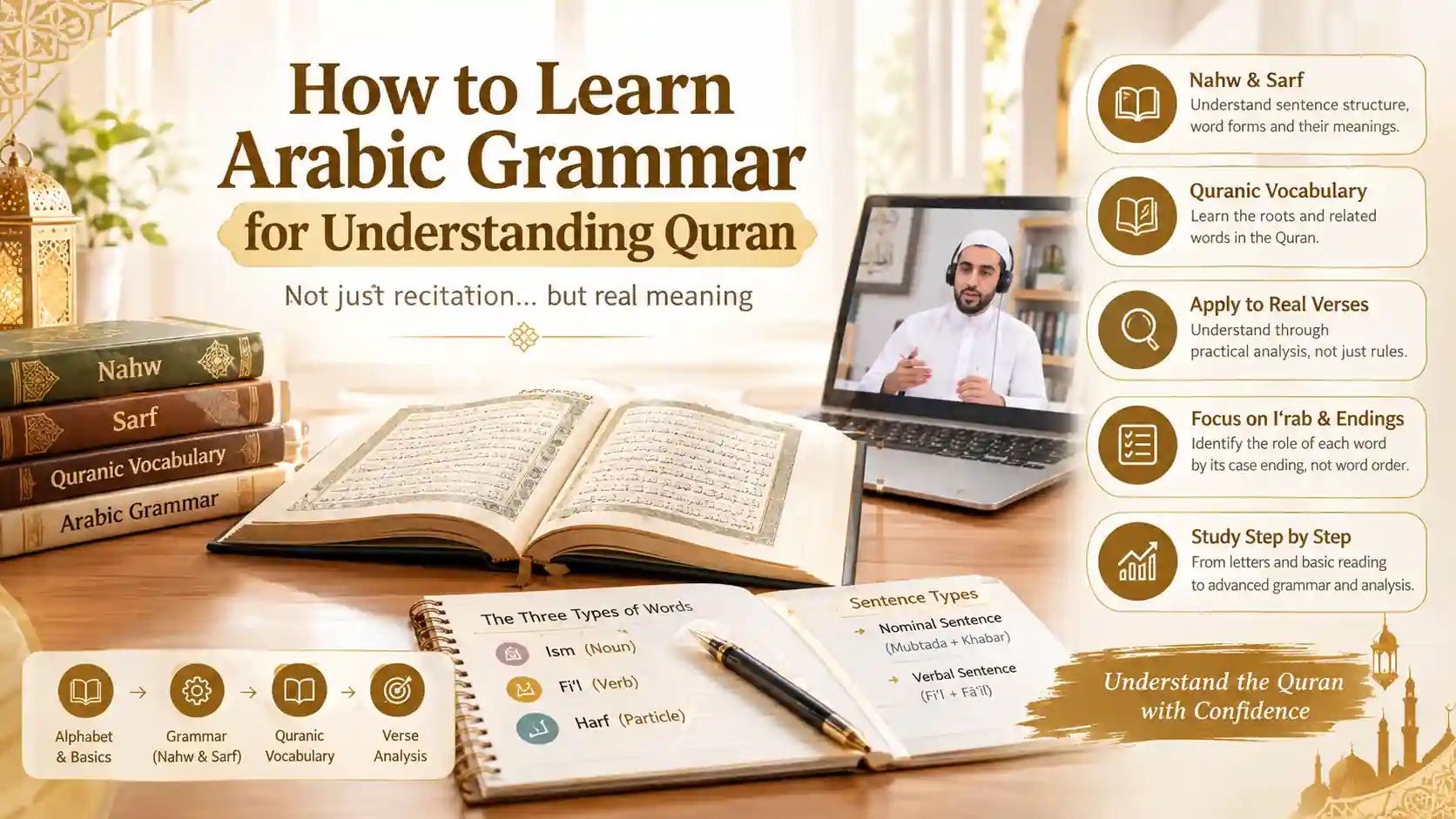
Learn Arabic Grammar for Understanding Quran is done through a combination of Nahw (syntax) and Sarf (morphology), as well as important Quranic vocabulary, and then applied to actual verses, not memorized rules.
Nahw demonstrates the relationship of subject, object, and role. Sarf gives examples of how a single word can be transformed into a dozen of related words. When done with short verse analysis, sequencing helps to differentiate between those who can read and those who can only recite.
What Does Arabic Grammar Have to Do With Understanding the Quran?
In Arabic grammar, it is the grammar that determines who is doing what to whom, and without it, even if you know every word, you could still misread the way the words are connected. A translation does not reveal the reason for the Arabic’s meaning.
It only provides the agreed meaning of one scholar. Therefore, it has been emphasized that before learning tafsir without any doubt at all, the classical scholars recommend learning the Arabic language, as grammar enables you to verify the meaning rather than get it second-hand.
What Is Noor Al Bayan? Learn Quran Reading Step by Step
What Should You Learn Before Studying Quranic Grammar?
One can’t really start learning grammar without recognizing letters, reading basic words fluently, and building a small vocabulary. Attempting to learn quranic arabic grammar without being able to read the letters properly will cause you to have to focus on decoding and analysis. learn online quranic arabic will begin with a short foundations stage alphabet, short vowels and simple reading before mubtada or majrur arise.
The Three Types of Arabic Words You Need to Recognise:
There are three types of words in the Quran:
- Ism (noun) names a person, place, thing or idea; has case endings.
- Fi’l, verb, an action that is related to a time: past, present, or command.
- Harf (particle): a word that can be used as a connector (“in,” “and,” “from”) only in combination with other words.
The first true skill that anyone should Learn Arabic Grammar for Understanding Quran is to label a word on sight.
Best Way to Learn Fusha Arabic Ultimate Beginner Guide
How Quranic Sentences Are Built?
There are two types of sentences in Quranic Arabic. A mubtada khabar pair a topic and what is said about it is the basis for a nominal sentence. A verbal sentence has a verb in the front, and the action is the main part of the sentence.
Emphasis is frequently put on nominal sentences arabic constructions, and verbal ones marking an event occurring. If you find the first word, you’ll be able to rule out what you don’t need to look for as you read the rest of the line.
Online Arabic Classes for Adults – Learn Arabic from Home
How Nahw Changes the Meaning of a Quranic Verse?
The same ‘case’ (arabic grammar) that ends a word can cause a change in the way the verse is described, which changes its subject. For Arabic, it’s not the words that tell you where to start or not, it’s the short vowels at the end of a word.
identical words in identical order, can mean opposite things, proof you cannot learn Arabic grammar for understanding quran from guessing only by word sequence.
Arabic language origin tree Complete Guide to Its History
How Sarf Helps You Understand Unfamiliar Quranic Words?
The vast majority of the vocabulary in the Quran is composed from three-letter roots, and no one knows more than a handful of them, so if one gets a handle on the meanings of a root, other closely related forms are easy to spot and don’t require random guessing.
The word “Kataba” (he wrote) comes from common roots with the word “kitab” (book) and the word “maktab” (office). This is because it allows a reader to deduce the meaning of an unknown word in Arabic from its form without referring to other books, a fundamental principle in the Learn Arabic Grammar for Understanding Quran.
Ace Your Arabic Test with Online Proficiency Classes
Understanding I’rab and Arabic Case Endings:
The system of case ending that are used in the Arabic language to indicate if a noun is a subject, an object, or a possessive is called I’rab. There are three noun cases (marfoo’, mansoob, majroor) and similar verb cases. The ambiguity above is resolved by reading i’rab correctly, as the ending and not word order will determine the job of a word.
Basic Arabic Lessons for Beginners Step by Step Guide
The Most Important Quranic Grammar Rules for Beginners:
New learners of nahw arabic grammar will benefit most, initially, from a short set of rules:
- Recognize sentences that are nominal or verbal.
- Understand how to identify and use the three noun cases and their markers (damma, fatha, kasra).
- Identify the definite article “al-“, and the role it plays in the function of a noun.
- Study attached pronouns, as they are found on nouns, verbs and particles.
- Understand the most common particles (fī, mīn, Īlāh, ʾalāh) and the cases they require.
How to Learn Arabic Grammar for Understanding Quran With a Live Teacher?
Translation is the greatest difficulty with self-study, and studying Arabic grammar online and learning from a live, 1-on-1 teacher is the remedy. The Arabic Language Course by Quran Beauty Online combines native Arabic teachers, who have received Ijazah in the recitation of the Qur’an, with intensive 30-minute lessons in three levels one for the advanced level, where you will learn to understand Quranic Arabic.
How to Analyse a Quranic Verse Step by Step?
Good Grammar analysis of the Qur’ān always proceeds in the same order:
- Say whether each word is a ism, a fi’l or a harf.
- Determine whether it is a nominal or verbal sentence.
- Find the mubtada and khabar, verb and subject.
- To determine the case ending of each noun, check for its role.
- Compare your reading with another translation and/or tafsir that you trust.
Having the structure recognized in short verses first will help you to skip these steps in familiar verses.
Amazing 10 Facts About Arabic Language You Must Know
How Quranic Vocabulary and Grammar Work Together?
Grammar provides structure, Quranic vocabulary gives meaning, and they both grow best when combined. If you have some knowledge of grammar but not much linguistic knowledge, you can identify the subject of a sentence without knowing what it is. This is because quranic arabic for beginners courses teach a new rule and the vocabulary for applying it in the same course.
How to Use Translation and Tafsir While Learning Arabic?
Translation and tafsir are checkpoints for your own reading, not replacements for it this is what lets you learn quranic arabic instead of only learning about it. Analyze a verse yourself first, then compare it against a reliable translation. As the gap narrows, it confirms your grammar is genuinely improving.
Intensive Online Arabic Classes for Fast Arabic Fluency
A Practical Study Plan for Learning Quranic Arabic Grammar:
A realistic plan to learn quranic arabic online moves through stages rather than covering everything at once:
| Stage | Focus | Duration |
|---|---|---|
| Foundations | Alphabet, short vowels, reading | 1–2 months |
| Core Grammar | Word types, sentence types, i’rab | 3–5 months |
| Applied Analysis | Parsing real verses with a teacher | Ongoing, weekly |
| Independent Reading | Checking your own analysis against tafsir | Ongoing |
Pace differs by student, but the order reading, then grammar, then applied quranic grammar analysis stays roughly the same for anyone who wants to learn Arabic grammar for understanding Quran properly rather than in a rushed, scattered way.
How to Learn Basic Arabic Quickly: Beginner Guide?
How to Measure Your Progress in Understanding the Quran?
Real progress isn’t how many rules you’ve memorized, but whether you can correctly identify sentence type, word roles, and case endings in a verse you haven’t studied before. Weekly checkpoints with a teacher help, since self-assessment tends to overestimate reading and underestimate grammar recall. Track how often you still need a translation for a simple verse versus how often you follow it directly that ratio should keep improving as you continue to learn Arabic grammar for understanding Quran.
Learn Arabic in English Step by Step for Complete Beginners
Start Learning With Guidance, Not Guesswork:
Quran Beauty Online supports students who want to build a stronger understanding of Quranic Arabic through structured, live instruction. Its Arabic Language Course combines grammar, vocabulary, reading practice, and practical verse analysis with guidance from qualified teachers. Instead of relying only on memorized rules or translations, students can receive direct feedback while developing their ability to recognize Arabic structures and understand Quranic language more confidently.
Learning Arabic grammar can transform the way you approach Quranic verses, helping you recognize word roles, sentence structures, and meanings more independently. Quran Beauty Online offers live Arabic Language Courses with qualified teachers who can guide you through Nahw, Sarf, Quranic vocabulary, and verse analysis. Book your free trial class today and start building the skills needed to understand the Quran more directly.
Frequently Asked Questions
Do I need to finish learning to read Arabic before starting grammar?
No. You do not need advanced Arabic reading skills before beginning grammar. Once you can recognize Arabic letters, vowels, and simple words comfortably, you can gradually study basic grammar alongside reading. This approach allows both skills to develop together through consistent practice.
Is Quranic Arabic grammar the same as Modern Standard Arabic grammar?
Quranic Arabic and Modern Standard Arabic share the Importance of Studying Arabic Language foundations in Nahw and Sarf, but they are not identical. Quranic Arabic contains classical vocabulary, expressions, grammatical structures, and rhetorical features that may appear less frequently in contemporary Modern Standard Arabic.
Can I learn Arabic grammar for understanding Quran online with a live teacher?
Yes. Online lessons with a live teacher can provide structured instruction in Quranic grammar while allowing immediate correction. A teacher can explain sentence structures, case endings, vocabulary patterns, and verse analysis according to your level, helping you avoid repeating mistakes during independent study.
How long until I notice a real difference in understanding the Quran?
Progress depends on your reading ability, study schedule, vocabulary, and consistency. Many learners begin recognizing basic sentence structures and word roles after several months of regular study. Developing broader independent comprehension usually takes longer and requires continued grammar, vocabulary, reading, and verse analysis practice.