

Intensive online Arabic classes are the fastest path to real fluency — if you pick the right program and know what you’re walking into. This guide covers everything: how to choose between Fusha and dialects, how to survive a high-speed curriculum without burning out, how to set up your home environment for genuine immersion, and how to keep your Arabic alive long after the program ends. Whether you’re in Oslo, London, or New York, you’ll leave knowing exactly what to do next.
How Many Hours Do Intensive Online Arabic Classes Require?
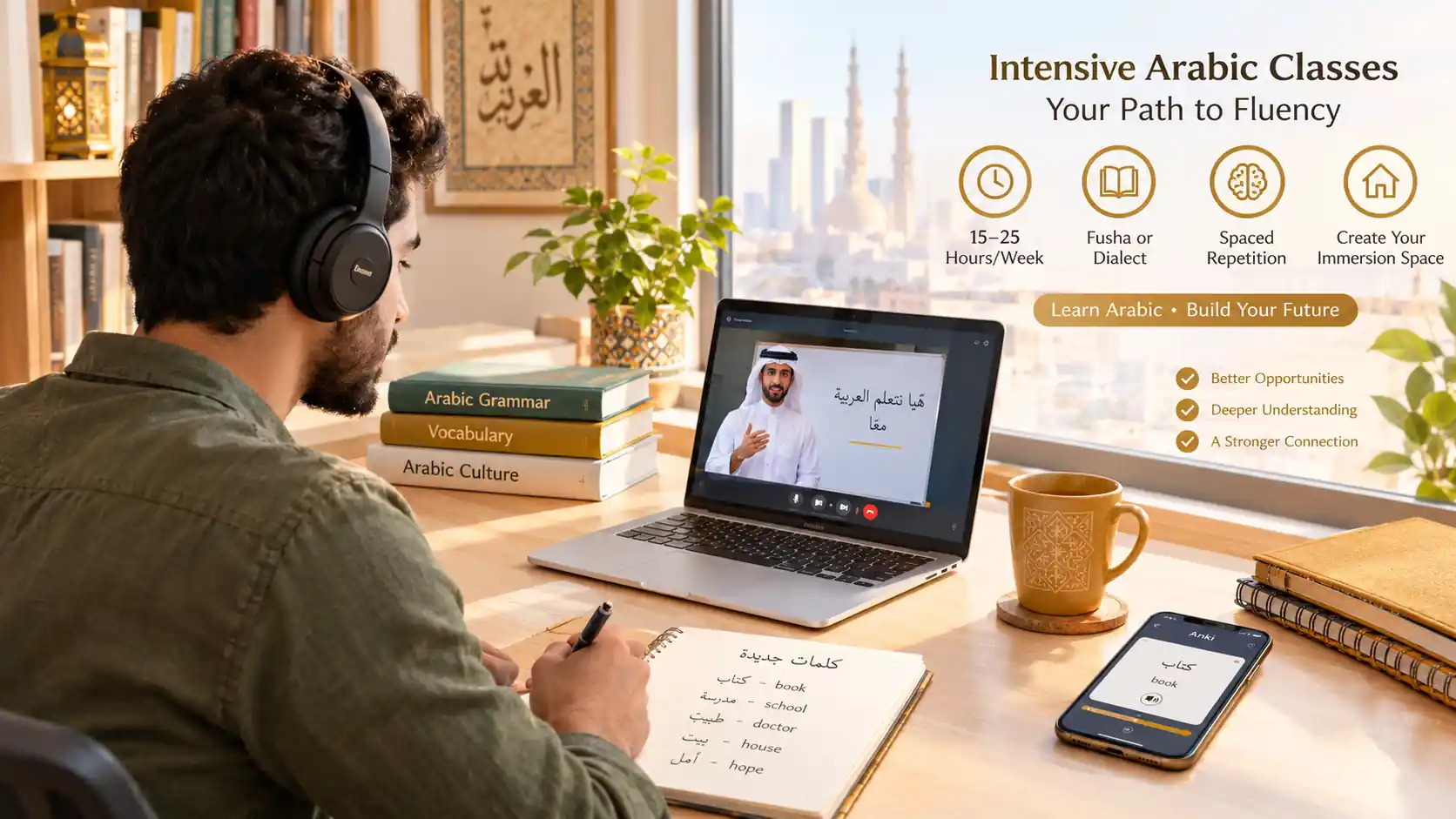
Most intensive online Arabic classes run between 15 and 25 hours of structured study per week. That’s not a typo. Unlike a casual evening course, an intensive program treats language learning as a second job — and your progress depends entirely on treating it that way.
Here’s what a typical week looks like:
- Live instruction: 8–12 hours (daily sessions of 90–120 minutes)
- Homework and review: 4–6 hours
- Self-study and immersion activities: 3–7 hours
ExploreOnline Quran, Arabic & Islamic Studies courses
Should you learn Fusha or a dialect when time is short?
The answer depends on why you’re learning Arabic — and there’s no universally correct choice.
Modern Standard Arabic (Fusha) is the written lingua franca of the Arab world. It’s used in news broadcasts, official documents, literature, and the Quran. If your goal involves reading, writing, religious study, or communicating formally across multiple Arab countries, Fusha is the foundation you need.
Regional dialects — Egyptian, Levantine, Gulf, Moroccan — are what people actually speak at home, in markets, and on social media. Egyptian Arabic, for instance, is widely understood across the Arab world due to Egypt’s media influence.
For intensive online Arabic classes, the practical recommendation is:
- Fusha first if you need written proficiency, work in journalism, policy, or Islamic studies
- Dialect first if your goal is conversational fluency for travel, relationships, or regional business
- Hybrid track if your program offers it — Fusha grammar with dialect conversation practice
Most top-rated intensive programs now offer both tracks. Ask explicitly before enrolling which the curriculum prioritizes, because switching mid-course is expensive in both time and money.
What Is Noor Al Bayan? Learn Quran Reading Step by Step
How to Memorize Arabic Vocabulary Faster?
The honest answer: spaced repetition combined with contextual exposure. Rote memorization of word lists is the slowest approach — and in intensive online Arabic classes, slow is the enemy.
Spaced Repetition Systems (SRS):
Tools like Anki allow you to review vocabulary at scientifically optimized intervals, just before you’d forget it. Research published in Psychological Science confirms SRS outperforms massed practice for long-term retention.
Active recall over passive review:
Instead of re-reading your notes, close them and write down everything you remember. The act of retrieval strengthens memory more than re-exposure.
Root-pattern recognition:
Arabic is a root-based language. Learning that the root ك-ت-ب (k-t-b) relates to writing gives you access to كتب (wrote), كتاب (book), مكتبة (library), and كاتب (writer) simultaneously. Investing 30 minutes in root logic saves hours of rote memorization later.
For Arabic script specifically: don’t avoid it. Studies on second-language acquisition consistently show that learning to read a script alongside vocabulary dramatically improves both retention and pronunciation accuracy.
Online Arabic Classes for Adults – Learn Arabic from Home
Why Do Students Quit Intensive Arabic Courses?
Burnout in intensive online Arabic classes usually follows the same pattern: strong start, plateau around week two, mounting frustration, dropout by week four. Understanding this arc in advance gives you a real edge.
The plateau is neurological, not personal. When input volume exceeds consolidation time, the brain essentially pauses forward progress to integrate what it’s already received. This is normal. It passes. The people who quit during the plateau are the ones who interpret it as failure.
Practical prevention strategies:
- Schedule deliberate rest. One full day off per week isn’t laziness — it’s when your hippocampus does the organizing work that makes the next week’s input stick.
- Track wins, not gaps. Keep a one-sentence daily log of something new you understood or said. Progress in language is invisible on any given day and visible across months.
- Change your input format. If live classes feel overwhelming, switch to passive immersion (Arabic podcasts, YouTube) for one session. It’s still study. Your brain won’t know the difference.
- Talk to your instructor early. Good intensive programs have seen this before. A pacing adjustment in week two beats a complete withdrawal in week five.
Best Way to Learn Fusha Arabic Ultimate Beginner Guide
What equipment and environment do you actually need for intensive online Arabic classes?
Your home setup matters more than most students realize. Poor audio quality alone can derail pronunciation learning, since Arabic phonemes — particularly the emphatic consonants and pharyngeal sounds — are extremely sensitive to audio distortion.
Non-negotiable technical requirements:
- Headset with a boom microphone: Not earbuds. A proper headset positions the mic correctly and eliminates echo. The Jabra Evolve2 30 (~$80) is a reliable mid-range option.
- Stable internet connection: Minimum 25 Mbps for video call quality. Use a wired ethernet connection if possible — WiFi fluctuations interrupt live pronunciation feedback at exactly the wrong moment.
- Dedicated quiet space: Arabic pronunciation practice requires you to produce sounds out loud repeatedly. A shared living room with background noise is a genuine obstacle.
Useful additions:
- A second monitor or tablet for displaying your Anki deck or reference notes during class
- An Arabic keyboard sticker set (about $8) to build typing muscle memory faster than on-screen keyboards allow
- Digital whiteboard app (Miro or Notability on iPad) for practicing Arabic script in real time with your tutor
Arabic language origin tree Complete Guide to Its History
How do intensive Arabic programs handle students spread across multiple time zones?
This is one of the most practical questions and one of the least-addressed on most school websites. The gap between Norway (CET/CEST), the UK (GMT/BST), and US time zones (EST to PST) spans anywhere from 6 to 11 hours — enough to make a fixed schedule genuinely inaccessible for part of your cohort.
The best intensive online Arabic classes solve this in one of three ways:
- Asynchronous-first design: Core content is delivered via pre-recorded modules that you watch on your own schedule. Live sessions (conversation practice, Q&A) are offered at multiple times across the week so you can choose the slot that fits.
- Regional cohort grouping: Programs with enough students create separate Europe-morning and US-afternoon cohorts. This gives you live interaction without 6am alarms.
- Recorded live sessions: Every live class is recorded and made available within 24 hours. Students who miss a session due to time zone friction can watch the recording and submit written responses asynchronously.
When evaluating programs, ask directly: “What happens if I miss a live session? Is the recording available? Are there live options outside standard Cairo or Amman business hours?” The answer tells you more about a school’s commitment to international students than any marketing copy will.
Basic Arabic Lessons for Beginners Step by Step Guide
What should you do before day one of your intensive Arabic program?
The students who hit the ground running in intensive online Arabic classes share one trait: they arrive with zero surprises. Everything that can be learned before week one should be.
Two to three weeks before start:
- Learn the Arabic alphabet. This sounds obvious, but many students arrive without it. Apps like Alif Baa or the free resources at Madinah Arabic cover the script in 10–15 hours of self-study. Arriving able to read — even slowly — frees your first week’s cognitive load for actual vocabulary and grammar.
- Install and configure your SRS app. Set up Anki, load an Arabic frequency deck (the “Arabic 5000 Most Frequent Words” deck is widely recommended), and start a small daily habit of 15 minutes. You’ll arrive with a foundation.
- Set up your technical environment. Test your headset, internet connection, and the video platform your school uses. Do a trial call with a friend. Eliminate surprises before they eat into class time.
One week before:
- Establish a sleep schedule that supports your class time. If you’re in Norway and your live sessions start at 8am Cairo time (which is 7am your time in winter), shift your wake-up 30 minutes earlier each day for a week.
- Read your program’s syllabus. Map out which skills are covered in which weeks. Knowing what’s coming reduces first-week anxiety dramatically.
Amazing 10 Facts About Arabic Language You Must Know
How do intensive programs measure your progress — and what does real improvement look like?
Most reputable intensive online Arabic classes align their assessments to the CEFR (Common European Framework of Reference for Languages), which gives you a standardized benchmark that’s meaningful beyond any single school’s internal grading.
The six CEFR levels for Arabic learners in practice:
| CEFR Level | What You Can Do |
|---|---|
| A1 | Introduce yourself, handle very basic transactions |
| A2 | Understand familiar topics, simple conversations |
| B1 | Navigate everyday situations, express opinions |
| B2 | Understand complex topics, fluent interaction |
| C1 | Express ideas fluently and spontaneously |
| C2 | Full mastery, equivalent to educated native |
Most intensive programs target A1 to B1 in a 3–6 month sprint, which is ambitious but achievable with consistent effort. Progress assessments typically include weekly vocabulary quizzes, bi-weekly speaking evaluations with your tutor, and end-of-module written tests.
The most meaningful progress marker, though, isn’t any test. It’s the moment you stop translating in your head and start understanding Arabic directly. Most intensive students report this happening somewhere between weeks six and ten — a distinct cognitive shift that no exam captures but every learner recognizes immediately.
Learn Arabic in English Step by Step for Complete Beginners
Is a hybrid approach — private tutor plus group class — worth the extra cost?
For most serious learners, yes. Here’s why the hybrid model works better than either format alone.
What group intensive online Arabic classes give you?
- Peer accountability (showing up for a cohort is socially reinforced in a way that solo study isn’t)
- Exposure to different accents and speaking styles within your learning level
- Structured curriculum with a defined weekly pace
- Lower per-hour cost
What private 1-on-1 tutoring adds?
- Immediate correction of your specific errors, not the group’s
- Ability to slow down or accelerate based on your actual comprehension
- Pronunciation drilling that a group format can’t accommodate
- A relationship with a teacher who knows your learning history
The optimal structure, based on what works for motivated adult learners: three group sessions per week for curriculum progress and peer interaction, plus one 45-minute private session for targeted error correction and speaking confidence. The private session doesn’t need to cover new material — its job is to fix what the group sessions are producing.
At Quran Beauty Online, this hybrid model is built into the program structure, so students don’t have to piece it together themselves.
How to Learn Basic Arabic Quickly: Beginner Guide?
What happens to your Arabic if you stop studying after the intensive program?
Without maintenance, language skills decay — and Arabic, due to its morphological complexity, decays faster than many other languages. Research on language attrition shows measurable decline within three to six months of stopping active use
The good news: maintenance requires far less effort than acquisition. A realistic post-intensive routine that preserves B1-level Arabic:
Daily (15–20 minutes):
- Anki review of your existing deck (no new cards required)
- 10 minutes of Arabic media: a news clip from Al Jazeera, an episode of an Arabic podcast, or a short YouTube video
Weekly (1–2 hours):
- One conversation session with a tutor or a native speaker via iTalki or a language exchange app
- Reading one short article in Arabic — the Al Jazeera Children’s website is accessible and surprisingly engaging for adult learners maintaining A2–B1 proficiency
Monthly:
- Reassess your vocabulary deck and retire cards you consistently answer correctly
- Add 50–100 new cards from a domain relevant to your goals (business, religious texts, current events)
The students who maintain fluency long-term aren’t the ones who trained hardest — they’re the ones who built small, sustainable habits that don’t require willpower to sustain.
Ace Your Arabic Test with Online Proficiency Classes
Arabic Classes Schedule and Fees
Choose the class schedule that best fits your learning goals and availability. Our flexible online Arabic classes are available from two to five classes per week, with monthly plans designed to make consistent learning simple and accessible. For students focused on Quran memorization, we also offer a dedicated Hifz program with 20 hours of classes per month.
| Schedule / Week | Classes per Month | Fee |
|---|---|---|
| 2 Classes / Week | 08 / Month | $28 / Month |
| 3 Classes / Week | 12 / Month | $43 / Month |
| 4 Classes / Week | 16 / Month | $56 / Month |
| 5 Classes / Week | 20 / Month | $70 / Month |
| Hifz Classes (hour) | 20 h / Month | $125 / Month |
Conclusion
Intensive online Arabic classes are genuinely one of the most efficient ways to build Arabic proficiency as an adult — but only when you go in prepared. Choose your dialect or Fusha track deliberately. Protect your schedule before you enroll. Set up your environment. Use spaced repetition. And when the plateau hits around week two, keep going.
If you’re ready to start with a program that handles the structure so you can focus on the language, Quran Beauty Online offers a free trial lesson — no commitment required. Book your session today and find out which track fits your goals.
Frequently Asked Questions
Can you reach conversational fluency in Arabic through an online intensive program alone?
Yes, but “conversational fluency” needs defining. At B1 level — handling everyday situations, expressing opinions, following most conversations on familiar topics — online intensive Arabic classes are fully capable of getting you there in 4–6 months with consistent effort. C1 or C2 mastery requires sustained years of use beyond any single program.
Do intensive online Arabic classes provide recognized certificates of completion?
It varies by school. Reputable programs issue certificates aligned to CEFR levels, which carry weight with employers and academic institutions. Some schools also offer preparation for ACTFL or ALPT (Arabic Language Proficiency Test) examinations. Always ask for the specific certification standard before enrolling — a certificate that names only the school’s own internal level is less useful professionally.
How do I know if I’m ready for an intensive format vs. a regular course?
The honest question is whether you can protect 3–4 hours of focused study daily for the duration of the program. Schedule availability matters more than prior language experience. If you’ve studied other languages before, you’ll adapt faster to the learning mechanics — but a true beginner with a clear schedule can succeed in an intensive format. Most programs offer a placement assessment that also gauges learning readiness.
What is the cost difference between intensive and standard online Arabic classes?
Intensive programs typically run $200–$600 per month depending on format (group vs. private), school reputation, and session frequency. Standard courses usually cost $50–$200 monthly. The higher cost of intensive programs reflects the volume of live instruction hours — not simply the label “intensive.” When comparing programs, calculate the cost per live instruction hour rather than the monthly headline price.