All parents hope that their children will be raised in the knowledge of Allah and love of Islam, but many don’t know how they can do this. The islamic knowledge for kid learner is best delivered gradually in accordance with the child’s age and integrated into their everyday lives. Through this guide you will know what to teach, when to teach it, and how to make it enjoyable so your child can develop a strong sense of faith that you can carry both into the future and beyond.
islamic knowledge for kid: What to Teach at Each Age?
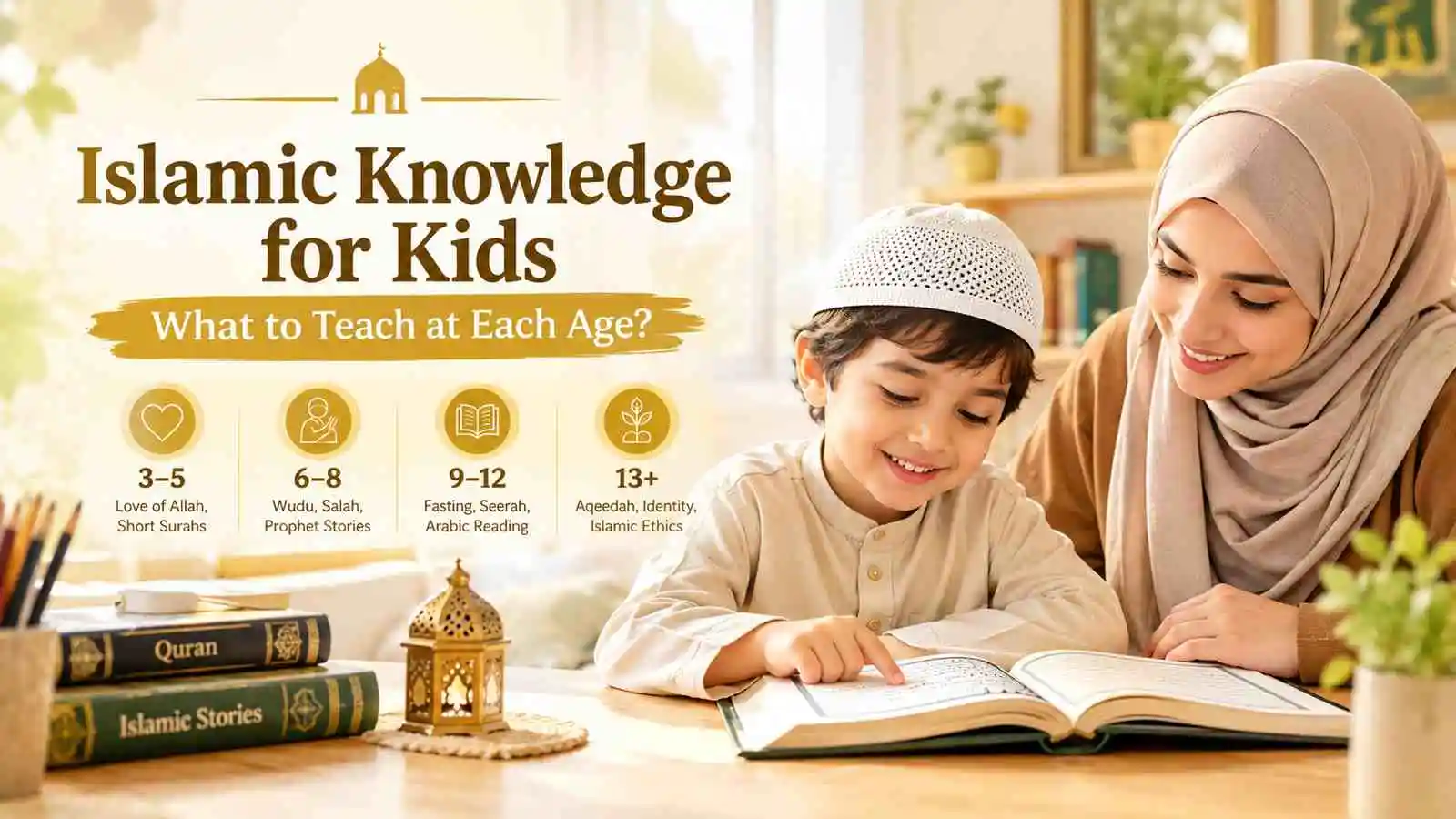
Begin with basic love of Allah in the early years and then build up to prayer, stories, and Qur’an as your child gets older. Follow this age guide of Islamic knowledge for kid planning:
| Age | Main focus |
|---|---|
| 3–5 | Bismillah, Alhamdulillah, Allah as Creator, short surahs |
| 6–8 | Wudu, basic salah, Prophet stories, daily duas |
| 9–12 | Full prayer, fasting practice, seerah, Arabic reading |
| 13+ | Aqeedah questions, identity, Islamic ethics in depth |
These stages are flexible, so follow your child’s pace. Next, let’s turn them into habits.
How to Build Islamic Knowledge Into Your Child’s Daily Routine?
Put one little Islamic custom on each aspect of the day. Follow these steps:
- Practice reciting Allah’s name before eating and after eating.
- Pray a prayer as a family.
- Read 5 minutes of Quran or Islamic story before going to sleep.
- Read one new dua or fact per weekend.
A short session is better than being inconsistent, so make all your islamic knowledge for kid habits short. After the routine becomes instinctive, the next level is belief.
What Is a Sanad in Islam? Meaning, Types and Importance
Basic Aqeedah for Kids: Teaching Tawheed and Knowing Allah
Tawheed is a belief in Allah’s oneness and that He created everything. Let the children learn by observing. Point to the rain, the trees, and their hands, and ask, “Who made them?” Introduce Allah’s names one by one and connect each to a time of their day, e.g., Ar-Rahman (the Most Merciful), and connect this with one of their experiences during the day.
At this age, concrete examples will be more effective than definitions. This is the core of Islamic knowledge in kids’ education, and it is a source to give meaning to worship, which leads to wudu and salah.
What Does Islam Say About Judgement Day? Signs and Events
How to Teach Wudu and Salah to Kids Step by Step?
Teach wudu first and then teach salah, a little at a time:
- Slowly perform wudu: hands, mouth, nose, face, arms, head, ears, feet.
- Have your child follow your example as you make the copy.
- Practice the prayer movements before recitation.
- Start with Al-Fatihah and then slowly add other surahs.
- Ask them to join you in all prayers.
Accepting efforts rather than perfection of Islamic knowledge for kid lessons should be comfortable, not stressful. Stories are the best way to demonstrate faith in action after worship.
What Is Isnad and Matn? Understanding Hadith Science
Islamic Stories for Kids: Seerah, Prophets, and Moral Lessons
Story is a medium for teaching faith and character. Explain to the children how Ibrahim relied on Allah, how Yusuf was patient, and how Musa was courageous. Describe from the seerah how the Prophet (saws) interacted with neighbors, animals, and children in a good manner.
Ask, “What would you have done?” at the end of each story to get the lesson into the world of real decisions. Stories also flow easily into the words that children can say to Allah each day.
Can I Recite Quran on My Period?
Daily Duas and Adhkar for Children:
What are some of the duas that should be taught to children first? Start with the types in which they use them regularly:
- Before and after a meal
- When first waking and before retiring to bed
- Going in and out of the house,
- Entering the bathroom
Teach one or two days a week, as the islamic knowledge for kid is retained by repetition. Use one simple sentence to explain the meaning of the words so they don’t sound like words. As these words become familiar, they influence the behavior, and that’s where values come in.
Islamic Studies for 5 Year Olds Complete Learning Guide
Teaching Islamic Values and Manners Through Everyday Life:
Demonstrate the behavior, then talk about it. Children will emulate behavior: model mistakes and admit to them. Be courteous and say salam to people. Learner respect for parents and gentle speech at home. Whenever the value is mentioned: “That was sharing, and Allah loves it.
These little things add up over time to create character, which the child takes along with him or her from home, including to a society with norms different from his or her own.
Islamic Special Religious Education for Quran and Islamic Learning
Raising Muslim Kids in Western Society: Identity and Peer Pressure
Let your child know the reason for being Muslim, rather than just what, so they feel proud to be Muslim! Discuss openly the concepts of halal food, prayer in school, hijab, and Eid. Practice making simple statements like, “I don’t eat that; I’m Muslim.
“Make friends with Muslim kids in your community or in your mosque, or through Islamic studies for kids online; it will make Islamic knowledge for kid learners feel like ‘at home.'” “Pride and community do better to protect kids than fear.
Best Islamic Online Courses for Quran Arabic and Islamic Studies
Choosing Islamic Books, Apps, and Halal Media for Kids:
Good Islamic knowledge for kid resources is factual, suitable for their age level and sourced from authentic sources. When selecting, there are three things to check first:
- Read all books and apps or watch all videos before you recommend them.
- Seek out material that has been checked by qualified Muslim scholars or teachers.
- Establish screen time guidelines.
Young children can be using picture books, and older children can be using Quran apps and online Islamic lessons with qualified teachers. Online Arabic lessons for kids can also help with their learning of the Quran. Having great tools is the next challenge: how do you make them fun?
Revelation Recording and Memorisation of the Holy Quran Guide
Fun Ways to Teach Islamic Knowledge to Kids at Home:
Lessons become memories with games and crafts, and fun Islamic learning for kids gets them asking for more.
Games & Crafts That Make Islamic Knowledge for kid Lessons Stick
- Re-enact a prophet’s story using toys.
- Construct a masjid using blocks!
- Make a Ramadan countdown calendar.
- Make dua flashcards to match.
- Have a family quiz contest, offering little rewards.
Vary these activities to make them interesting. But don’t just do it for fun, structure it!
Combine Quran and Islamic Studies Online for Non-Arabs
How to Answer Difficult Questions Kids Ask About Islam?
Answer honestly, simply, and calmly. Follow these steps:
- Thank your child for asking.
- Answer at their level in one or two sentences.
- If you don’t know, say so, then research it together from a trusted scholar or reliable source.
- Never shame a question.
A child who feels safe asking at home won’t look for answers elsewhere. Reliable answers need a steady learning plan behind them.
Enroll in our online Islamic studies course and deepen your children’s understanding of Islam from the comfort of your home.
Building a Simple Islamic Studies Curriculum for Children:
A simple Islamic studies for kids plan covers five areas: Quran, aqeedah, basic fiqh, seerah, and Arabic. Give each area one short slot per week, about 15 minutes a day in total. A strong Islamic knowledge for the kid curriculum moves slowly and reviews often. If you need structure, online Islamic studies for kids with a certified teacher can fill the gaps. With a plan in place, the last piece is the child’s attitude.
Join our Arabic language course and develop your children’s speaking, reading, writing, and listening skills with experienced teachers.
How to Make Islamic Learning Enjoyable Without Pressure?
Keep learning light, and the love of Islam will follow. Try these steps:
- Keep sessions under 15 minutes.
- Choose times when your child is rested.
- Celebrate small progress.
- Never compare siblings or friends.
Pressure-free Islamic knowledge for kids learning builds love first, and discipline follows naturally.
Start learning Quranic Arabic with Noorani Qaida Online and build a strong foundation in correct pronunciation and Quran reading.
Start Your Child’s Journey Today:
Teaching Islamic knowledge to kids works best when lessons are age-appropriate, consistent, and guided by qualified teachers who understand both Islamic studies and children’s learning needs. At Quran Beauty Academy, children can learn the Quran, Tajweed, Islamic studies, and essential Islamic values through structured one-on-one lessons with qualified teachers. This gives parents a practical way to support their child’s faith and build positive learning habits at home.
Join our live Quran memorization course with Al-Azhar certified teachers, a clear Hifz plan, and regular revision. Book your free trial class today and recite your first surah with expert guidance.
Give your child a structured and enjoyable way to learn about Islam. Book a free trial online Islamic classes for kids with Quran Beauty Academy and let a qualified teacher help your child build Islamic knowledge step by step, at a pace that suits their age and learning needs.
FAQs:
What Islamic knowledge should kids learn first?
Children should begin with simple concepts such as knowing Allah, saying daily duas, learning good manners, and listening to short Quranic stories. As they grow, parents can gradually introduce prayer, wudu, Quran reading, seerah, aqeedah, and basic Islamic rulings.
How can I make Islamic learning enjoyable for my child?
Keep lessons short, interactive, and connected to everyday life. Use stories, games, crafts, quizzes, Quran activities, and simple discussions. Encourage questions and celebrate progress without creating pressure. A positive learning environment helps children associate Islamic knowledge with curiosity, confidence, and love.
When should children start learning about Islam?
Islamic learning can begin from the early years through simple conversations, duas, stories, and daily habits. Formal lessons can become more structured as children grow. The pace should match their age, attention span, understanding, and individual development rather than following a rigid timetable.
Can online Islamic studies help children learn Islam?
Yes, online Islamic studies can provide structured learning with qualified teachers while allowing children to study from home. One-on-one lessons can also give children personalized attention, regular practice, and opportunities to ask questions about Quran, Islamic beliefs, manners, and everyday religious practices.