
importance of arabic in islamic studies is that the Qur’an, the Hadiths, Fiqh, and Tafsir were all composed first in Arabic, and translating is a step away from the Arabic. If she/he didn’t, he/she relies solely on another person’s interpretation of the source. This guide explains where Arabic is needed, just how much you really need, and how to incorporate Arabic into serious study.
What Is the Importance of Arabic in Islamic Studies?
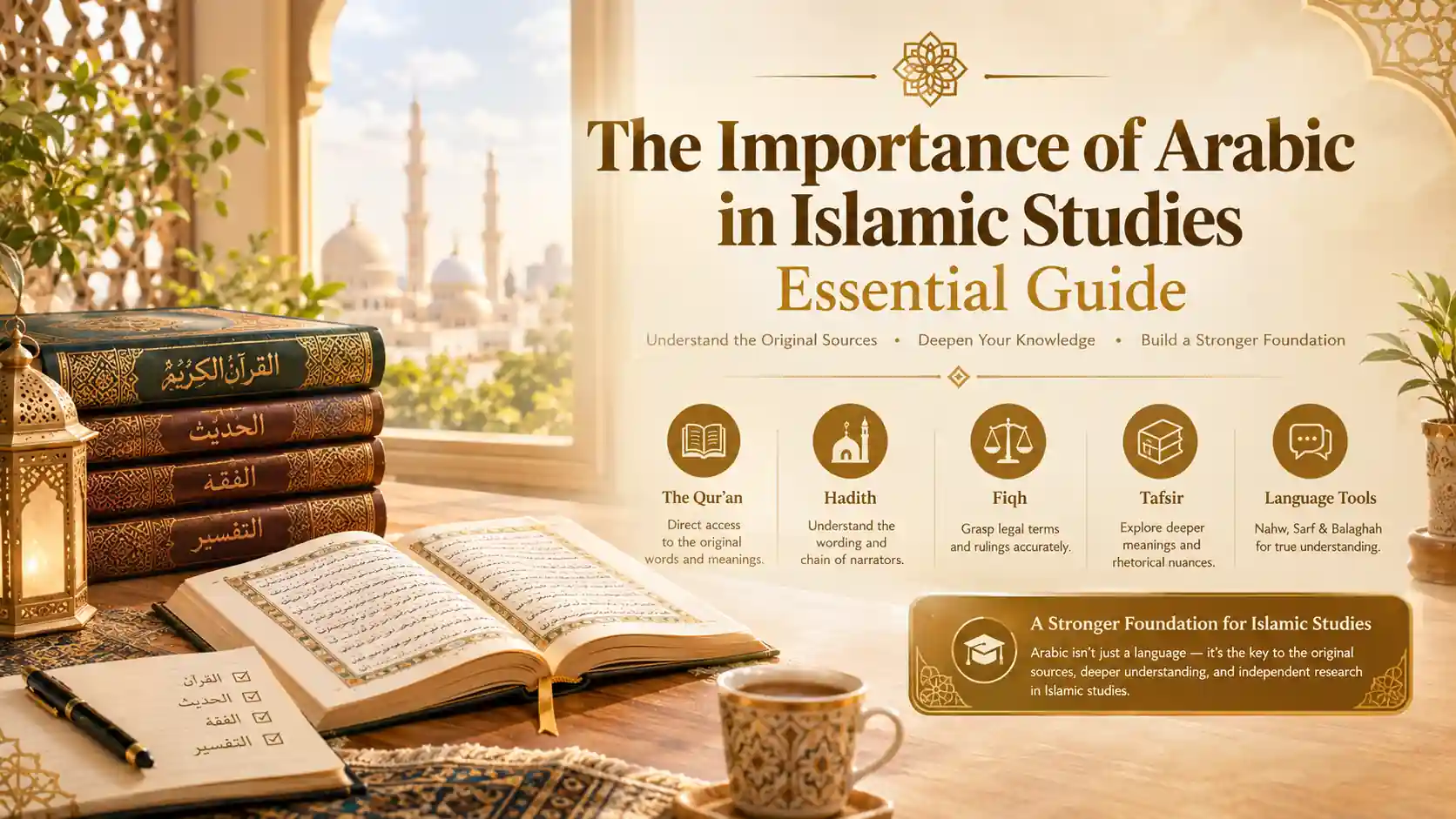
The importance of arabic in islamic studies is based on the one simple premise that the Qur’an, the Hadith, and the classical scholarly tradition are not in translation; they are in Arabic. If a student cannot read Arabic, he cannot read what a translator wanted to preserve. Arabic provides immediate access to legal terms, grammatical nuances, and rhetorical form that are of significance to a decision.
Arabic and the Qur’an: Accessing the Original Text:
Importance of Arabic in Islamic studies begins with the Qur’an, which was revealed in Arabic, and the word, grammar, and rhythm of the Qur’an are part of its meaning. The Arabic language of the Qur’ān employs the word order and case endings to emphasize exactly where the emphasis is required, which is not always the case with translation.
When a student comprehends the word in Arabic, he or she becomes aware of the multi-layered meanings of the word, which are typically not captured by the choice of one English word by the translator.
Learn Arabic Grammar for Understanding Quran Clearly and Deeply
How Arabic Improves the Study of Hadith?
Accurate Arabic is essential in Hadith scholarship in two aspects, the matn (wording) and isnad (chain of narrators). A student reading only translations cannot assess subtle differences in wording, which have been and are used by scholars as a means of assessing authenticity. In addition, through the Arabic language, a student can follow the biographical dictionaries which are developed in order to test the narrators.
Join our Arabic Language Course
The Role of Arabic in Fiqh and Islamic Law:
Islamic law is grounded in Arabic legal terminology, and a single word can have a technical meaning that alters the entire ruling: one of the clearest examples of the significance of Arabic in Islamic study, beyond scripture.
Classical jurists, like Imam al-Shafi’i, have said that it was essential for them to know Arabic well to be able to derive the ruling from anything; otherwise, if the words were translated loosely, they would end up applying a ruling that the Arabic has not specified.
What Is Noor Al Bayan? Learn Quran Reading Step by Step
Arabic and Usul al-Fiqh: Understanding Legal Language:
Usul al-Fiqh is the methodology of Islamic law, where the Arabic language plays an important role: a general term versus a specific term, a literal expression versus a figurative expression. Without good Arabic, a student can neither understand the differences between ‘am (general) and khas (specific), or haqiqah (literal) and majaz (figurative)
Why Arabic Matters in Tafsir and Quranic Exegesis?
Tafsir is done by exploring the meaning of the Arabic text that is in the Qur’ān, by comparing the ways the same root is used in different places of the Surah. One student, who does not have Arabic, can only read the work of another student and not verify it.
Learning the quran at this level also enables a student to understand the inimitability of the language (i’jaz), which is one of the most importance of arabic in islamic studies with which tafsir deals.
Best Way to Learn Fusha Arabic Ultimate Beginner Guide
Nahw, Sarf and Balaghah: The Three Essential Language Tools:
The three linguistic sciences that do much of the work behind the points mentioned above are Nahw (syntax), Sarf (morphology) and Balaghah (rhetoric). When a word’s use is explained, Nahw and Sarf are used to provide the grammatical role and the root meaning of the word and its phrases.
Nahw and Sarf are used to explain the meaning of the root of a word or its phrases and their grammatical role when the word or phrase has been used.
For Arabic studies, the classical scholars believed that all three were necessary to understand the importance of Arabic in Islamic studies; that is, to understand the meaning of a phrase, one must master the Balaghah, without which understanding of the importance of Arabic in Islamic studies is impossible.
Online Arabic Classes for Adults – Learn Arabic from Home
Arabic and the Classical Islamic Scholarly Tradition:
For centuries, Islamic theology, philosophy, and law were discussed virtually exclusively in Arabic. Imam al Ghazali, Ibn Taymiyyah, and Ibn Rushd are read in their original texts, not a translation, directly granting access to their arguments. This is also where the role of the Arabic language in Islam goes beyond the scriptures
Arabic language origin tree Complete Guide to Its History
Arabic Sources vs Translations in Islamic Studies:
| Aspect | Arabic Sources | Translations |
|---|---|---|
| Access to the text | Provides direct access to the original wording and structure | Provides an interpreted representation of the original |
| Word meanings | Allows students to examine roots, forms, and contextual meanings | Usually presents one selected meaning in the target language |
| Grammar | Reveals Nahw, Sarf, case endings, and sentence relationships | Grammatical details may be simplified or explained differently |
| Technical terminology | Preserves specialized terms used in Fiqh, Hadith, and Tafsir | May require explanatory notes or approximate equivalents |
| Ambiguity | Allows readers to examine possible meanings in the original context | The translator may need to select one interpretation |
| Research | Supports direct engagement with primary and classical sources | Useful for orientation, comparison, and initial understanding |
| Best use | Essential for deeper study and independent analysis | Valuable as a supporting resource alongside the Arabic text |
What Level of Arabic Do Islamic Studies Students Need?
For the majority of primary sources a student does not need to be a native speaker of Arabic to begin benefiting from them: functional reading, a working knowledge of Nahw and Sarf, and sufficient vocabulary to follow an annotated text already open the majority of primary sources. It is true that deeper Fiqh, Usul al-Fiqh, or Tafsir requires more, as arguments rely on fine grammatical nuances.
Ace Your Arabic Test with Online Proficiency Classes
How Arabic Changes Academic Research in Islamic Studies?
The absence of Arabic as a research language means that researchers who do not know it are limited to the secondary literature and the translation of these sources; this is a situation which best illustrates the importance of arabic in islamic studies level. Primary manuscripts enable a researcher to follow the development of a ruling rather than take a modern statement of it on faith.
Basic Arabic Lessons for Beginners Step by Step Guide
Common Arabic Challenges for Islamic Studies Students:
The common difficulties that most students face are:
- Classical vs. Modern Arabic: The vocabulary that is used in the Qur’an is unusual in the context of Modern Standard Arabic.
- Case endings (i’rab) : The same short vowel could affect the role of the word and consequently, the meaning of the sentence.
- Technical terms: Fiqh and Usul al-Fiqh terms are not easily translatable to one English language term.
- A subtlety of Balaghah: the rhetorical nuance is typically the final thing to master, and it is what causes some verses to be a topic of debate among scholars.
Amazing 10 Facts About Arabic Language You Must Know
A Practical Roadmap for Learning Arabic for Islamic Studies:
A viable route for Arabic in the context of Islamic studies is:
- Develop reading fluency and key vocabulary first.
- Develop basic skills in Nahw and Sarf to identify sentences.
- Use grammar to understand short Qur’anic verses and simple Hadiths.
- After having memorized grammar, add Balaghah and technical Fiqh/Usul al-Fiqh vocabulary.
- Make comparisons between your reading and trusted tafsir and commentary.
This order is importance of arabic in islamic studies because it prevents new skills from floating in the abstract, but it will always have something to which
You can explore our courses
How to Use Arabic Effectively in Islamic Studies Research?
Effective use of Arabic in research means checking your own reading against the text before accepting a translation at face value. Keep a running list of key terms in their original Arabic, since the same root often carries slightly different implications in different contexts.
Intensive Online Arabic Classes for Fast Arabic Fluency
Build Your Arabic Skills for Academic Islamic Studies:
A strong academic foundation in Arabic can improve how students approach primary Islamic sources and classical scholarship. Quran Beauty Online combines structured Arabic instruction with live teacher feedback, helping learners develop practical skills in reading, grammar, vocabulary, and textual analysis. This approach supports students who want to move beyond relying exclusively on translations and gradually develop greater independence when studying Islamic texts.
Students pursuing serious Islamic studies need more than translated summaries. Developing Arabic reading skills allows you to engage with Qur’anic texts, Hadith collections, classical Fiqh works, Tafsir, and academic references in their original language. Quran Beauty Online’s Arabic Language Course provides structured, live instruction designed to help students strengthen reading, grammar, vocabulary, and comprehension skills for deeper Islamic study. Book a free trial class and begin building a stronger foundation for academic research.
Frequently Asked Questions
Can I study Islamic law seriously using only English translations?
Translations can help you learn general knowledge, but serious legal study requires an ability to read and understand Arabic. Arabic allows students to examine terminology, grammatical structures, and meanings in their original context, which may be simplified in translations, especially when studying advanced Fiqh and Usul al-Fiqh.
Is Qur’anic Arabic harder to learn than Modern Standard Arabic?
The Arabic of the Qur’an is classical Arabic, with words, grammatical structures, and expressions that may differ from modern usage. Students who develop knowledge of reading, Nahw, Sarf, and vocabulary can gradually become accustomed to it. Studying selected Qur’anic passages alongside structured instruction can make the learning process easier.
Do I need Balaghah if I only want to read Tafsir, not write it?
Advanced knowledge of Balaghah is not required to begin studying Tafsir. However, understanding its basic principles can help you understand discussions of word choice, emphasis, metaphor, rhetorical structure, and textual nuance. Deeper knowledge becomes increasingly useful when studying advanced classical Tafsir and the works of scholars.
How long does it take to reach a useful level of Arabic for Islamic studies?
The time varies depending on your reading ability, existing vocabulary, study plan, and academic goals. A student may develop basic reading skills within a few months, while advanced academic and research-level study takes longer. Regular exposure to primary texts, grammar, vocabulary, and teacher feedback can support steady academic progress.