Learning how to read Quran Arabic is one of those goals that feels huge at the start and surprisingly manageable once you break it into the right stages. You don’t need to speak Arabic. You don’t need prior religious education. What you need is a clear roadmap — from the shape of individual letters all the way to reading short surahs fluently. That’s exactly what this guide gives you.
The Unique Nature of Quranic Script vs Modern Arabic
Quranic Arabic is easier to read than news Arabic. That surprises most people.
Modern Standard Arabic — the kind you see in newspapers or hear on Al Jazeera — drops most vowel markings. Readers are expected to supply them from context and grammatical knowledge. If you’re a beginner, that’s a wall.
The Quran is different. It uses a fully vocalized script, meaning every letter carries small symbols called harakat that tell you exactly which vowel sound to produce. There’s no guessing. The text does the work for you.
This is why many non-Arabic speakers who would struggle to read a news article can, with practice, learn to read Quranic text accurately. The system is designed for precision, not inference. Your job as a beginner is simply to learn how to decode that system, not to understand classical grammar.
How do you memorize 28 new letters without burning out?
Group them by shape, not by alphabetical order.
Arabic letters share visual skeletons. Change a dot or two, and you get a completely different letter. Grouping them by their base shape dramatically cuts memorization time.
The “boat family” is a classic example. The letters ب (ba), ت (ta), and ث (tha) all sit on the same curved base — what looks like a little boat. The only difference is the number and position of the dots: one dot below for ba, two dots above for ta, three dots above for tha.
Other groupings follow the same logic:
- ج (jeem), ح (ha), خ (kha) — same hook shape, different dots
- د (dal) and ذ (dhal) — same diagonal, one with a dot
- ر (ra) and ز (zain) — same curved stroke, one with a dot
Working through 28 letters as 10 or so visual families gets most beginners through the alphabet in one to two weeks of daily practice, rather than months of rote memorization.
Best Way to Learn Fusha Arabic Ultimate Beginner Guide
What are harakat and why do they matter for reading Quran Arabic?
Harakat are the small marks written above or below Quranic letters that indicate vowel sounds. Without them, you’d be guessing. With them, every word is readable.
There are five you need to know immediately:
Fatha (َ) — a small diagonal stroke above a letter. Produces an “a” sound. So بَ is read “ba.”
Kasra (ِ) — the same stroke but placed below. Produces an “i” sound. بِ is “bi.”
Damma (ُ) — a small curl above the letter. Produces a “u” sound. بُ is “bu.”
Sukoon (ْ) — a small circle above a letter. Means no vowel sound follows. The letter is “closed.” بْ is just “b.”
Shadda (ّ) — looks like a small “w” shape above a letter. It doubles the consonant. بّ means you hold the “b” sound briefly before releasing it.
Once these five are locked in, you can generate a sound for any letter in any Quranic word. The mechanics are that simple. What takes practice is speed — producing sounds fluently rather than one careful letter at a time.
Why does the same letter look different in different positions?
Arabic is a cursive script. Most letters connect to their neighbors, which means each letter has up to four forms depending on where it appears in a word.
The four positions are:
- Isolated — the letter standing alone
- Initial — at the start of a word (connects to the right)
- Medial — in the middle of a word (connects on both sides)
- Final — at the end of a word (connects to the left only)
Six letters are exceptions: ا (alif), د (dal), ذ (dhal), ر (ra), ز (zain), and و (waw). These never connect to the letter following them. When you encounter one of these in the middle of a word, there’s a visible break to the right. Recognizing these six on sight saves a lot of confusion when you’re trying to parse words.
The good news is that letter forms share enough visual similarity across positions that after a few weeks of reading practice, your brain starts recognizing them automatically. You stop thinking about forms and start seeing words.
Best Way to Learn Fusha Arabic Ultimate Beginner Guide
How do you actually decode a Quranic word?
Arabic reads right to left. When you encounter a word, you work through it from right to left, letter by letter, applying each harakat as you go, then blending the sounds together.
Take the word بَيْتٌ (bayt, meaning “house”):
- Start at the right: بَ → “ba” (ba + fatha)
- Move left: يْ → “y” (ya + sukoon, so no vowel after the “y”)
- Final letter: تٌ → “tun” (ta + tanwin damma, which creates a “un” ending sound)
- Blend: ba + y + tun = “baytun”
The tanwin (double harakat) appears frequently at word endings in the Quran and produces a nasal “n” sound. It’s worth drilling separately once you have the basic five harakat down.
This letter-by-letter decoding is slow at first. Most beginners spend two to four weeks on simple three-letter words before their reading pace picks up. That’s normal — don’t mistake slowness for failure.
What is makharij al-huruf and why does it affect your Quran reading?
Makharij (مخارج الحروف) refers to the precise points in the mouth and throat where Arabic sounds originate. Some Arabic letters have no equivalent in English, so English speakers need to train muscles they’ve never consciously used for language before.
The three main articulation zones you need to work on first:
Throat sounds (حلقية):
The letters ع (ayn) and غ (ghain) come from deep in the throat. Ayn produces a constricted, voiced sound with no English parallel. Ghain is softer — closer to a French “r” but produced further back. Many beginners gloss over these and substitute easier sounds. That’s a mistake for Quranic accuracy.
Tongue-tip sounds (ذلقية):
Letters like ث (tha), ذ (dhal), and ظ (dha) require the tongue to touch or nearly touch the upper teeth. Think of the English “th” in “this” — that’s a starting point, though the Arabic versions are distinct.
Emphatic sounds (مطبقة):
Letters ص (sad), ض (dad), ط (ta), and ظ (dha) are “heavy” versions of their lighter counterparts. The tongue presses against the back of the upper teeth and the back of the mouth drops, producing a fuller resonance.
You don’t need to master all 17 articulation points at once. Work on the sounds that are furthest from English phonetics first — ع, غ, ح, and ق — then refine the rest over time.
Arabic language origin tree Complete Guide to Its History
Is tajweed required before you can start reading Quran Arabic?
No — but three rules are practical enough that you should apply them from day one.
Ghunna (غنة):
A nasalization lasting roughly two counts, applied to ن (noon) and م (meem) when they carry a shadda, or when noon appears in specific configurations. You produce it by letting sound resonate through the nose. It’s audible in every surah — once you hear it, you can’t unhear it.
Madd (مد):
Natural vowel elongation. Some vowels in the Quran are held for two counts, some for four or six. The most common form is the natural madd — when a long vowel (ا، و، ي) appears after a letter with a matching vowel sound. Stretch it for two counts and move on.
Qalqalah (قلقلة):
A slight echo or bounce produced on five specific letters — ق ط ب ج د — when they carry sukoon. The sound doesn’t fully stop; it echoes slightly. You’ll hear it clearly in سورة الإخلاص on the letter “د” in “أَحَد.”
These three rules don’t require an understanding of advanced tajweed theory. They’re mechanical — you practice until they become automatic.
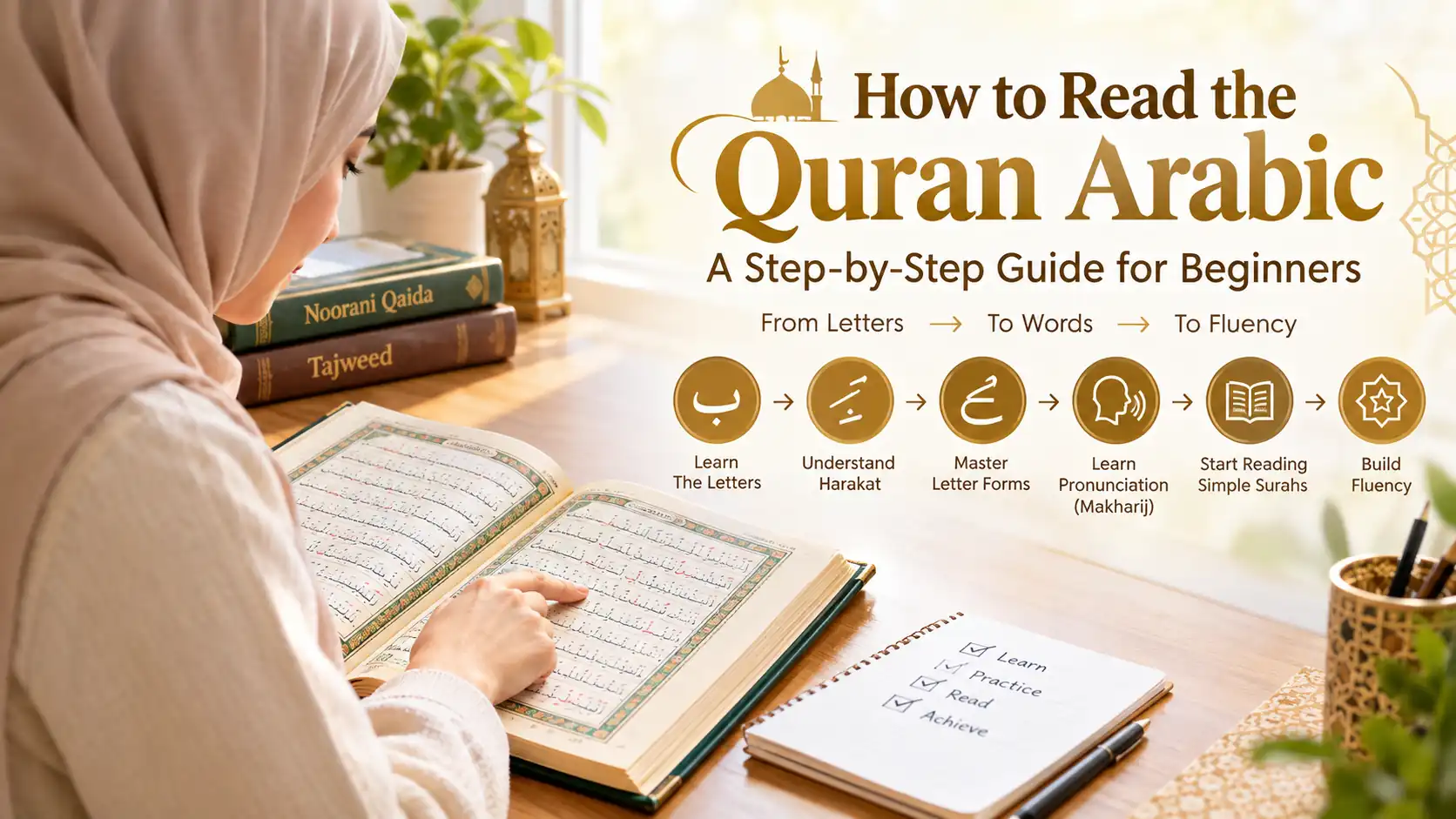
Which method is actually better for learning how to read Quran Arabic as a beginner?
Both work. The choice depends on how you learn.
Noorani Qaida
It is the traditional booklet developed by Molvi Noor Muhammad Haqqani in the 19th century. It drills letters, harakat, letter combinations, and basic tajweed in a carefully sequenced progression. Millions of children and adults worldwide have started Quranic reading through it. The sequence is tested. A good teacher working through Noorani Qaida with a student is still one of the fastest paths to literacy.
The downside: it’s dense, purely text-based, and the phonetic notation assumes you already know roughly how Arabic sounds. For a complete beginner with no exposure to Arabic, the early pages can feel abstract without audio support.
Modern digital alternatives
like Tarteel, Quran Companion, and the Learn Quran Tajwid app add audio playback, visual highlighting, and spaced repetition — things a booklet can’t offer. They’re particularly useful for self-learners who have no access to a teacher.
The honest answer for most beginners: use a digital tool to get your ear tuned and your letter recognition sharp, then switch to a structured course — Noorani Qaida or otherwise — once the basics click. The audio-first approach solves the single biggest problem beginners face, which is having no reliable internal model of what correct Arabic sounds like.
What Is Noor Al Bayan? Learn Quran Reading Step by Step
Where should you start reading inside the actual Quran?
Juz Amma — the 30th and final section of the Quran — is the standard starting point. It contains the shortest surahs, written with high-frequency letters and straightforward harakat patterns. Most Arabic-literate Muslims memorized this section as children precisely because it’s accessible.
The recommended sequence:
- Surah Al-Fatiha — seven verses, recited in every prayer. Most learners already know the sound; the goal here is connecting what you hear to the text on the page.
- Surah Al-Ikhlas — four verses, very short. Good first test of independent reading.
- Surah Al-Asr — three verses. Introduces the long madd clearly.
- Surah Al-Falaq and Al-Nas — slightly longer, introducing more variety in letter combinations.
Work through each surah line by line. Read a line slowly, listen to a verified reciter (Sheikh Mahmoud Khalil Al-Husary’s slow recitation is widely recommended for learners), then read again. The goal at this stage isn’t speed — it’s accuracy in decoding. Speed follows accuracy; it never precedes it.
Why do beginners stutter or mix up similar-looking letters when reading Quran Arabic?
Letter confusion and stuttering are the two most reported mechanical problems at the beginner stage.
Letter confusion
usually comes down to pairs that share a base shape — ب/ت/ث, or ح/ج/خ, or ع/غ. The solution isn’t more alphabet drills; it’s more reading. Isolated letter practice and word-level reading use different cognitive processes. Get into actual words earlier than you think you’re ready to.
Stuttering mid-word
typically happens when you’re holding too much in working memory at once. Beginners try to identify the letter, recall its form, apply the harakat, and produce the sound all simultaneously. That’s genuinely cognitively demanding for a new script. Two things help: slowing down deliberately (reading at one-quarter of conversational pace is fine and expected), and chunking — treating short syllable groups as single units rather than processing letter by letter.
Performance anxiety when reading to a teacher
is real and rarely discussed. Many adult learners who read adequately alone fall apart in front of a teacher or during prayer. The fix is deliberate exposure — read aloud to yourself, record yourself, and listen back. The gap between silent reading and oral reading closes faster than most people expect once you get accustomed to hearing your own voice produce Arabic sounds.
Plateau phases are normal. If you’ve been practicing daily for two or three weeks and progress has stalled, you’re not failing — you’re consolidating. Keep the practice short and consistent rather than grinding longer sessions.
Amazing 10 Facts About Arabic Language You Must Know
How much daily practice do you actually need to make progress?
Fifteen minutes, done consistently, outperforms ninety-minute sessions done twice a week. That’s not motivational talk — it reflects how procedural skill acquisition works. Arabic reading is a motor and perceptual skill. It needs repetition at regular intervals, not marathon sessions.
The most reliable approach is habit anchoring: attach your 15-minute practice to something you already do every day. After Fajr prayer, after morning coffee, before bed — pick one anchor and protect it.
What those 15 minutes should contain?
- 5 minutes reviewing letters or harakat combinations you found difficult in the previous session
- 7 minutes reading new Quranic text slowly and accurately
- 3 minutes re-reading the same passage faster, aiming for smoother flow
A simple pencil mark in a notebook — one line per day of practice — is a more effective tracker than any app. The visual accumulation of marks creates its own momentum.
Expect meaningful fluency in Juz Amma — reading short surahs accurately without stopping to decode — after roughly three to six months of this kind of daily practice. Adults often reach this point faster than they expect, because adult learners bring stronger metacognitive skills than children even if they lack the phonetic flexibility.
Can You Learn to Read the Quran Without Knowing Arabic?
Yes, absolutely. Millions of Muslims worldwide recite the Quran fluently without speaking conversational Arabic. Reading the Quran is primarily a phonetic skill, not a language-comprehension skill. You learn to recognize the 28 Arabic letters, their shapes, connections, and vowel markings (Harakat), then apply Tajweed rules for correct pronunciation. This is distinct from understanding Arabic grammar (Nahw/Sarf) or vocabulary. Most beginners start with a structured primer like Noorani Qaida, which teaches letter recognition, sounds, and basic word formation without requiring prior Arabic knowledge. With consistent 1-on-1 instruction (2–3 classes per week) and 15 minutes of daily practice, adult beginners typically complete the foundational Qaida within 3 to 4 months and begin reading directly from the Mus-haf shortly after.
Basic Arabic Lessons for Beginners Step by Step Guide
What Is the Best Way to Learn Quran Reading as an Adult?
The most effective path for adults follows a structured, step-by-step roadmap with a qualified teacher who understands beginner pedagogy. Here’s the proven approach:
1. Start with the Arabic Alphabet & Noorani Qaida
Begin by mastering letter names, basic sounds, shape changes, and connections. Noorani Qaida breaks this into progressive lessons covering short vowels (Fatha, Kasra, Damma), Sukoon, Shaddah, Tanween, and long vowels. You do not need any prior Arabic knowledge—lessons are conducted in your language (e.g., English) while you learn to decode Arabic script.
2. Learn Core Tajweed Rules Early
Apply fundamental articulation rules (Makharij) with an Al-Azhar certified tutor to build correct pronunciation from day one. This prevents bad habits and ensures your recitation is valid for Salah.
3. Practice Daily in Short Sessions
15 minutes daily beats long, infrequent sessions. For adults over 25, repeat each new verse 15–20 times aloud, connect it to the prior verse 5–7 times, then review the full passage 3 times.
4. Transition to Juz Amma
Once you can join letters into words fluently, move to Short Surah recitation in Juz Amma to apply rules in real Quranic text. Most adults reach this stage within 3 to 6 months with consistent practice.
5. Set Clear Goals & Track Progress
Decide if you want to read fluently, learn Tajweed, or memorize chapters. Keep notes or use an app to see monthly progress, and ask questions freely—good teachers welcome them.
6. Choose the Right Learning Method
Online 1-on-1 classes are ideal for busy adults: flexible scheduling, patient tutors, and lessons in your language. Many academies offer free trial sessions to match you with the right teacher.
Conclusion
Learning how to read Quran Arabic doesn’t require Arabic fluency, years of study, or special aptitude. It requires a clear starting point, the right sequence of skills, and consistent daily practice in short sessions.
Start with letter shape families. Get your harakat mechanics solid before moving into words. Build your ear with verified audio from the beginning. Move into Juz Amma surahs as soon as basic decoding feels manageable — don’t wait until you feel “ready.”
If you want structured guidance alongside your self-study, Quran Beauty Online offers one-to-one sessions with qualified teachers across all experience levels. Book a free trial class and see how quickly your reading can move when the feedback loop is tight.
Frequently Asked Questions
How long does it take an adult beginner to read Quran Arabic fluently?
Most adults reach comfortable reading in Juz Amma within three to six months of 15-minute daily practice. Full fluency across the Quran takes considerably longer — typically one to two years — but functional reading ability comes much faster than people expect.
Can I learn to read Quran Arabic without understanding what the words mean?
Yes, and millions of people do. Reading fluency and comprehension are separate skills. Quranic Arabic literacy means decoding the script accurately; understanding the meaning requires a separate study of classical Arabic vocabulary and grammar. You can have one without the other.
What are the six non-connecting letters in the Arabic alphabet?
They are: ا (alif), د (dal), ذ (dhal), ر (ra), ز (zain), and و (waw). None of these connect to the letter that follows them. You’ll see a visual gap to their left in any word containing them.
Is it better to learn Quran reading from an app or a human teacher?
Apps are better for building initial letter and sound recognition — the audio playback and repetition tools are genuinely useful. Human teachers are better for correcting pronunciation errors you can’t detect yourself, particularly throat sounds and subtle tajweed applications. The two aren’t mutually exclusive; most successful learners use both.