
The importance of tuhfat al atfal is that it took just 61 verses to convert such a multitude of rules for reciting the Qur’an in a correct way into a single short, easy-to-memorize poem. This is one of the starting points of nearly all teachers of Qur’an in the world. In this guide, you will learn who constructed it, what is being learned from it, and how to learn it so that you don’t change your memory but instead your recitation.
Who Wrote Tuhfat al Atfal and Why Was It Written?
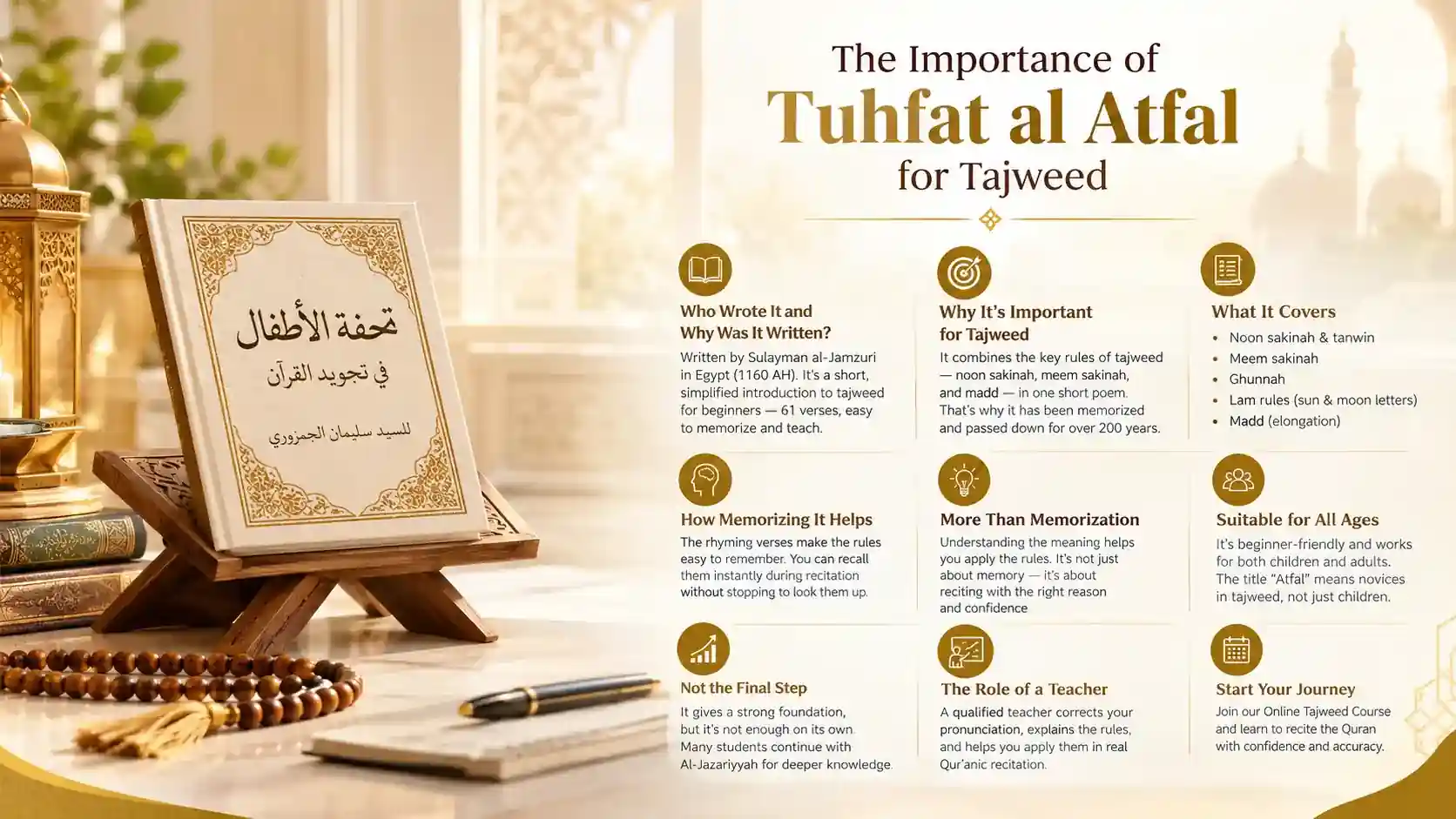
Written in Egypt by the scholar Sulayman al-Jamzuri in the village near Tanta in 1160 AH. He wrote the poem in 61 verses, a short, simplified introduction to tajweed for those who are just starting to learn it, the “atfal,” the novices, in the title. The importance of tuhfat al atfal is because of that one design choice: Memorize quickly and teach easily.
What Is the Importance of Tuhfat al Atfal for Learning Tajweed?
The importance of Tuhfat al Atfal for learning the tajweed is that it condenses the fundamental principles of tajweed that a learner is able to retain. Noon sakinah, meem sakinah, and madd are not written in separate books, but instead in one short poem. That is the reason why it has been taught, memorized, and passed down through continuous chains of teachers to students for over 200 years.
Major and Minor Mistakes in Tajweed Every Reciter Must Fix
What Tajweed Topics Does Tuhfat al Atfal Cover?
That compression can be best seen in the topics of which the poem does treat. The poem is structured according to a well-defined set of rules of tajweed in the recitation of the Quran:
- Noon sakinah and tanwin The four cases (izhar, idgham, iqlab and ikhfa) that determine how a silent noon and tanwin are pronounced.
- Meem sakinah: three parallel cases for the silent meem.
- Ghunnah: the nasal sound in doubled noon and meem.
- Lam rules for “al-” (sun and moon letters) and the verbal lam.
- Madd the rules of vowel elongation and its different lengths.
Focusing on these five areas, we cover the rules a student should understand before he/she tries to learn fluent Qur’an recitation.
How Does Memorising Tuhfat al Atfal Help Tajweed Students?
Memorization is what’s needed to retain what you know in pressure situations. When a student recites the poem, he or she can have instant recall of a rule midway through that recitation and not have to stop and look it up. Each rule is worded to rhyme and meter and so will stick.
like the words in a song, and a teacher can just point to a verse number to fix that mistake. This is one of the reasons why this is Importance of tuhfat al atfal in traditional teaching: it makes those rules become the student’s own rules, rather than rules that are left behind in a book.
Master Arabic Qalqalah Letters and Recite the Quran Correctly
Why Understanding Tuhfat al Atfal Matters More Than Memorising It Alone?
Simply memorizing, however, only takes a student halfway. If the student is able to recite the 61 verses from memory and then she adds the meaning so he can apply them, she will be a student who recites the poem and then applies it. If the student can recite the 61 verses in memory, then she adds the meaning so she can apply it. She will be a student who recites the poem and then applies it.
The real Importance of tuhfat al atfal doesn’t become evident until the student can state for himself the reasons behind the pronunciation of the specific noon with ikhfa, rather than izhar, and then hear them read in a specific Qur’anic verse. Memory begins; comprehension is the key to usefulness.
Can Tuhfat al Atfal Improve Quran Recitation?
Memorization and comprehension are what make an actual difference in recitation. Yes, because the rules of the poem easily correspond to actual mistakes during recitation of the Quran: incorrect pronunciation of noon sakinah, dropping ghunnah, and length of madds. A student who has internalized Tuhfat al Atfal sees these patterns.
when he recites them automatically, without first reciting and then having it corrected. It is the reader’s regular reading of the Qur’an who is interested in it for its practical application in everyday life that makes the difference between mere corrective action and awareness inbuilt, a shift that is what Tuhfat al Atfal has made.
Different Types of Quran Recitation Explained Clearly
Is Tuhfat al Atfal Suitable for Beginners?
That usefulness is contingent on the text being at the learner’s level, beginning with novices. Yes, it was made specifically for the beginner, as is shown by the title and the scope. It doesn’t assume any previous knowledge of tajweed and gradually presents one rule at a time, in a logical order, without piles of difficult rules, such as articulation points (makharij) or letter characteristics (sifaat).
This is the very reason for the importance of tuhfat al atfal in almost every curriculum for the Qur’an used in the world.
Join our Online Tajweed Course and learn to recite the Quran with confidence and accuracy.
Is Tuhfat al Atfal Suitable for Adults and Children?
“Beginner-friendly” doesn’t have to mean that there’s an age limit. Yes, for both. The word “atfal” in the title is a reference to novices in the tajweed science rather than literal children and as such is intended for adults as well as children.
The children learn it by heart and by memorizing rhymes; the adults mostly learn it by the grammar explanations, one for every rule of it, which is also the importance of tuhfat al atfal is used for both starting points: children and adults.
Is Tuhfat al Atfal Enough to Learn Tajweed?
Suitable for every age does not equate to enough, however. Not entirely. In Tuhfat al Atfal there is a comprehensive coverage of makharij and sifaat and stopping and starting rules, but not the more detailed explanation of these rules as presented in Al-Jazariyyah.
Most curricula consider it to be the required first step rather than the final step and a person who stops here has usable tajweed, but not complete tajweed.
Join our Online Quran Ijazah Course and earn authentic certification while mastering Quran recitation with qualified teachers.
Tuhfat al Atfal vs Al Jazariyyah: What Is the Difference?
Tuhfat al Atfal and Al Jazariyyah are both important Tajweed poems, but they serve different stages of learning. Tuhfat al Atfal provides a shorter introduction to key tajweed rules for quran recitation, while Al Jazariyyah goes deeper into pronunciation, letter characteristics, and advanced recitation principles.
| Aspect | Tuhfat al Atfal | Al Jazariyyah |
|---|---|---|
| Main purpose | Introduces essential Tajweed rules | Provides more advanced Tajweed principles |
| Length | 61 verses | More than 100 verses |
| Difficulty | Beginner-friendly | Intermediate to advanced |
| Main topics | Noon sakinah, tanwin, meem sakinah, ghunnah, and madd | Makharij, sifaat, madd, stopping rules, and other detailed topics |
| Learning stage | Usually studied first | Often studied after a basic Tajweed foundation |
| Teaching approach | Short, structured, and easier to memorize | More detailed and comprehensive |
| Best suited for | Beginners learning core Tajweed | Students developing deeper Tajweed knowledge |
Should You Study Tuhfat al Atfal Before Al Jazariyyah?
Yes. It is as if a student, who already knows the rules of Tuhfat al Atfal, is knowledgeable about the rules of the noon and madd even when they are presented again in Al-Jazariyyah, as the rules are reviewed. The sifaat and full makharij of Al-Jazariyyah are presented first, and the easier rules last, because the harder rules come before the easier ones, so teachers always present the makharij first, then the sifaat.
Join our Quran Memorization Course Online and memorize the Holy Quran with confidence through personalized guidance from qualified teachers.
How to Study Tuhfat al Atfal Effectively?
These are the four steps for studying the text well when the next question is How to do the sequencing
Sequencing, which is according to importance of Tuhfat al Atfal
There are three steps to effective study, not just one big memorization session:
- Learn in small units 2 or 3 verses a day, reviewing the previous verses daily.
- Discuss the explanations of the teachers (Sharhs), not just the words.
- Immediately use each rule in actual Qur’anic recitation, thus making the rule and the sound believably connected.
The importance of Tuhfat al Atfal is lost at stage two or three since the poem was never composed as a recitation.
Quran Ahkam Tajweed Rules for Correct Quran Recitation
Common Mistakes When Studying Tuhfat al Atfal:
Even with a clear method, most students still fall into the same handful of traps. The most frequent mistakes are memorizing without understanding the meaning, rushing through verses without daily revision, and never practicing the rules on live Qur’anic text. A less obvious mistake is treating the poem as a one-time task rather than a reference a student returns to for years .
The Role of a Qualified Teacher in Studying Tuhfat al Atfal:
Most of these mistakes only surface and get corrected with outside help. A teacher does two things a student can’t do alone: catch mispronunciations in real time and explain the grammar behind each verse in context.
Ijazah-certified, native Arabic-speaking tutors, the kind found in Quran Beauty Online’s Tajweed program walk students from Noorani Qaida through Tuhfat al Atfal and into full Tajweed with live correction at every stage, which is the difference between reciting the poem and actually reciting the Qur’an correctly because of it.
What Can You Learn After Completing Tuhfat al Atfal?
With a teacher confirming that foundation, a clear next stage opens up. After Tuhfat al Atfal, most students move to Al-Jazariyyah for advanced makharij, sifaat, and pausing rules, then apply everything through guided, corrected Qur’an recitation and eventually Hifz. Some students continue further toward a formal Tajweed Ijazah, which requires both texts memorized and understood, with a certified teacher confirming mastery before granting the chain of transmission.
Tajweed Course Certificate Online With Certified Quran Teachers
Build Your Tajweed Foundation With Tuhfat al Atfal:
Quran Beauty Online supports students who want to develop their Tajweed through structured, teacher guided learning. Its Tajweed program can take learners from foundational reading skills toward Tuhfat al Atfal and more advanced Tajweed study. Live correction helps students identify pronunciation and application errors while practicing Quranic recitation, allowing memorization to develop alongside accurate understanding and practical use.
If you are ready to strengthen your Quran recitation, studying Tuhfat al Atfal with a qualified teacher can help you connect memorized rules with practical recitation. Quran Beauty Online provides live Tajweed lessons with structured guidance and real-time correction. Book a free trial class and start learning Tuhfat al Atfal as part of a clear, progressive Tajweed program.
Frequently Asked Questions
How long does it take to memorize Tuhfat al Atfal?
By following a schedule, many students are able to memorize the 61 verses within a few weeks. The rate of memorization, however, depends on previous experience, daily practice and revision. In fact, learning Tajweed and its rules and applying them correctly typically requires other ongoing study and practice of Quran recitation.
Is Tuhfat al Atfal written in Arabic only, or are translations available?
The original Tuhfat al Atfal poem is in Arabic. Although it can be studied with the help of a qualified teacher, translation and an explanatory commentary can also be useful for the non-Arabic-speaking student to grasp the content of the verses, as the verses contain rules of Tajweed that must be followed correctly when reciting the Quran.
Do I need to know Arabic grammar before starting Tuhfat al Atfal?
No, I don’t need to learn advanced Arabic grammar to start learning Tuhfat al Atfal. A new student can learn the poem with a teacher who will explain words and ideas that are not familiar to him or her. The prerequisite is a proper base in reading the Quran and its basic Tajweed pronunciation prior to moving forward.
Can I study Tuhfat al Atfal without a teacher?
Memorization and review of Tuhfat al Atfal can be done by students on their own, but it is advised that a teacher guide them in the correct application of Tajweed. A qualified teacher is able to correct pronunciation, discuss complicated verses, show examples of rules from the Quran, and catch errors that might otherwise develop into bad habits when reciting the Quran.