
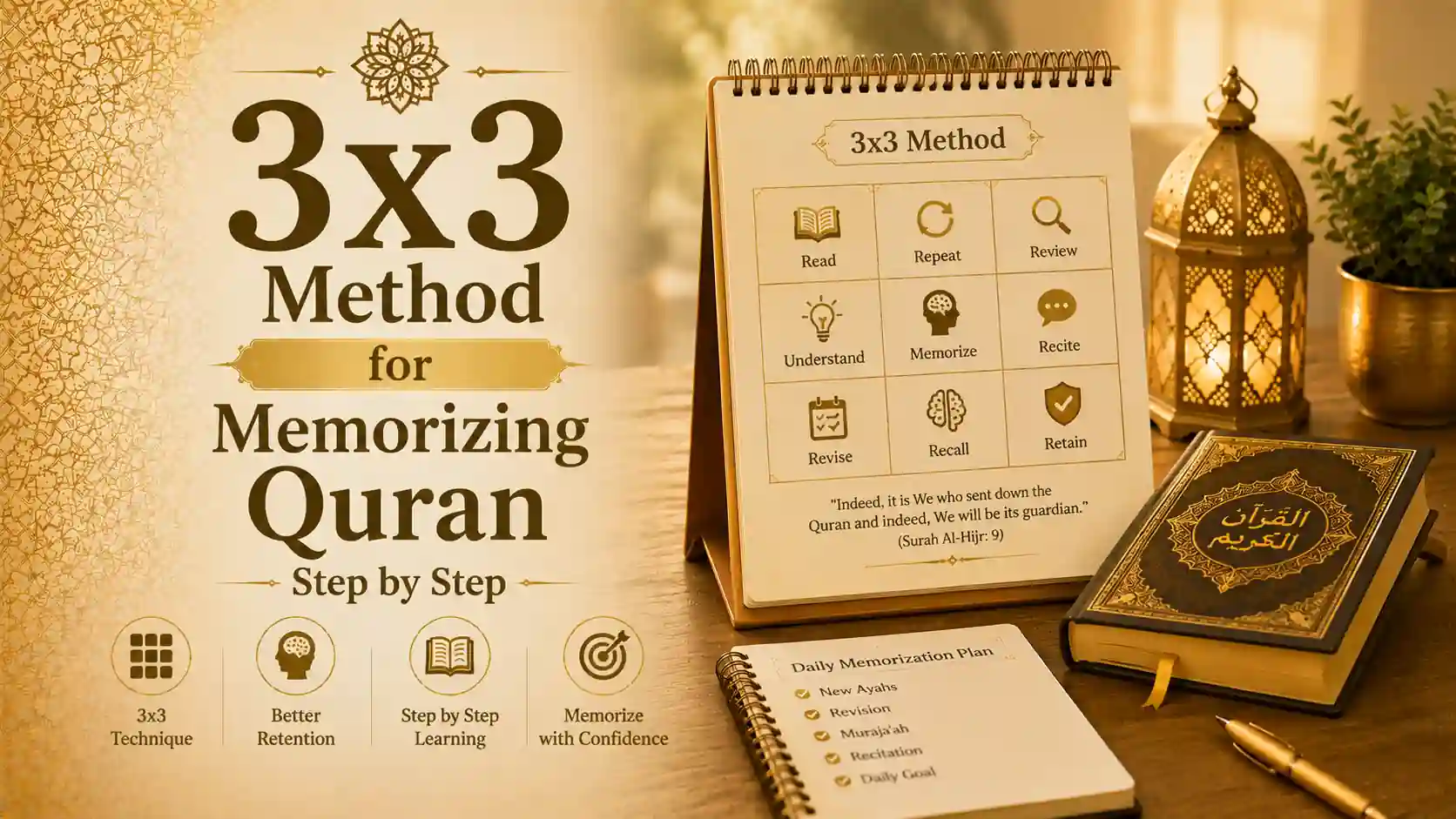
Those who have attempted to memorize entire pages and found themselves forgetting it within days may find the 3×3 method for memorizing quran to be just what the doctor ordered. It is based on using memory rather than against memory by breaking memorization into three verses at a time, three times at each verse, and three combined times. It takes you step-by-step through the application, using examples and a sample 30-day application plan you can use right now starting today.
What Does the 3×3 Method for Memorizing Quran Actually Mean?
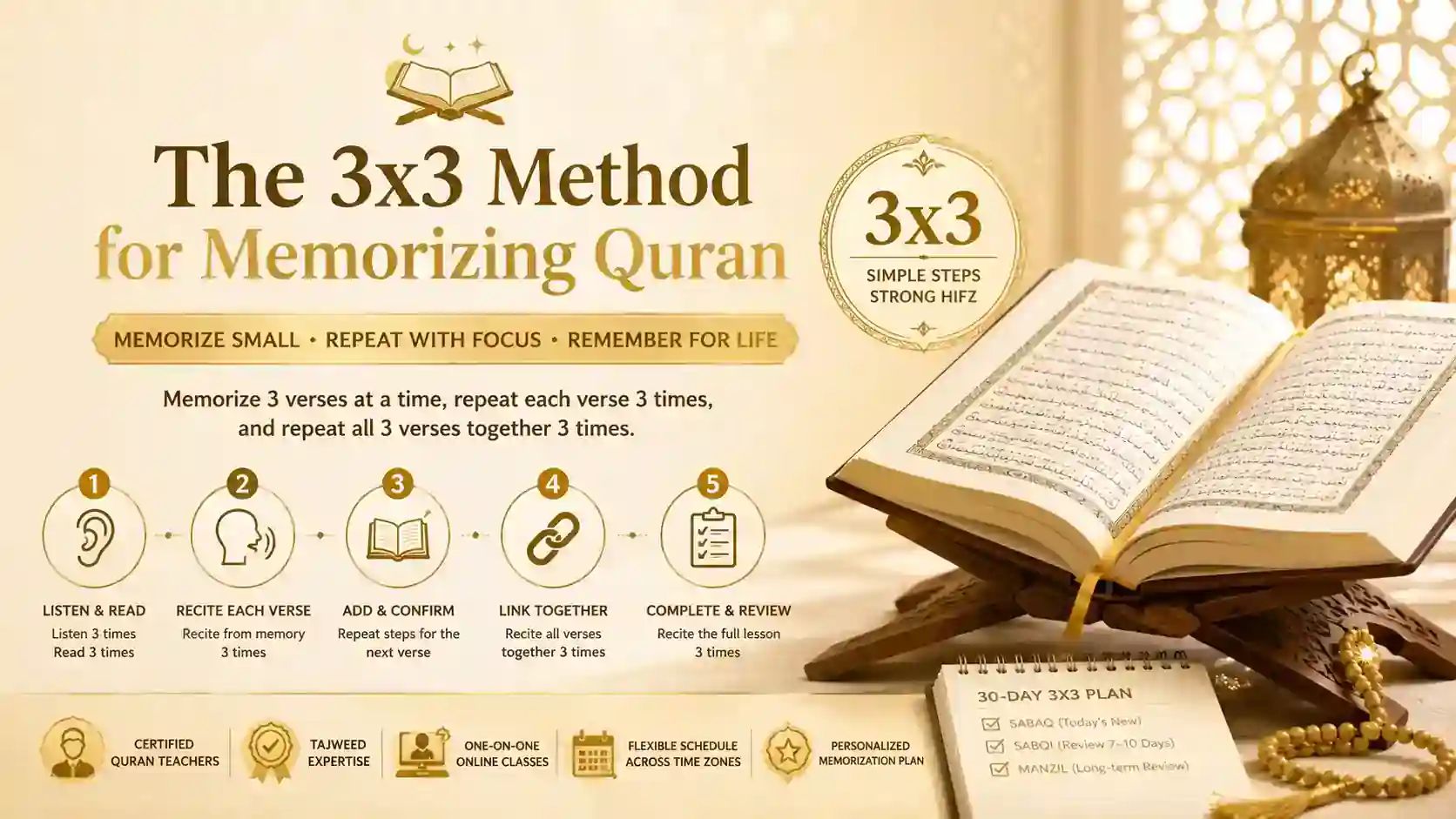
The 3×3 method for memorizing quran is memorizing three verses at once, then repeating each verse three times, and then repeating the three verses again. It is one of the easier hifz memorization techniques, which focuses on small, manageable amounts and not too many pages. The framework is regarded by many teachers to have been developed by Sheikh Wisam Sharieff, although many modern-day Hifz programs follow slightly different versions.
Why Does Breaking Quran Into Small Units Make Hifz Easier?
This small-sized division of the Quran is possible because of the fact that the human brain can retain only a few new concepts in short-term memory at a time. Three verses at a time is that natural limit that we don’t have to beat.
This is also why 3×3 method for memorizing quran proves to be a more relaxed and sustainable method of memorizing the Quran as compared to memorizing a whole page at a time.
Best Way to Memorize Quran Fast for Beginners
What Do You Need Before Starting the 3×3 Method?
A few basics for the 3×3 method for memorizing quran. The following is required:
- A Mushaf or Quran application with a clear indication of the target verses.
- Recording of a qualified reciter to listen to first.
- A peaceful, quiet area where 15-30 minutes of quiet time is available.
- Corrector Teacher or Study Partner to correct pronunciation errors.
How Do You Listen and Read the Target Ayah in Step One?
Step one is to listen first and read second. There are three parts to follow:
- Hear a knowledgeable reciter recite the ayah three times.
- Read the ayah three times independently while referring to the mushaf.
- If you come across any words you don’t know or letters that are confusing, jot them down first, then move on.
This step helps prevent any mistakes from being memorized along with the words, helping to develop correct pronunciation first.
Quran Ahkam Tajweed Rules for Correct Quran Recitation
How Do You Recite From Memory in Step Two?
In Step Two, one goes from reading to recalling. Here’s how it works:
- Cover or close the mushaf altogether.
- Recite the same ayah three times from memory (without looking back)
- If you mess up, move on and correct yourself as soon as you notice you are wrong, then go back to the same task and do it again.
- Only move forward once you recite it smoothly three times in a row.
How Do You Add and Confirm the Next Ayah in Step Three?
None of this is done together; Step Three repeats Steps One and Two for the next ayah individually. You hear, read, and recite the second ayah independently first and then check it to see if it is solid on its own. You can only link the verses together in Step 4 when both verses are independently secure.
Top Online Quran Classes with Tajweed for USA Learners
How Do You Link Memorized Ayahs Together in Step Four?
The two verses form a unit at Step Four. This is the prprocess;t goes like this:
- Recite both the memorized ayahs together, back to back from memory.
- Do the combined pair three times, without stopping between each repetition.
- If the joint is hesitant, repeat the pair.
How Do You Complete and Review the Full Lesson in Step Five?
This is the end of the session in Step Five. After linking all the ayahs in a portion of the day, recite the ayahs from the beginning to the end three times in a row. This last repetition establishes the entire unit as one, rather than as individual verses that are loosely stitched together.
Online Tajweed Classes for Sisters with Expert Female Quran Teachers
How Do You Apply the 3×3 Method to Long Ayahs?
If the ayah is long, break it into natural phrase breaks first then split the larger ayah into smaller ones. Here’s the adjustment:
- Divide the long ayahs at natural pause points (waqf marks are useful).
- Repeat listening, reading, and reciting with each of the phrase segments.
- Now link the segments with the same method as you would link two shorter ayahs.
Online Hifdh Program for Quran Memorization and Revision
How Do You Combine Tajweed and Meaning With 3×3 Memorization?
The Tajweed and meaning are added in at Step One, rather than added on later. Listen and read, paying attention to points of articulation and pause briefly to grasp the meaning of each phrase. This allows the 3×3 method for memorizing quran to be used in a way that leads to true understanding and not memorization without understanding.
What Is the Best Revision Schedule When Using the 3×3 Method?
Use a combination of daily 3×3 method for memorizing quran and a sabaq sabqi manzil for the best results. So, Sabaq is your new 3×3 for the day; Sabqi is the review of the previous 7 to 10 days; and Manzil is the review of anything you have memorized previously. This layered system is the best way to memorize quran without forgetting it.
Can You Read Quran Without Tajweed A Complete Beginner Guide?
What Mistakes Make the 3×3 Method Less Effective?
There are a few habits that subtly sabotage this approach. Watch out for:
- Running the reps too quickly and not concentrating on the reps.
- Omitting the linking step of Step 4, going directly to review.
- Learning words by rote without comprehending their meanings.
- Skipping the correction of Tajweed till it becomes a habit of error.
- Adding too many verses in a session in haste.
Tajweed Course Certificate Online With Certified Quran Teachers
Is the 3×3 Quran Memorization Method Suitable for Every Learner?
For most people, including beginners and busy adults, who can only study 20 to 30 minutes a day, the 3×3 method for memorizing quran is ideal. One of the easier techniques for quran memorization for beginners is this one. This structure typically does not fit naturally for very young children or complete non-readers who require a phonetic-first adaptation first led by a teacher.
Quran Tajweed With English Translation for Easy Learning
How Do You Track Accuracy and Progress With the 3×3 Method?
There is a method to monitoring progress to keep things honest. Here are a few easy tests:
- Make sure you record on a daily basis which verses you did.
- Record yourself reciting and compare to a qualified reciter.
- Arrange weekly meetings with the teacher to correct.
- Practice the manzil of the last week without introducing anything new. Check the manzil of the previous week until you have mastered it, then add a new manzil.
What Does a 30-Day 3×3 Quran Memorization Plan Look Like?
A 30-day plan applies the same daily cycle, just scaled across a full month.
Sample 30-Day 3×3 Method for Memorizing Quran Plan
| Week | Focus | Daily Target |
|---|---|---|
| Week 1 | Learn the steps, build the habit | 3 to 6 verses a day |
| Week 2 | Add sabqi review of Week 1 | 6 to 9 verses a day |
| Week 3 | Introduce manzil review sessions | 6 to 9 verses a day |
| Week 4 | Full cycle: sabaq, sabqi, and manzil together | Consolidate and revise |
Adjusting the daily target up or down based on verse length keeps this quran memorization method realistic instead of rigid.
Is There Any Method Better Than the 3×3 Method for Memorizing Quran?
There is no one approach that is better for all learners; it is relative to the learner. Some learners like to hear their lessons repeated on the whole page, some like to use an app with a listen and repeat response, and some learners thrive on having the lesson repeated by a teacher with no set structure. The 3×3 method for memorizing the Quran can be applied primarily because it is very simple and it has an inbuilt revision habit.
Start Memorizing the Quran with Confidence
Quran Beauty Online’s memorization tutors are Ijazah-certified, native Arabic speakers who build personalized review and repetition schedules for every student, breaking lessons into small, manageable parts much like the 3×3 method for memorizing quran described here. Classes run live and one-on-one, with separate male and female tutors available and flexible scheduling across US time zones.
Ready to put the 3×3 method for memorizing quran into practice with a real teacher listening to every repetition? Start a free trial class with Quran Beauty Online today and get a personalized memorization plan built around your pace.
Frequently Asked Questions
Can the 3×3 method work for Quran memorization for adults with full-time jobs?
Yes. The 3×3 method is particularly useful for busy adults since it typically takes 20-30 minutes a session. It can be fitted in during lunch breaks, commutes, or evenings and helps learners make consistent progress in memorizing without overloading their schedules.
Does the 3×3 method replace the need for a teacher?
No. You can use the 3×3 technique for memorization, but it’s no substitute for a good teacher. A teacher corrects Tajweed, pronunciation, and memorization errors; provides individual correction; and checks that each verse is memorized correctly before moving on to new material.
How many verses should a total beginner start with per session?
Routine: Three verses each session, as in the original 3×3. After they are able to memorize, link and review those verses without having to make many mistakes, they can then, if they are confident and consistent, gradually expand the daily quantity of verses they memorize.
Are there any Quran memorization tips that pair well with the 3×3 method?
Yes. Going over the verses before bed, reciting the verses throughout the day, reciting the verses during voluntary prayers, and having a revision schedule every day helps to make the verses stick in your mind. When these habits are used with the 3×3 method, the results of memorization over time are more consistent.
What should I do if I forget verses after using the 3×3 method?
It is not a failure of the method if one forgets to memorize the Quran. Forgetting verses is a normal part of Quran memorization, not a failure of the method. Go back to the forgotten verses, repeat the 3×3 steps, and increase your daily review. When short-term memory is converted to long-term memory, it is through consistent revision.