Izhar Noon Sakinah in Tajweed | Clear Quran Recitation
Have you ever listened to a wonderful Quran recital and wondered how it sounds so smooth and clear? Tajweed rules, particularly those governing Noon Sakinah, play a significant role in creating this magic.
Today, we’re delving into the izhar noon sakinah rule, which is one of the fundamental rules that ensures your recitation sounds genuine and sincere. If you’re learning Tajweed, mastering izhar noon sakinah will improve your pronunciation, making specific words crisp and unique.
Introduction to Tajweed and Its Importance
Tajweed is the precise art of reciting the Quran as it was revealed to Prophet Muhammad (PBUH). Rather than simply reading words, it focuses on honoring the divine message through flawless pronunciation.
The Significance of Tajweed in Reciting the Quran
Even minor mispronunciations might change meanings or diminish the verse’s attractiveness in the absence of Tajweed. Rules like izhar noon sakinah help to preserve the Quran’s elegance. The best among us are those who study and teach the Quran, according to the Prophet (PBUH), and correct recitation is essential to that greatness.
Meaning of Izhar in Tajweed
“Izhar” means “to make clear” or “manifest.” In Tajweed, the “n” sound of Noon Sakinah is pronounced fully and clearly, with no nasal twang or merging into the next letter.
Why is Izhar Halqi called that?
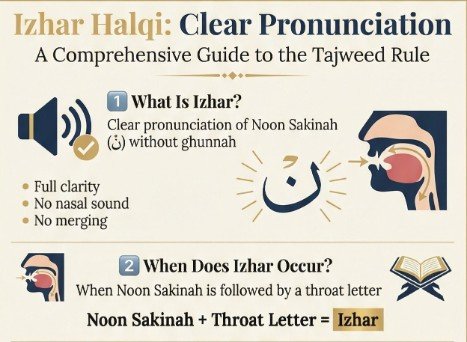
The term “Halqi” means “throatal” since the triggering letters originate in the throat.Pure clarity in izhar noon sakinah results from the distance between these throat letters and the Noon’s departure (nose/tongue), which renders blending unnatural.
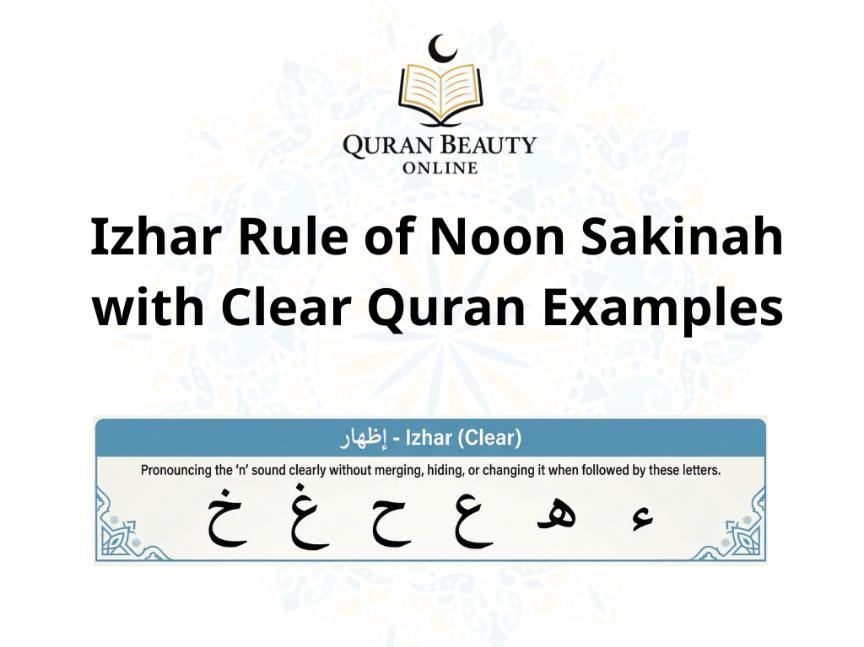
The Six Throat Letters Triggering Izhar:
They’re classified as throat letters for a reason: their deep, guttural sounds require separation.
- ء (hamzah).
- ه (haa).
- ع (ayn).
- ح (haa).
- غ (ghayn).
- خ(khaa).
Clear Quran Examples of Izhar Noon Sakinah
| Letter | Example | Explanation |
| ء | (النَّبِيُّ أَوْلَىٰ بِالْمُؤْمِنِينَ مِنْ أَنفُسِهِمْ) | The phrase is :(مِنْ أَنفُسِهِمْ). The Noon Sakinah in “min” meets hamzah in “anfusihim.” Pronounce it as “min ‘anfusihim” ,clear “n.” |
| ه | (خَالِدِينَ فِيهَا لَا يُخَفَّفُ عَنْهُمُ الْعَذَابُ وَلَا هُمْ يُنظَرُونَ) | The word is :(عَنْهُمُ) . The Noon Sakinah followed by ” haa “. Say “anhum” with distinct “n” before the soft haa. |
| ع | (هَلْ عِندَكُم مِّنْ عِلْمٍ فَتُخْرِجُوهُ لَنَا) | The phrase is 🙁 مِّنْ عِلْمٍ ). The Noon Sakinah (نْ) is followed by the letter ‘Ayn (ع), which is one of the six throat letters.You produce a clear, distinct “n” sound without any extra nasalization (Ghunnah) or hiding. |
| ح | (فَصَلِّ لِرَبِّكَ وَانْحَرْ) | In the word “وَانْحَرْ”, the Noon Sakinah (نْ) is followed by the letter Ḥaa (ح). You must pronounce the “n” clearly and quickly by touching the tip of your tongue to the roof of your mouth, then move immediately to the sharp, breathy “h” sound of the Ḥaa. Do not hide the “n” or add a nasal vibration (Ghunnah). |
| غ | (مِنْ غَيْرِ سُوءٍ) | The phrase is : (مِنْ غَيْرِ). “Min ghayr” that “n” pops before the raspy ghayn. |
| خ | (وآمنهم مِنْ خَوْفٍ) | The phrase is : (مِنْ خَوْفٍ). The Noon Sakinah is followed by Kha (خ), the sixth throat letter. |
How to Apply the Izhar Rule of Noon Sakinah.
Once you’ve identified the pattern, using izhar noon sakinah is easy.
Pronunciation Guidelines
- Say the “n” sharply from the tip of the tongue touching the gums of the upper front teeth, then proceed directly to the throat letter. There is no stop, but there is also no rush.
- There is no Ghunnah in Izhar, which is an important distinction.There is no nasal sound (ghunnah) here. That’s what distinguishes izhar noon sakinah: pure “n.”
Clear Quran Examples of Izhar Noon Sakinah
- Examples with Hamzah (ء):
From Surah Al-Ahzab (33:6)
“النَّبِيُّ أَوْلَىٰ بِالْمُؤْمِنِينَ مِنْ أَنفُسِهِمْ“
The Noon Sakinah in “min” meets hamzah in “anfusihim.” Pronounce it as “min ‘anfusihim” ,clear “n.”
- Examples with Haa (ه):
From Surah Al-Baqarah(2:162)
“خَالِدِينَ فِيهَا لَا يُخَفَّفُ عَنْهُمُ الْعَذَابُ وَلَا هُمْ يُنظَرُونَ“
Noon Sakinah followed by haa. Say “anhum” with distinct “n” before the soft haa.
- Examples with Ayn (ع):
From Surah Al-An’am (6:148)
“هَلْ عِندَكُم مِّنْ عِلْمٍ فَتُخْرِجُوهُ لَنَا”
The Noon Sakinah (نْ) is followed by the letter ‘Ayn (ع), which is one of the six throat letters.You produce a clear, distinct “n” sound without any extra nasalization (Ghunnah) or hiding.
- Examples with Haa (ح)
From Surah Al-Kawthar(108:2)
“فَصَلِّ لِرَبِّكَ وَانْحَرْ”
In the word “Wanhar”, the Noon Sakinah (نْ) is followed by the letter Ḥaa (ح).How to pronounce it: You must pronounce the “n” clearly and quickly by touching the tip of your tongue to the roof of your mouth, then move immediately to the sharp, breathy “h” sound of the Ḥaa. Do not hide the “n” or add a nasal vibration (Ghunnah).
- Examples with Ghayn (غ)
From Surah Taha (20:22)
“مِنْ غَيْرِ سُوءٍ“
“Min ghayr” that “n” pops before the raspy ghayn.
- Examples with Khaa (خ)
Surah Quraish (106:4)
“وآمنهم مِنْ خَوْفٍ”
Why it’s Izhar: The Noon Sakinah is followed by Kha (خ), the sixth throat letter.
Common Mistakes in Applying Izhar Noon Sakinah
Beginners frequently add a nasal hum (ghunnah) by habit, transforming izhar noon sakinah into something more similar to Ikhfa. Alternatively, they rush and combine it slightly.
Confusing Izhar with Ikhfa or Idgham
Remember: Throat letters = Izhar only.
Practical Tips to Perfect Your Izhar Noon Sakinah
Practice Techniques:
Repeat phrases with throat letters daily. Record yourself and compare to renowned reciters.
Listening to Expert Reciters:
- Tune into recitations focusing on izhar noon sakinah spots. You’ll hear the clarity and feel inspired.
- You can also practice the izhar Noon Sakinah rule directly from a Quran Mushaf with Tajweed colors, which helps you clearly recognize the hidden Meem pronunciation.
- Mastering izhar noon sakinah isn’t just a rule, it’s a step closer to reciting like the angels. It brings out the Quran’s true rhythm, making your connection deeper and more rewarding.
Izhar noon sakinah is a component of proficiency. Each letter is an assurance from Allah. Take care of it.
Conclusion
Izhar noon sakinah rule can help you recite the Quran more clearly and authentically. By clearly pronouncing the “n” before those six throat letters, you revere the Quran’s pristine form. With the samples we’ve looked at, you’ll be able to recognize and apply izhar noon sakinah anywhere you see it. Maintain consistency, seek help, and witness your Tajweed flourish.
frequently asked questions (FAQs):
Q1.What happens if Noon Sakinah is followed by a throat letter across two words versus within the same word, does the Izhar rule apply differently?
No, the Izhar rule applies exactly the same way whether the throat letter is in the next word or (rarely) in the same word. The “N” is always crisp and clear. If you find your tongue lingering or air escaping through the nose, the Izhar is not being performed correctly.
Q2. Is there any variation in the strength or clarity of Izhar depending on which of the six throat letters follows the Noon Sakinah?
Yes, classically, Izhar has ranks:
- Highest (Strongest): Occurs with Hamzah (ء) and Ha (هـ) because they originate from the deepest part of the throat, furthest from the tongue.
- Medium: Occurs with ‘Ayn (ع) and Hha (ح), which originate from the middle of the throat.
- Lowest: Occurs with Ghayn (غ) and Kha (خ) because they originate from the top of the throat (closest to the mouth).
The “n” remains fully clear without ghunnah in all cases.
Q3. How can beginners avoid accidentally adding a slight ghunnah when applying Izhar with deeper throat letters like ghayn or khaa?
Tips to Eliminate Accidental Ghunnah
- Sharp Articulation: Focus on striking the tip of the tongue firmly against the upper gums (the makhraj of Noon) and releasing it instantly.
- Rapid Transition: Do not allow the tongue to linger. Move immediately from the “N” sound to the throat letter (غ or خ).
- Zero Holding Time: Unlike Ikhfa or Idgham, Izhar has no “waiting period.” The duration of the Noon should be exactly the same as any other letter with a Sukun.
- Physical Exaggeration: When practicing, intentionally exaggerate the “cut” between the two letters. Think of it as a clean break rather than a smooth slide.
- Slow-Motion Practice: Recite at a very slow pace (Tahqiq) to consciously monitor the nose. If you feel vibration in the bridge of your nose during the “N,” you are applying Ghunnah.
Q4. Is it acceptable to slightly elongate the noon in izhar for emphasis or beauty?
No. In izhar noon sakinah, the ن is sakinah, which means it must be spoken without extending (no madd) or ghunnah. Any extension or vocal embellishment changes the letter’s structure and contradicts tajweed. Clarity and respect to standards, rather than vocal ornamentation, are what give Quranic recitation its beauty.