
Iqlab meaning in Tajweed is changing Noon Sakinah or Tanween into a hidden Meem sound when followed by the letter Baa (ب). This rule helps Quran learners avoid common recitation mistakes and pronounce verses more accurately. In this guide from Quran Beauty Online, you will learn the Iqlab rule, its letter, Quran examples, and how to practice the correct pronunciation with an audio file and live teacher support.
Today, we will explain how Iqlab turns the hidden “n” sound into a soft “m” sound with Ghunnah, making your recitation smoother and more accurate.
Iqlab Meaning and Its Rule in Tajweed
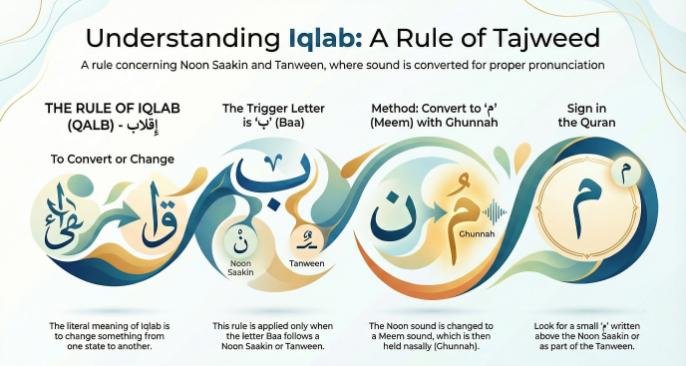
Iqlab meaningin Tajweed is“conversion” or “turning something into something else.” In Quran recitation, it means turning Noon Sakinah or Tanween into a hidden Meem sound before the letter Baa (ب).
This does not mean that you write a real Meem in the word. Instead, you pronounce the Noon Sakinah or Tanween as a soft hidden Meem with nasalization.
In simple words:
If Noon Sakinah or Tanween comes before Baa (ب), we apply Iqlab.
The sound changes from:
نْ / Tanween sound → hidden م sound + Ghunnah
Iqlab Rule with Noon Sakinah and Tanween
Iqlab applies in two main cases:
1. Iqlab with Noon Sakinah
This happens when a Noon Sakinah (نْ) is followed by the letter Baa (ب).
Example: مِنْ بَعْدِ
Here, the word مِنْ ends with Noon Sakinah, and the next word begins with Baa. So the Noon sound changes into a hidden Meem sound with Ghunnah.
2. Iqlab with Tanween
This happens when Tanween ـً ، ـٍ ، ـٌ is followed by the letter Baa (ب).
Example: سَمِيعٌ بَصِيرٌ
Here, the word سَمِيعٌ ends with Tanween, and the next word بَصِيرٌ begins with Baa. So the Tanween sound changes into a hidden Meem sound with Ghunnah.
This is an important point for beginners: Iqlab is not only for Noon Sakinah. It also applies to Tanween when Tanween is followed by Baa.
Iqlab letter Baa
The Iqlab rule has only one letter:
ب — Baa
Whenever Noon Sakinah or Tanween comes before Baa, Iqlab is applied.
This makes Iqlab easier to recognize than other Noon Sakinah and Tanween rules because it has only one trigger letter.
How to Pronounce Iqlab Correctly
To pronounce Iqlab correctly, follow these steps:
First, identify Noon Sakinah or Tanween.
Second, check if the next letter is Baa (ب).
Third, change the Noon Sakinah or Tanween sound into a hidden Meem sound.
Fourth, pronounce the hidden Meem with Ghunnah from the nose.
Fifth, hold the Ghunnah for two counts before moving to the Baa.
The sound should be soft and smooth. Do not pronounce a clear “n” sound, and do not press the lips too hard.
Lip Position in Iqlab
When applying Iqlab, the lips should come together gently for the hidden Meem sound.
Some teachers explain that the lips should close lightly, while others describe a very small gap. In practical recitation, the most important point is this:
Do not press the lips strongly. Keep the sound soft, nasal, and relaxed.
If the lips are too tight, the sound becomes heavy and unnatural. If the Ghunnah is missing, the Iqlab will sound incomplete.
Iqlab examples
Examples of Iqlab with Noon Sakinah and Tanween
| Examples | Type of Iqlab | Explanation |
|---|---|---|
| ﴿كَمَثَلِ حَبَّةٍ أَنـبَـتَتْ سَبْعَ سَنَابِلَ فِي كُلِّ سُنـبُلَةٍ مِّئَةُ حَبَّةٍ﴾ Al-Baqarah 2:261 | Within a single word | The first example is أَنـبَـتَتْ, and the second example is سُنـبُلَةٍ. In both words, Noon Sakinah is followed by the letter Baa (ب) in the same word, so the Noon sound changes into a hidden Meem sound with Ghunnah. |
| ﴿ذَلِكَ مِنْ أَنبَـاءِ الْغَيْبِ نُوحِيهِ إِلَيْكَ﴾ Aal Imran 3:44 | Within a single word | The word أَنبَـاءِ is a clear example of Iqlab. The letter Baa (ب) comes after Noon Sakinah (نْ) within the same word, so the Noon is changed into a hidden Meem sound. |
| ﴿أَلَمْ تَرَ إِلَى الْمَلَإِ مِن بَـنِي إِسْرَائِيلَ مِن بَـعْدِ مُوسَى﴾ Al-Baqarah 2:246 | Between two words | The first example is مِن بَـنِي, and the second is مِن بَـعْدِ. The word مِنْ ends with Noon Sakinah, and the next word starts with Baa (ب). In this case, the Noon sound changes into a hidden Meem sound with Ghunnah for two counts. |
| ﴿إِنَّ اللَّهَ سَمِيعٌ بَصِيرٌ﴾ | Tanween followed by Baa | The word سَمِيعٌ ends with Tanween, and the next word بَصِيرٌ starts with the letter Baa (ب). Because Tanween is followed by Baa, Iqlab is applied. The Tanween sound changes into a hidden Meem sound with Ghunnah. |
| ﴿وَاللَّهُ عَلِيمٌ بِذَاتِ الصُّدُورِ﴾ | Tanween followed by Baa | The word عَلِيمٌ has Tanween, and the following word بِذَاتِ begins with Baa (ب). This is an example of Iqlab with Tanween. The reciter should not pronounce the Tanween clearly; instead, it is changed into a soft Meem sound with nasalization. |
| ﴿لَنَسْفَعًا بِالنَّاصِيَةِ﴾ Al-Alaq 96:15 | Tanween followed by Baa | The word لَنَسْفَعًا ends with Tanween, and the next word بِالنَّاصِيَةِ starts with Baa (ب). Here, the Tanween changes into a hidden Meem sound and is held with Ghunnah for two counts. |
| ﴿كِرَامٍ بَرَرَةٍ﴾ Abasa 80:16 | Tanween followed by Baa | The word كِرَامٍ ends with Tanween Kasr, and بَرَرَةٍ begins with Baa (ب). This is a clear example of Iqlab with Tanween. The hidden Meem sound should be gentle and nasal. |
| ﴿مِن كُلِّ زَوْجٍ بَهِيجٍ﴾ | Tanween followed by Baa | The word زَوْجٍ ends with Tanween, and the next word بَهِيجٍ starts with Baa (ب). Since Baa follows Tanween, the Tanween sound is changed into a hidden Meem with Ghunnah. |
Visual Indicators of the Quran
Most copies of the Mushaf (Quran) include a very thin Meem (م) is put above the letter Noon (ن) to signal the Iqlab Noon Sakinah rule. Typically, the Sukoon (°) is removed to make space for it.
Iqlab is one of the main 7 Proven Steps to Master Noon Sakinah Rules in Tajweed, along with Izhar, Idgham, and Ikhfa, so understanding these rules helps you recite the Quran more accurately.
Common Mistakes in Applying Iqlab Noon Sakinah
The “Clear Noon” Trap:
- The Mistake: Your tongue touches the roof of your mouth, making a sharp “N” sound before the “B.”
- The Fix: Imagine your tongue is “frozen” at the bottom of your mouth. For Iqlab Noon Sakinah, the tongue should not do any work; the lips and the nose handle everything.
Exaggerating the Meem (Clamping Effect):
- The Mistake: Too much pressure on the lips (Itbaq). This produces a “bumping” sound and disrupts the smooth flow of the Ghunnah.
- The Fix: Use “The Paper Test.” Your lips should touch so gently that if you tried to pull a thin piece of paper from between them, it would flow out with no effort.
The “Missing” Ghunnah:
- The mistake: Changing the letter to Meem but skipping the nasal vibration. It sounds like a plain “M” (e.g., Am-ba rather than Amm-ba).
- The Fix: Remember that Iqlab Noon Sakinah is a three-in-one rule. Change the letter + hide the contact + add vibration. If you plug your nose, the sound should stop entirely. If the sound continues, you are not utilizing enough Ghunnah.
Timing issues (the two-count rule):
- The Mistake: Rushing through the rule (1 count) or dragging it out (3 or more counts).
- The Fix: The time it takes to slowly fold or unfold one finger is used as the standard measure for two counts. The “rhythm” of the Quran relies heavily on consistency.
read our guide on Idgham Noon Sakinah and learn how the Noon sound blends into the following letter.
Easy Practical Tips to Master Iqlab Rule
1. The Feather-Light Lip Closure: Rather than “closing” your mouth, try “bringing the lips to meet.”
Expert Tip: If you notice tension in your jaw or facial muscles, you’re pressing too hard. The lips should be relaxed and in a similar position as when you breathe properly through your nose.
- Shifting to the Nasal Sound (Ghunnah): Iqlab Noon Sakinah is 70% nose and 30% mouth.
The Test: When practicing a word like (مِنۢ بَعْدِ), pinch your nose mid-sound. The sound should stop immediately. If the sound continues to come out of your mouth, you are focusing too much on the “oral sound” and not enough on the “nasal sound.”
- The “Slow-Motion” Method: When you first start, don’t worry about the verse’s speed.
Practice Drill: Say the first part of the term. Make a stop at noon.Switch to the Meem and hum for 3 or 4 seconds (deliberately too long) in order to feel the vibration. Release into the Baa. Once you feel the vibration, return the timing to the right two counts.
- Comparison with a “Qualified Qari”:These Qaris are well-known for applying the Iqlab Noon Sakinah rule precisely and clearly when looking for voices to mirror:
- The “Teacher of Reciters” is Mahmoud Khalil Al-Hussary. His pace is ideal for students.
- Mohamed Siddiq El-Minshawi: Great for understanding the Ghunnah’s depth of emotion.
You can also practice the Iqlab Noon Sakinah rule directly from a Quran Mushaf with Tajweed colors, which helps you clearly recognize the hidden Meem pronunciation.
- Start with “Juz Amma” (Short Surahs):
Short Surahs have frequent examples of Iqlab Noon Sakinah that are easy to find.
Importance of What is Iqlab in Tajweed in Beautiful Recitation
Iqlab Noon Sakinah is important in beautiful recitation because it acts as a vocal bridge that maintains linguistic fluency while also preserving Tajweed’s unique Prophetic lineage.
By moving the sound from the tongue (Noon) to the lips (Meem), it avoids the phonetic “clash” that happens when moving suddenly between distant articulation points, substituting a harsh transition with a resonant, two-count nasal hum (Ghunnah).
This method not only maintains the verse’s rhythmic harmony, but it also protects against Lahn Khafi (hidden errors) that could alter the sanctity of Quranic Arabic.
A reciter’s skill and profound regard for the accurate oral transmission of the Revelation are shown to the listener by a flawlessly performed Iqlab, which is characterized by a soft, relaxed lip contact and adds a layer of melancholy beauty and spiritual calm.
Why Expert Teacher is Essential for Mastering Iqlab Noon Sakinah
While self-study assists with the definitions, mastering Iqlab Noon Sakinah requires a licensed teacher delivers three things that a book cannot:
- Auditory Precision: Recognizing the smallest distinction between a closed-mouth “M” and a correct Tajweed “M” with a slight gap or light contact.
- Immediate Correction: Identifying “over-nasalization” or “clicking” sounds before they become a habit.
- Step-by-Step Progression: Moving from isolated words like Min-ba’di to applying the rule fluently within long verses during recitation.
Why Choose Quran Beauty Online Academy?
Selecting the ideal environment for studying the Quran is an important choice. Through an unique, structured approach, Quran Beauty Online Academy aims to close the gap between theoretical knowledge and spiritual connection.
With Quran Beauty Online Academy, academic accuracy meets flexible learning to take you on a one-of-a-kind spiritual journey. We provide one-on-one live lessons with a small set of trained and Ijazah-holding instructors.
We lead you via planned methods and programs designed for both children and adults as you learn Tajweed, memorize the Quran, and even get your own Ijazah. Our flexible scheduling helps you to learn the Book of Allah from anywhere in the world, making it an easy, pleasurable, and accessible experience.
Realize your dream of mastering recitation and earning an Ijazah. Contact us to begin your own personalized study journey.
Email: [email protected]
WhatsApp/phone: +201102797178.
Frequently Asked Questions (FAQs):
Q1: Why is the sound modified particularly to a ‘Meem’ rather than any other letter?
The transition to Meem is due to the letters’ phonetic relationship. The Meem has the same articulation point (Makhraj) as the Baa (the lips), but it also has nasal quality (Ghunnah) like the Noon. This makes the Meem an ideal “bridge” for the perfect phonetic bridge for Iqlab Noon Sakinah.
Q2: Is there a difference in the length of the Ghunnah for Iqlab compared to Ikhfa?
Iqlab’s Ghunnah lasts about two counts, which is the same as Ikhfa’s or Idgham’s. The idea is to maintain a consistent rhythm throughout your recital.
Q3: What happens if Iqlab rule in Tajweed is followed by a “Baa” containing a Shaddah?
The rule stays exactly the same. Even if the letter Baa (ب) contains a Shaddah, you must do the Iqlab (converting Noon to Meem with Ghunnah) for two counts before pronouncing the stressed Baa.
Q4: Does the Ghunnah in Iqlab sound heavy (Tafkheem) or light (Tarqeeq)?
The Ghunnah of Iqlab Noon Sakinah is constantly light (Tarqeeq). This is because the letter Baa is a light one. Unlike Ikhfa, where the Ghunnah matches the nature of the next letter, Iqlab always has a thin, light nasal sound.
Q5: Is Iqlab Noon Sakinah applied if I stop (Waqf) on the word containing the Noon Sakinah?
No. Iqlab Noon Sakinah only happens when you connect (Wasl) the Noon Sakinah with the following letter Baa. If you stop on the word ending with Noon Sakinah (e.g., at the end of a verse), you pronounce the Noon clearly with a Sukoon, and the Iqlab rule is not applied.
If you want guided correction and real recitation practice,
explore our Online Tajweed Course with expert Quran teachers.