
Mastering Tajweed brings beauty, fluency, and precision to Qur’an recitation. One of the most important Tajweed rules is Ikhfa Haqiqi, a rule that applies when Noon Sakinah or Tanween is followed by one of the 15 Ikhfa letters. This rule creates a smooth and balanced sound between clarity and concealment.
Learning Ikhfa Haqiqi with Noon Sakinah and Tanween helps students improve their pronunciation, rhythm, confidence, and connection with the Qur’an. Instead of reading each sound separately, Ikhfa teaches you how to move naturally from the hidden “n” sound into the next letter while keeping the beautiful nasal sound known as Ghunnah.
What Are Noon Sakinah and Tanween?
Before learning Ikhfa Haqiqi, it is important to understand Noon Sakinah and Tanween, because this rule is directly connected to both of them.
Noon Sakinah is the Arabic letter Noon (ن) with a sukoon (نْ). This means the Noon is pronounced without a vowel. It can appear in the middle of a word or at the end of a word.
Tanween is the “n” sound added to the end of a noun. It appears as double vowels: ـً ، ـٍ ، ـٌ. Although Tanween is not written as a Noon letter, it is pronounced with a hidden “n” sound.
Ikhfa Haqiqi happens when either Noon Sakinah or Tanween comes before one of the 15 Ikhfa letters. That is why students should not study Ikhfa only with Noon Sakinah; they must also practice it with Tanween
Before mastering Ikhfa Haqiqi, it is helpful to understand the main Noon Sakinah rules in Tajweed, including Izhar, Idgham, Iqlab, and Ikhfa.
What Is ikhfa hakiki in Tajweed?
- what is ikhfa in tajweed ?
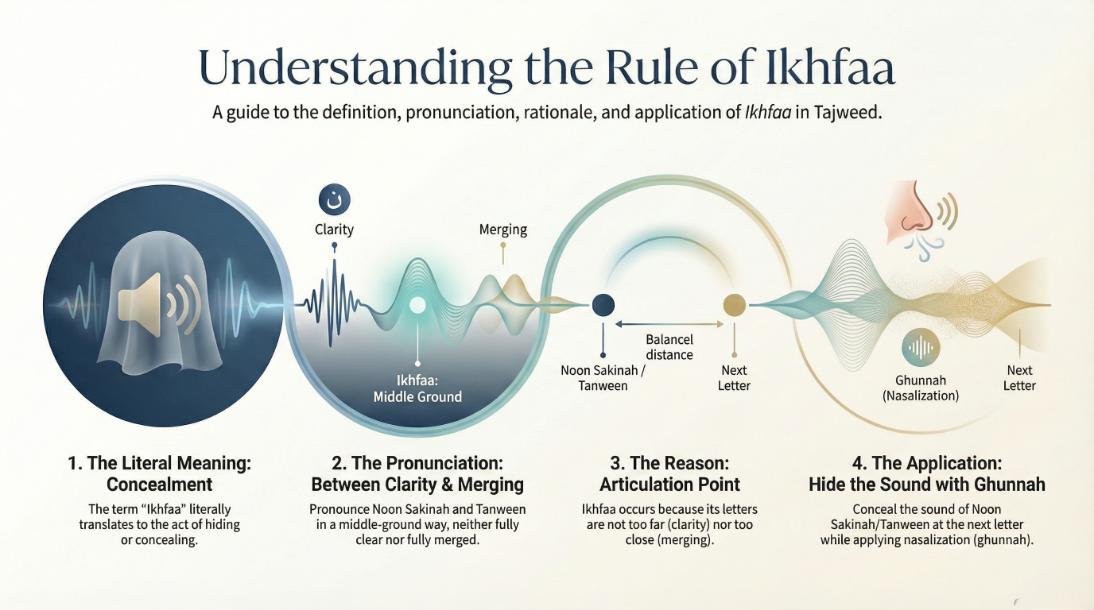
Ikhfa Haqiqi means “real concealment.” In Tajweed, it refers to hiding the sound of Noon Sakinah or Tanween when it is followed by one of the Ikhfa letters. - The sound is not pronounced clearly like Izhar, and it is not fully merged like Idgham. Instead, the reciter produces a soft hidden “n” sound with Ghunnah for two counts.
- In simple words, Ikhfa Haqiqi is a middle state between clear pronunciation and complete merging.
- When applying Ikhfa:
- The tongue does not touch the normal articulation point of Noon.
- The Noon Sakinah or Tanween sound becomes partially hidden.
- Ghunnah is held for two counts.
- The mouth prepares for the next letter smoothly.
- This creates a natural and flowing transition in recitation.
When Do We Apply Ikhfa Haqiqi?
We apply Ikhfa Haqiqi in two main cases:
1. When Noon Sakinah is followed by one of the 15 Ikhfa letters.
Example: مِنْ قَبْلِهِمْ
Here, Noon Sakinah in مِنْ is followed by Qaaf ق, so Ikhfa is applied.
Here, Noon Sakinah in مِنْ is followed by Qaaf ق, so Ikhfa is applied.
2. When Tanween is followed by one of the 15 Ikhfa letters.
Example: عَلِيمًا خَبِيرًا
Here, Tanween in عَلِيمًا is followed by Khaa خ. However, because Khaa is not one of the 15 Ikhfa letters, this is not Ikhfa. A correct Ikhfa example is: قَوْمًا جَبَّارِينَ, where Tanween is followed by Jeem ج.
This distinction is important because many beginners recognize Ikhfa with Noon Sakinah but forget that the same rule also applies to Tanween.
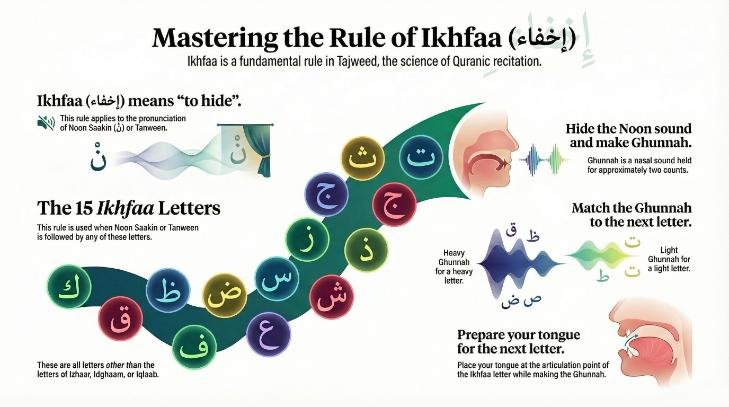
The 15 Letters of ikhfa hakiki
The 15 letters of Ikhfa Haqiqi are:
ت، ث، ج، د، ذ، ز، س، ش، ص، ض، ط، ظ، ف، ق، ك
You can remember them through the famous Arabic line:
صف ذا ثنا كم جاد شخص قد سما دم طيبًا زد في تقى ضع ظالمًا
Whenever Noon Sakinah or Tanween comes before one of these letters, Ikhfa Haqiqi must be applied.
Light and Heavy Ikhfa
Because Ikhfa prepares the mouth for the next letter, the Ghunnah can be light or heavy.
Heavy Ikhfa
Heavy Ikhfa happens when Noon Sakinah or Tanween is followed by one of the heavy letters:
ص، ض، ط، ظ، ق
In this case, the Ghunnah should sound deeper and fuller.
Example with Noon Sakinah: مِنْ قَبْلِهِمْ
Example with Tanween: رِيحًا صَرْصَرًا
Light Ikhfa
Light Ikhfa happens when Noon Sakinah or Tanween is followed by one of the remaining light Ikhfa letters, such as:
ت، ث، ج، د، ذ، ز، س، ش، ف، ك
In this case, the Ghunnah should remain thin and light.
Example with Noon Sakinah: مَنْ ثَقُلَتْ
Example with Tanween: شَيْئًا فَرِيًّا
Examples of ikhfa words in quran
Examples of Ikhfa Haqiqi with Noon Sakinah and Tanween
Learn Ikhfa Haqiqi through clear Quranic examples with Noon Sakinah and Tanween, including light and heavy Ikhfa cases with audio recitation for each example.
How to Apply ikhfa haqiqi Correctly
- The “Near-Touch” (Gap):
- The Rule: The tongue should not contact the roof of the mouth.
- Pro-Tip: Imagine the tongue “hovering” at the door of the following letter. If you touch your gums, you have mistakenly done Izhar (clear N). If you press too hard on the next letter, you will mistakenly do Idgham (merging).
- The Nasal Ghunnah:
- The Rule: The sound must come from the nose (Khayshum), not the throat.
- Pro-Tip: To see if you’re doing it correctly, pinch your nose while trying to say the Ikhfa. If the sound fully stops, you’re doing it correctly! If the sound continues, it indicates that you are utilizing your mouth/throat extensively.
- Two-Harakah Timing:
- The Rule: Hold for around two counts.
- Pro Tip: Keep the timing consistent throughout your recitation. A common mistake is speeding through the Ikhfa in fast recitation or taking too long in slow recitation. It should be rhythmic.
- The Smooth Transition:
- The Rule:Transition Effortlessly to the Following Letter.
- Pro Tip: The letter you are going to say should already match the “shape” of your mouth during the Ghunnah.
- After learning Ikhfa Haqiqi, students can also study the Iqlab Noon Sakinah rule to understand how Noon Sakinah changes before the letter Baa.
Common Mistakes in Applying ikhfa hakiki
- Touching the Tongue: The “Izhar” Trap:
A common mistake is letting the tongue tip to come into contact with the alveolar ridge, which is the roof of the mouth. You have made a distinct “N” sound (Izhar) as soon as your tongue touches that point.
- Ignoring the “Heavy” and “Light” Ghunnah:
Beginners make a slight mistake by using the same nasal sound for each Ikhfa letter. The sound of the Ghunnah ought to “preview” the letter that follows:
- Heavy Ikhfa: If the next letter is heavy ( ص, ض, ط, ظ, ق), the Ghunnah should also be heavy/thick.
- Light Ikhfa: If the following letter is light (ت, ث, د, ز), the Ghunnah should be thin and light.
- The “Vowelization” Mistake:
Reciters occasionally add a little “u” or “i” sound to the Noon Sakinah or tanween before the Ikhfa begins. This frequently occurs when the mouth moves too quickly toward the next letter’s form.
Tips to Perfect ikhfa-haqiqi
- Memorize the 15 letters using charts or mnemonics.
- Begin by practicing Ghunnah independently.
- Record your recitation and compare it to that of professionals.
- Enroll in organized courses to receive feedback.
With consistent practice ikhfa in tajweed will become natural.
To compare Ikhfa with merging sounds, read our guide on Idgham Noon Sakinah and learn how the Noon sound blends into the following letter.
Transform Your Recitation with Quran Beauty Online
Mastering Ikhfa Noon Sakinah is an important step in every student’s Tajweed journey. It marks the shift from simply reading the Qur’an to reciting it with beauty and flow. While this guide gives you a strong foundation, perfecting Ikhfa is something you develop by listening and practicing, just as it has been passed down through generations of oral recitation.
is an important step in every student’s Tajweed journey. It marks the shift from simply reading the Qur’an to reciting it with beauty and flow. While this guide gives you a strong foundation, perfecting Ikhfa is something you develop by listening and practicing, just as it has been passed down through generations of oral recitation.
Don’t Practice Until You Get It Right; Practice Until You Can’t Get It Wrong !
The melody of the Quran is waiting for you. Join the thousands of successful students at Quran Beauty Online Academy and let us help you perfect your ikhfa hakiki
Contact us to begin your own personalized study journey.
Email: [email protected]
WhatsApp/phone: +201102797178.
Frequently Asked Questions (FAQs):
Q1: How should I distinguish between ikhfa-haqiqi and Ikhfa Shafawi?
It’s easy to get confused ikhfa haqiqi uses the letter Noon (ن) and tanween . Ikhfa Shafawi refers to the letter Meem Sakinah (م) followed by the letter Ba (ب). The mouth position differs because Meem is a labial (lip) letter.
Q2: Is there a difference in the “closeness” of the Ikhfa according to the letter?
Yes. Scholars divide ikhfa haqiqi into three degrees of “closeness”:
- Highest (Aqrab): When followed by (ط, د, ت), since their exit point is closest to the Noon.
- Lowest (Ab’ad): When followed by (ق, ك), since their departure point is the farthest (back of the tongue).
- Middle (Awsat): For the last 10 letters.
Q3: Does the “Heavy” (Tafkheem) Ghunnah imply that I should make noon itself heavy as well?
No. By its very nature, the Noon Sakinah is a light letter. The term “heaviness” does not refer to the Noon letter itself, but rather to the sound of the Ghunnah (the vibration in the nose) as it prepares for the heavy letter.
Q4: Is Ghunnah required in ikhfa hakiki?
Yes, Ghunnah is an absolute essential for ikhfa-haqiqi. In reality, when you “hide” the Noon or tanween, the most important characteristic that remains is Ghunnah.
Q5: Why are the letters “Waw” (و) and “Ya” (ي) not included in ikhfa-haqiq?
Despite seeming to be “hidden,” these letters belong to the Idgham rule (merging). In ikhfa-haqiqi, the Noon ot tanween are simply “hidden” or “masked” while getting ready for the next sound, but in Idgham, it is completely or partly absorbed into the subsequent letter with a pull.
If you want guided correction and real recitation practice, explore our Online Tajweed Course with expert Quran teachers.