Idgham Noon Sakinah: The Art of Merging in Tajweed

Reciting the Quran is an act of love and precision, when the heart and tongue are in perfect harmony. At the heart of this harmony is Idgham Noon Sakinah, the key to the smooth, flowing melody heard in beautiful recitation.
If you have ever wondered why some sounds merge smoothly in Quran recitation while others remain clear, this rule holds the answer.
In the following sections, we will break down the complexity of Idgham Noon Sakinah into simple, understandable steps. Designed with the modern learner in mind, this guide bridges the gap between theory and practice, giving you what you need to advance your recitation from basic reading to skilled reciting.
Understanding Noon Sakinah in Tajweed
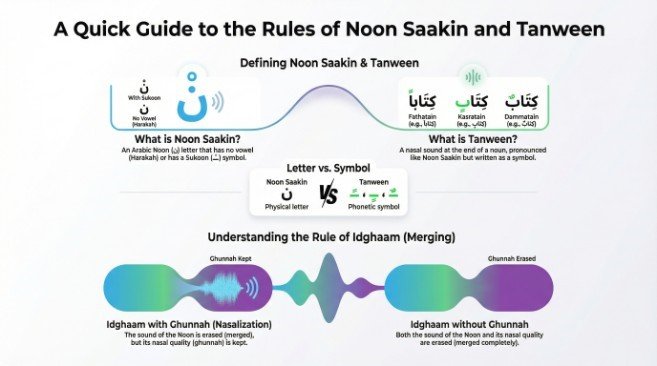
To master the art of merging, we must first recognize the starting point: the Noon Sakinah (نْ).
Noon Sakinah (نْ) refers to:
- The letter ن with sukoon (ْ).
- Or a Noon that appears without any vowel at the end of a word.
The flexibility of the Noon Sakinah, a “social” letter that modifies its personality according to its neighbor, is what makes it so beautiful. This interaction is divided into four different rules in Tajweed.
Idgham Noon Sakinah is perhaps the most transforming, combining two distinct sounds into a one, seamless breath, even though each is vital to the flow of the Quran.
What Is Idgham Noon Sakinah?
Linguistically, Idgham translates to ‘merging’, think of it as two things becoming one.In Tajweed, Idgham Noon Sakinah refers to the process of dissolving the Noon Sakinah into the letter that follows. Instead of a distinct ‘N’ stop, the two letters combine to create a unified, doubled sound (Mushaddad) that permits your recitation to continue uninterrupted.
This rule applies when Noon Sakinah is followed by specific letters known as Idgham letters.
Letters of Idgham Noon Sakinah
Tajweed scholars combined the letters of Idgham Noon Sakinah into one memorable word: (يَرْمَلُون). Consider this word your ‘Idgham Compass.’ When you see a Noon Sakinah followed by any of these six letters, the ‘Merging Rule’ is immediately activated. It is the key that opens the door to a continuous recitation.”
The letters are:
ي (Ya).
ر (Ra).
م (Meem).
ل (Lam).
و (Waw).
ن (Noon).
Types of Idgham Noon Sakinah
There are two types of Idgham noon sakinah, which are distinguished by the presence or absence of ghunnah (nasal sound).
1. Idgham with Ghunnah (Nasalization):
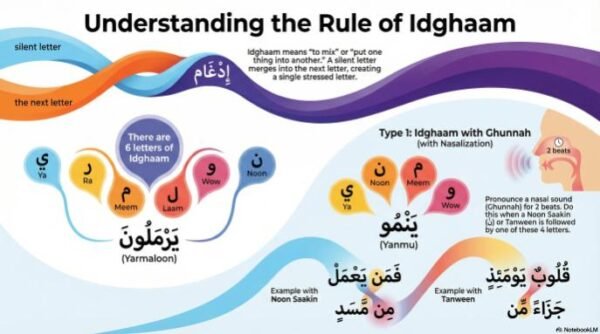
When the Noon Sakinah meets the letters (ي, ن, م, و), it merges with a Ghunnah. This is a rich nasal resonance that lasts for two beats. It provides a melodic pull to your recitation, signaling a great combination.
Idgham with Ghunnah is further divided into two sub-categories based on how much of the original “Noon” sound remains.
- Complete Idgham with Ghunnah:
This occurs with two letters: Meem (م) and Noon (ن).
- Why is it “Complete”? It is called complete because the original letter (the Noon Sakinah) is entirely absorbed into the next letter.
- The Secret of the Sound: While you still hear a nasal sound (Ghunnah), that Ghunnah now belongs to the second letter (the one you are merging into), not the original Noon.
Examples of Complete Idgham with Ghunnah:
| Example | Letter | Explanation |
| ﴿وَإِثْمُهُمَا أَكْبَرُ مِن نَّـفْعِهِمَا﴾ (البقرة 219) | ن | In the phrase مِن نَّـفْعِهِمَا ,the Tajweed rule applied is Complete Idgham with Ghunnah. A Noon Sakinah (نْ) at the end of the word “Min” is followed by the letter Noon (نَّ) at the beginning of the word” نَّـفْعِهِمَا.” |
| ﴿وَيُسْقَى مِن مَّـاء صَدِيدٍ﴾ (ابراهيم 16) | م | In the phrase مِن مَّاءٍ ,the Tajweed rule applied is Complete Idgham with Ghunnah. A Noon Sakinah at the end of the word “Min” is followed by the letter Meem at the beginning of “مَّـاء.” |
Incomplete Idgham with Ghunnah :
This type of merging involves two letters: Waw (و) and Ya (ي).
- Why is it called “Incomplete”? It is called incomplete (Naqis) because the Noon Sakinah does not vanish entirely. While the “body” of the letter Noon disappears, its characteristic which is the Ghunnah (nasal sound) remains present during the transition.
- The Source of the Sound: The Ghunnah you hear during the merge is actually the trace of the original Noon (the Mudgham), not the following letter. Since a part of the Noon still lingers, the merging is considered “incomplete.”
Examples of Incomplete Idgham with Ghunnah
| Example | Letter | Explanation |
| ﴿وَمَا لَكُم مِّن دُونِ اللّهِ مِن وَلِيٍّ وَلاَ نَصِيرٍ﴾ (البقرة 107) | و | A Noon Sakinah at the end of the word “مِن” is followed by the letter Waw at the start of “وَلِيٍّ.” |
| ﴿فَمَن يَـعْمَلْ مِثْقَالَ ذَرَّةٍ خَيْراً يَرَهُ﴾ (الزلزلة 7) | ي | A Noon Sakinah (نْ) at the end of the word “فَمَن” is followed by the letter Ya (ي) at the beginning of “ يَـعْمَلْ“ |
2. Idgha without Ghunnah:
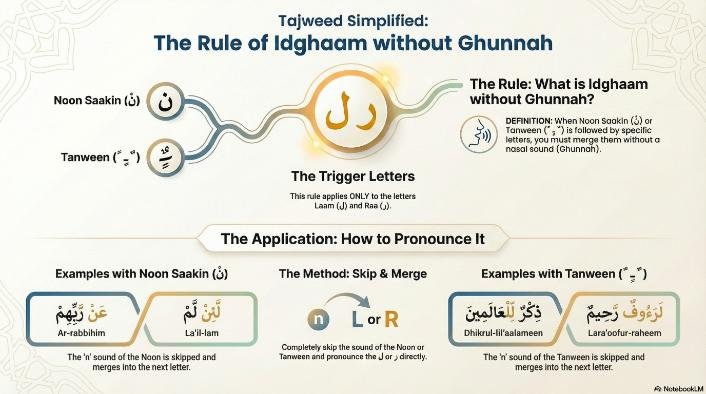
When the Noon Sakinah meets the letters( ل , ر), the merge becomes ‘total.’ The Noon fades totally, leaving no trace, echo, or nasal sound. The transition is like a fast-moving stream; you move directly from the letter before Noon to a doubled Lam or Ra. Be careful! The most common mistake here is ‘lingering’ in the nose; keep it sharp and clean.
Examples Of Idgham without Ghunnah
| Examples | Letter | Explanation |
| ﴿وَيُؤْتِ مِن لَّـدُنْهُ أَجْراً عَظِيماً﴾ (النساء 40) | ل | A Noon Sakinah (نْ) followed by the letter Lam (ل). Complete Idgham without Ghunnah . |
| ﴿أُوْلَـئِكَ عَلَى هُدًى مِّن رَّبِّهِمْ﴾ (البقرة 5) | ر | Noon Sakinah (نْ) followed by the letter Ra (ر). The Noon is entirely deleted. Since the letter is Ra, there is no nasal sound allowed. The transition is sharp and direct. |
The Significance of Idgham Noon Sakinah in Tajweed
Mastering Idgham Noon Sakinah is more than a linguistic exercise; it is a spiritual and technical need for all reciters. Here is why it is significant:
- Preserving Revelation: It enables us to recite the Quran precisely as it was revealed to the Prophet Muhammad (peace be upon him) and passed down through generations.
- Melodic Rhythm and Fluency: Idgham eliminates the “clunky” stops between words. By merging sounds, the recitation produces a smooth, flowing rhythm that is both lovely to hear and easy to recite.
- Preventing Mistakes: Many beginners mistakenly pronounce every “N” sound clearly (Izhar). Proper Idgham prevents these “heavy” pronunciations where a “light” merge is required.
- Path to Ijazah: Mastery of the nuances of Idgham Noon Sakinah , such as the difference between Complete and Incomplete Idgham, is an essential requirement for those desiring a formal certification (Ijazah).
- Spiritual Impact: When the sound structure of a verse is recited correctly, it enhances the listener’s focus and helps the meanings of the Quran penetrate the heart more deeply.
Common Pitfalls in Idgham Noom Sakinah
Even after knowing the rules, many students face specific challenges with Idgham Noon Sakinah. Recognizing these early is the first step toward perfect recitation.
- The “Nasalization” Trap:
The Mistake: Adding a nasal sound (Ghunnah) to the letters Lam (ل) and Ra (ر).
The Fix: Remember that these two letters are “Ghunnah-free.” Your tongue should hit the makhraj (articulation point) and move on immediately without lingering in the nose.
- Confusing Idgham with Ikhfa:
The Mistake: Merging the sound too weakly (like Ikhfa) or hiding it when it should be fully merged.
The Fix: In Complete Idgham, the Noon must disappear entirely. In Ikhfa, a “shadow” of the Noon remains. Look for the Shaddah (ّ)—if it’s there, merge firmly!
- Rushing the 2-Beat Count:
The Mistake: Not giving the Ghunnah enough time (2 counts) for the letters ي ن م و. The Fix: You must dwell on the nasal sound for the duration of two vowel movements (like folding or unfolding a finger slowly).
Idgham Noon Sakinah in a Single Word:
The Mistake: Attempting to merge a Noon and an Idgham letter when they appear inside the same word (e.g., Dunya).
The Fix: Remember the Absolute Manifestation (Izhar Mutlaq) rule. Idgham only happens between two separate words.
Expert Tips for Mastery Idgham Noon Sakinah
Mastering Tajweed is a journey of the tongue and emotions. Use these professional ways to improve your Idgham Noon Sakinah quickly:
- Learn the Mnemonic: The word “Yarmaloon” should be internalized. Remember that these six letters are your “merging triggers” each time you sit down to recite.
- Prioritize Tarteel (Slow Recitation): Accuracy is hampered by speed. To give yourself time to identify the next letters and get ready for the proper transition (Complete vs. Incomplete), practice slowly.
- Imitate the Masters: Listen to Qaris renowned for their clear Tajwee.Observe carefully how they “hang” on the Ghunnah and jump directly into the Lam and Ra.
- The Feedback Loop: Record your recitation of Surah with your phone. Pay close attention to the two-beat count when you listen back. We frequently believe that we are holding the Ghunnah long enough of time, but in reality, we are rushing it.
- Use a color-coded Mushaf (Tajweed Quran) for visual mapping: Idgham Noon Sakinah letters are frequently color-coded in these copies to help you remember whether or not to use Ghunnah.
- Seek Official Instruction: Tajweed is an oral tradition. Your “Makharij” (articulation points) will be fixed in real time if you enroll in a structured course or sit with a certified teacher (having an Ijazah).
Learn Tajweed from Experts at Quran Beauty Online Academy
Quran Beauty Online Academy provides expert, structured, and personalized instruction aimed at bringing you closer to the Book of Allah if you really want to confidently understand Idgham Noon Sakinah and all Tajweed principles.
What We Offer:
- Learn the Quran online with qualified teachers who specialize in Tajweed.
- Online classes that provide real-time practical correction to help you improve your recitation.
- One-on-one or group programs with schedules that accommodate your lifestyle, regardless of age.
Are you ready to recite the Quran exactly as it was revealed? Reach out to us today:
Email: info@quranbeautyonline.com
WhatsApp/phone: +201102797178.
Frequently Asked Questions (FAQs):
Q1: What is the difference between Idgham with and without Ghunnah?
Idgham with ghunnah contains a nasal sound and applies to four letters, whereas Idgham without ghunnah contains no nasal sound and only applies to two letters.
Q2: Is idgham noon sakinah applied in all cases?
No, it only applies when Noon Sakinah or Tanween is followed by any of the six Idgham letters.
Q3: Can beginners learn idgham noon sakinah easily?
Yes, with adequate instruction and guided practice, beginners can learn it gradually.
Q4: Does incorrect Idgham change the meaning?
While it does not always change the meaning, it does affect the accuracy and beauty of Quranic recitation.
Q5: Is online Tajweed learning effective?
Yes, when taught by professional instructors and with live correction, online Tajweed learning is really effective.