
How Many Juz Are in the Quran?The Quran is divided into 30 Juz, and this simple structure has helped millions of Muslims around the world read, memorize, and connect with Allah’s words. Whether you’re preparing for Ramadan, starting your Hifz journey, or just trying to build a daily Quran reading habit, understanding the Juz system is the first step. Let’s skim through the lines and learn more about it.
Why the Quran Is Divided into Juz — The Wisdom Behind It
The division of the Quran into 30 Juz was not part of the original revelation. Early Islamic scholars introduced it as a practical tool to make the Quran more accessible for daily recitation — and it worked beautifully.
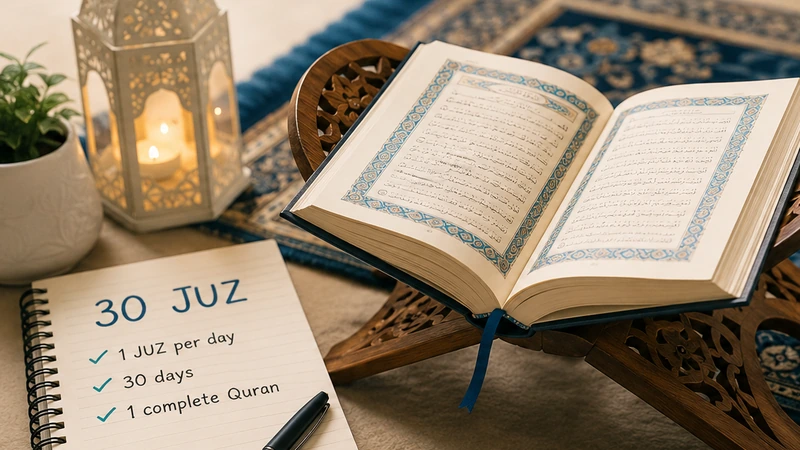
The wisdom is simple: one Juz per day equals one complete Quran per month. This is the rhythm that millions of Muslims follow during Ramadan, and it’s the same rhythm that keeps learners connected to the Quran year-round. The structure removes the overwhelm of facing 604 pages and replaces it with a manageable daily portion that anyone can work toward.
Historically, when manuscripts were expensive, and not every home could afford a complete Mushaf, mosques kept copies in thirty separate parts so the community could share access. That practical root grew into the spiritual habit we know today.
If you are beginning your memorization journey, you can also explore our guided online Quran memorization course with expert teachers.
A Complete Breakdown of Each Juz in the Quran
Each of the 30 Juz covers roughly 20 pages of the standard Mushaf. They are not divided by theme; a single Juz often covers multiple Surahs, but each Juz is named after the first word of its opening verse.
Here is a quick overview of all 30 Juz:
| Juz | Name | Begins At |
|---|---|---|
| 1 | Alif Lam Meem | Al-Fatihah 1:1 |
| 2 | Sayaqool | Al-Baqarah 2:142 |
| 3 | Tilkar Rusul | Al-Baqarah 2:253 |
| 4 | Lantanalu | Aal-Imran 3:92 |
| 5 | Wal Mohsanat | An-Nisa 4:24 |
| 6 | La Yuhibbullah | An-Nisa 4:148 |
| 7 | Wa Iza Samiu | Al-Ma’idah 5:82 |
| 8 | WaLau Annana | Al-An’am 6:111 |
| 9 | Qalal Malao | Al-A’raf 7:88 |
| 10 | Wa A’lamu | Al-Anfal 8:41 |
| 11 | Ya’tazeroon | At-Tawbah 9:93 |
| 12 | WaMamin Dabbah | Hud 11:6 |
| 13 | Wa Ma Ubarri’u | Yusuf 12:53 |
| 14 | Rubama | Al-Hijr 15:1 |
| 15 | Subhanallazi | Al-Isra 17:1 |
| 16 | Qala Alam | Al-Kahf 18:75 |
| 17 | Iqtaraba | Al-Anbiya 21:1 |
| 18 | Qad Aflaha | Al-Mu’minun 23:1 |
| 19 | Wa Qalallazina | Al-Furqan 25:21 |
| 20 | Amman Khalaq | An-Naml 27:56 |
| 21 | Utlu Ma Oohi | Al-Ankabut 29:46 |
| 22 | Wa Manyaqnut | Al-Ahzab 33:31 |
| 23 | Wa Mali | Ya-Sin 36:28 |
| 24 | Faman Azlam | Az-Zumar 39:32 |
| 25 | Elahe Yuruddu | Fussilat 41:47 |
| 26 | Ha’a Meem | Al-Ahqaf 46:1 |
| 27 | QalaFama Khatbukum | Adh-Dhariyat 51:31 |
| 28 | Qad Sami Allah | Al-Mujadila 58:1 |
| 29 | Tabarakallazi | Al-Mulk 67:1 |
| 30 | Amma | An-Naba 78:1 |
How Many Juz in the Quran and How Long Is Each One?
The Quran contains exactly 30 Juz. Each Juz covers approximately 20 pages in the standard Mushaf and contains a varying number of verses. Some contain longer Surahs with more words; others are packed with shorter Surahs.
Each Juz is further divided into 2 Hizb, making 60 Hizb in total across the Quran. Each Hizb is then divided into 4 quarters (Maqra), giving 240 Maqra in total. This layered system lets you break your reading into even smaller portions when needed — helpful for revision and memorization.
In terms of reading time, a single Juz takes most readers between 20 and 40 minutes, depending on pace and Tajweed application. For a fluent reader applying Tajweed correctly, 20 to 25 minutes per Juz is a comfortable estimate.
If you want to improve your recitation speed while keeping correct pronunciation, our online Tajweed course can help you read each Juz with more confidence.
How to Use the Juz System to Finish the Quran in Ramadan
Ramadan is the month of the Quran, and the 30 Juz were practically designed for it. One Juz per day, thirty days, one complete Quran. This is the most widely practiced Quran completion schedule in the world.
Here is how to make it work:
Plan your reading time.
Most people find it easiest after Fajr or before Isha, when the home is quiet. Even 25 to 30 minutes is enough for one Juz.
Use the Tarawih prayers.
In Ramadan, many masajid complete one Juz in Tarawih each night. If you follow along in prayer, you are already halfway to your daily goal without any extra effort.
Break it into halves if needed.
One Hizb after Fajr, one Hizb after Asr. Two short sessions are easier to maintain than one long one on busy days.
Don’t skip — catch up.
If you miss a day, read two Juz the next day rather than letting the gap grow. Ramadan is short; every day counts.
The Prophet ﷺ used to review the entire Quran with Jibreel عليه السلام once per year, and twice in the year he passed away. The Ramadan Khatam is a living continuation of that beautiful Sunnah.
The Difference Between Juz, Hizb, and Surah Explained Simply
These three terms describe different ways of dividing the Quran, and understanding them removes a lot of confusion:
Surah is a chapter. The Quran has 114 Surahs, ranging from the 286-verse Al-Baqarah to the 3-verse Al-Kawthar. Surahs are the thematic and structural units of the Quran — each one is a distinct revelation with its own name, character, and themes.
Juz is a recitation division. The 30 Juz divide the Quran into roughly equal portions for reading purposes. A single Juz often contains parts of two or three different Surahs — it crosses chapter boundaries. The Juz system is about length, not theme.
Hizb is a subdivision of the Juz. Each Juz contains 2 Hizb, and each Hizb contains 4 quarters. The 60 Hizb system is used by those who prefer to complete the Quran in 60 days (one Hizb per day) or to break their daily reading into smaller, precise portions.
Think of it this way: Surahs are the chapters of the book. Juz and Hizb are your reading schedule overlaid on top of those chapters.
Which Juz Are the Most Commonly Memorized by Beginners?
Not all Juz are equally approachable for beginners, and most Hifz teachers recommend starting with the same few — for good reason.
Juz Amma (Juz 30) is the universal starting point. It contains 37 Surahs, most of them short, rhythmic, and frequently recited in Salah. Surah Al-Fatiha, Al-Ikhlas, Al-Falaq, An-Nas, Al-Kawthar — these are the Surahs most Muslims know from childhood, and they all live in Juz Amma.
Juz Tabarak (Juz 29) is the natural second step. It begins with Surah Al-Mulk — one of the most beloved Surahs in the Quran — and contains many medium-length Surahs with beautiful rhythm and profound meaning.
Juz 28 is another popular choice for intermediate beginners, containing Surah Al-Mujadila through Al-Mursalat.
For children especially, starting with Juz 30 builds early confidence, establishes a connection with Salah, and creates a foundation that makes the rest of the Quran feel more familiar. Most structured Hifz programs begin here and work backwards through the Juz before tackling the longer Surahs of the early Juz.
Beginners who want personal support can start with short Surahs and receive step-by-step help through Quran Beauty Online teachers.
Best Tools and Apps to Track Your Juz Progress
You don’t need anything fancy to read the Quran — but the right tools can make your consistency stronger and your journey more enjoyable.
Quran.com (available as a website and app) is one of the most trusted free resources available. It organizes the Quran by Juz, includes audio recitations by dozens of Qaris, supports bookmarking, and auto-tracks where you left off. Clean, ad-free, and genuinely useful for daily reading.
Tarteel is the go-to app for anyone memorizing. Its AI listens to your recitation in real time and flags word-level errors instantly — essentially a revision partner available 24/7. It allows you to set goals by Juz or Surah, tracks streaks, and gives visual analytics of your progress.
Al Quran (Tafsir & By Word) by Greentech Apps is excellent for learners who want to understand what they’re reading. It offers word-by-word translation, Tajweed color-coding, 90+ translations, and a built-in Quran planner to track Khatam progress.
Quranly gamifies the experience with streaks, leaderboards, and a habit-tracking interface. Particularly good for those who need external motivation to maintain consistency.
Hifdh Tracker is purpose-built for memorization. You log each page as you memorize it, set targets by Juz, and track your complete Hifz journey visually over time.
Whatever tool you use, the goal is the same: open the Quran every day, even for a few minutes. The Juz system makes that easier — and the right app makes it stick.
Apps can help you track your progress, but live teacher feedback is still important for correcting recitation mistakes and building consistency.
Ready to Complete the Quran? Start Learning Today at Quran Beauty Online
The 30 Juz are your roadmap. Whether your goal is to complete the Quran, begin your Hifz journey, or simply build a consistent daily habit with Allah’s Book, the structure is already there waiting for you.
Start your Quran journey today with a free trial Quran class and learn one Juz at a time with expert support.