
7 Proven Steps to Master Noon Sakinah Rules in Tajweed
Introduction: Accurate Recitation of the Quran
The Quran is a recited revelation that has been accurately transmitted orally rather than just being a written text. Pronunciation accuracy became essential to maintaining holy speech from the moment Jibreel (AS) recited the Quran to the Prophet Muhammad ﷺ.
The Noon Sakinah rules play a fundamental role in the science of Tajweed, which protects this accuracy.
Allah explicitly commands:
“And recite the Quran with deliberate, measured recitation.”
(Al-Muzzammil Surah 73:4).
Correct articulation, appropriate pauses, and faithful application of phonetic rules, especially those governing frequently occurring letters like Noon Sakinah and Tanween are necessary for measured recitation (tarteel).
Noon Sakinah And Tanween
What Is Noon Sakinah?
Noon Sakinah (نْ) is the Arabic letter noon carrying a sukoon, indicating the lack of a vowel. It may appear:
- In the middle of a word.
- At the end of a word.
- In nouns, verbs, and particles.
The rules are context-based rather than set because its pronunciation is totally dependent on the letter that comes after it.
What Is Tanween?
Tanween refers to the doubled vowel markings:
- ً (fathatayn).
- ٍ (kasratayn).
- ٌ (dammatayn).
- Tanween is functionally identical to noon sakinah in pronunciation because it only occurs at the end of nouns and produces an audible “n” sound.
- Important Principle:
Every rule that applies to Noon Sakinah applies equally to Tanween.
Why Noon Sakinah Rules Are Essential?
Arabic is a very phonetic language. Meaning can be changed by even little variations in pronunciation.
Misapplying Noon Sakinah rules may:
- Distort the Quranic words’ phonetic structure.
- disturb the recitation’s rhythmic equilibrium.
- cause lahn jali, or obvious recitation mistakes.
“The one who is proficient in reciting the Quran will be with the noble and righteous angels,” said the Prophet ﷺ, highlighting the importance of mastery in recitation.
(Sahih Muslim & Sahih al-Bukhari).
Learning these rules is therefore essential to fulfilling the Quranic preservation trust.
The Four Rules of Noon Sakinah
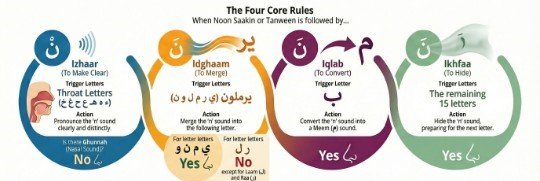
The letter that comes right after noon sakinah or tanween determines the rules.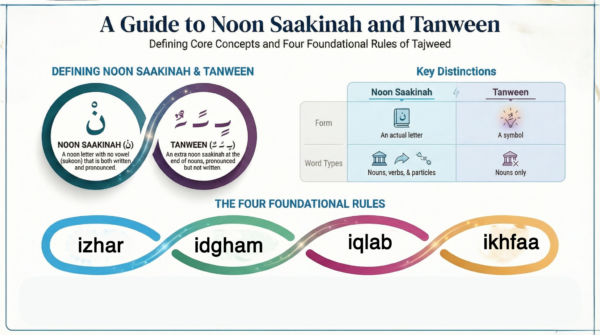
- Izhar (Clear Pronunciation).
Linguistic Meaning
Izhar signifies manifestation or clarity.
Technical Definition
Izhar happens when one of the six throat letters comes after noon sakinah or tanween. The noon sound must be spoken clearly, independently, and without nasalization.
- Izhar Letters:
These letters originate from the throat:
ء (Hamzah).
هـ (Haa).
ع (Ayn).
ح (Haa).
غ (Ghayn).
خ (Khaa).
Phonetic Reasoning
It would be abnormal to blend or conceal the noon because these letters arise from the throat far from the tongue’s articulation point.
Example from the Quran
{مِنْ هَادٍ}
(Surah Ar-Ra’d 13:7).
Here, there is no ghunnah and the noon sound is pronounced clearly.
- Idgham (Merging)
Idgham means to merge or assimilate.
Practical Definition
Idgham is the result of noon sakinah or tanween combining with the following letter to produce a single, stronger sound.
Idgham Letters:
We collected the Idgham Letters in the word : (يرملون)
ي (Ya).
ر (Ra).
م (Meem).
ل (Lam).
و (Waw).
ن (Noon).
There are two distinct kinds of idgham:
A. Idgham with Ghunnah
Letters: ي ن م و
(Waw). و
(Meem) .م
(Noon). ن
(Yaa). ي
The noon sound merges.
Ghunnah, or nasalization, is retained.
Ghunnah lasts for two counts.
Quranic Example
{مِنْ وَالٍ}
(Surah Ar-Ra’d 13:11).
B. Idgham without Ghunnah
Letters: ل ر
(Lam).ل
(Raa).ر
Final merging.
Absence of nasal sound.
Strong focus on the merged letter.
Quranic Example
{مِنْ رَبِّهِمْ}
(Surah Al-Baqarah 2:5)
Important Note: If the Idgham letter and noon sakinah come in the same word such as(الدنيا), Idgham does not exist.
- Iqlab (Conversion)
Linguistic Meaning
Iqlab means to transform.
Practical Definition
The noon sound becomes a hidden meem, pronounced with ghunnah, when noon sakinah or tanween is followed by ب (Baa).
Unique Characteristics
- Only one letter triggers Iqlab
- Pronounced with nasalization
- Often marked by a small meem (م) in the Mushaf
Quranic Example
{أَنْبِئْهُمْ}
(Surah Al-Baqarah 2:33).
The knowledge base of Iqlab:
Because noon and baa are phonetically distant, the conversion allows for smoother articulation.
- Ikhfa (To conceal)
Linguistic Meaning
Ikhfa means to hide.
Practical Definition
Ikhfa is a partially hidden noon sound with ghunnah that happens when any of the remaining fifteen letters come after noon sakinah or tanween.
Ikhfa Letters (15):
All Arabic letters excluding:
- Izhar letters.
- Idgham letters.
- Iqlab letter (ب).
Pronunciation Characteristics
- Tongue does not fully articulate noon.
- Sound is nasalized.
- Degree of concealment varies depending on the letter.
Quranic Example
{مِنْ قَبْلِكُمْ}
(Surah Al-Baqarah 2:38).
Common Mistakes in Noon Sakinah Rules Application.Even proficient learners may struggle with:
Common Mistakes in Noon Sakinah Rules Application
Even advanced learners may struggle with:
- Overextending ghunnah.
- Using Ikhfa rather than Idgham.
- Ignoring Iqlab’s meem conversion.
- hurrying through recitation and losing accuracy in articulation
These mistakes can be fixed by reciting slowly (tarteel) and regularly listening to professional reciters.
Spiritual and Pedagogical Aspects
Tajweed scholars agree that while proper application during recitation is fard ‘ayn, mastering these rules is fard kifayah.
Excellent reciting reveals:
- Respect the words of Allah.
- prophetic transmission continuity.
- spiritual self-control and awareness.
Conclusion
The most important principles of Tajweed are Izhar, Idgham, Iqlab, and Ikhfa, which are ruled by the Noon Sakinah. When used correctly, they improve the spiritual quality of recitation while maintaining the phonetic purity of the Quran.
It takes continuous study, dedication, and honest intent to master these rules; it doesn’t happen immediately. By doing this, the reciter performs an act of devotion as well as a linguistic obligation.
“To deepen your understanding of Tajweed, check out the detailed guide on https://quran.com/1
Common Questions About Noon Sakinah Rules:
Are all levels of Quran reciters have to follow the Noon Sakinah rules?
Yes. Beginners may concentrate on recognition, but once a person is ready to learn, proper application becomes necessary. Scholars differentiate between learning Tajweed rules (communal obligation) and applying them during recitation, which is an individual responsibility when errors affect pronunciation.
Can the meaning of Quranic words be altered by applying the Noon Sakinah principles incorrectly?
In some cases, yes. Persistent mispronunciation can change phonetic structure and, in rare cases, impact meaning, even if many errors fall under lahn khafi (hidden Mistakes). For this reason, even in delicate principles like Ikhfa and Iqlab, scholars put a strong emphasis on precision.
- Why does ghunnah vary in strength across different Noon Sakinah rules?
The proximity of articulation affects Ghunnah strength. Stronger nasalization is needed for letters around noon’s makhraj, and lighter ghunnah is needed for letters farther away. When reciting the Quran, this phonetic balance ensures smooth sound transitions.
Is it possible to learn Noon Sakinah rules without a teacher?
While theoretical understanding can be acquired through study, oral correction is necessary for actual mastery. Tajweed is an aural science that has traditionally been passed down from teacher to learner in order to prevent subtle pronunciation mistakes that written explanations are unable to catch.
Why is Iqlab limited to only one letter (Baa)?
Iqlab addresses a specific articulation challenge between noon and baa. A smoother phonetic transition is produced by turning noon into a hidden meem, illustrating how Tajweed regulations are based on linguistic efficiency rather than arbitrary regulation.
Do different Qira’at apply Noon Sakinah rules differently?
Although there may be slight phonetic variations, the fundamental ideas are the same in every authentic Qira’at. The richness of Quranic recitation is reinforced by these changes, which are approved by Allah and passed down through established generations.

In accordance with Noon Sakinah regulations, how long should ghunnah be held?
The standard ghunnah duration is two counts, although breath control-rather than an accentuated nasal sound+determines its clarity. One typical mistake that throws off the rhythmic balance is overextending ghunnah.
Why do Mushafs sometimes mark Iqlab with a small meem?
The small meem is not a substitute letter; rather, it is a visual help. It maintains the Quran’s original written form while notifying the reciter to the necessary sound modification.
In quick recitation, how can learners distinguish between Ikhfa and Idgham?
Controlled pace is essential. Ikhfa retains a trace of noon sound, while Idgham eliminates it through merging. Learners frequently misunderstand these two rules due to hurried recitation.
Is fluency in recitation more crucial than understanding the rules of Noon Sakinah?
Both are related to one another.Fluency without accuracy compromises authenticity, while accuracy without fluency disrupts flow.As demonstrated by the Prophet ﷺ, balanced recitation blends technical accuracy with rhythmic continuity.
Do children need to be clearly taught the rules of Noon Sakinah?
Before learning formal theory, children gain the most by listening and repetition. Early exposure creates good habits organically, which makes it easier to do technical study later on.
What is the reason behind the early emphasis on Noon Sakinah rules in Tajweed education?
The Quran regularly mentions noon and tanween, thus learning these rules early on helps prevent common mistakes and provides a solid foundation for more advanced Tajweed topics.
Does Tajweed need to be recited aloud or silently?
Oral recitation is the main application of Tajweed rules. While vocal recitation, especially during prayer, necessitates adherence to pronunciation rules, silent reading concentrates on comprehension.
How long does it usually take to master Noon Sakinah rules?
Recognition can take days, application weeks, and refinement months. Mastery depends on consistency, listening practice, and corrective feedback rather than memorization alone.
What is the spiritual benefit of focusing on such detailed rules?
Khushu, or aware present, is cultivated through attention to detail. Accurate recitation shows respect for Allah’s words and turns reading into a very deliberate act of devotion.
“Get Your Free Tajweed Trial Today – Learn Quran Recitation from Experts!”